
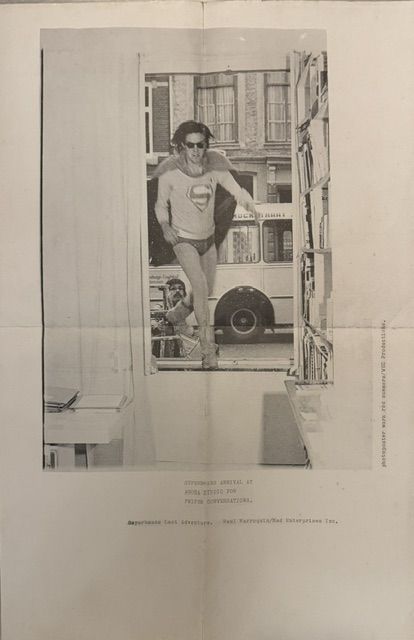
Pôster de Raúl Marroquín produzido em 1977 por Mad Enterprises Inc. e relacionado à série Superbmans Last Adventure.
Raul Marroquim . Mad Enterprises Inc
Categoria: Poesia Visual
Acervo: 03874
Data: 1977
Dimensões: 45,5 x 29,8 cm
Pôster de Raúl Marroquín produzido em 1977 por Mad Enterprises Inc. e relacionado à série Superbmans Last Adventure. A imagem apresenta o personagem Superbman entrando por uma janela do Agora Studio, espaço experimental ligado à produção artística e editorial desenvolvida em Maastricht, nos Países Baixos.A inscrição impressa abaixo da fotografia identifica a ação como Superbmans Arrival at Agora Studio for Fwiper Conversations. A palavra Fwiper apresenta leitura pouco nítida na reprodução e deve ser conferida diretamente no original antes da catalogação definitiva. Na parte inferior aparecem ainda as identificações Superbmans Last Adventure, Raul Marroquin e Mad Enterprises Inc.A composição fotográfica mostra Superbman usando óculos escuros, capa, botas, roupa curta e camiseta com um emblema inspirado na linguagem visual dos super heróis. O personagem atravessa uma janela aberta e parece ingressar diretamente no espaço interno do Agora Studio. O gesto transforma uma entrada arquitetônica comum em acontecimento performático e narrativo.Ao fundo aparecem uma rua, a fachada de outro edifício, um ônibus e uma figura humana parcialmente visível. A presença desses elementos preserva o caráter documental da fotografia e situa a ação em um ambiente urbano real. Ao mesmo tempo, o traje de Superbman introduz uma dimensão ficcional, aproximando o espaço cotidiano dos quadrinhos, do cinema, da televisão e da cultura de massa.A janela funciona como limite e passagem entre dois territórios. Do lado externo encontra se a cidade, representada pela rua, pelo transporte público e pelos edifícios. No interior está o espaço artístico, marcado por estantes, livros, papéis e estruturas de trabalho. A entrada de Superbman conecta essas duas dimensões e transforma o deslocamento físico em metáfora da entrada da ficção e dos meios de comunicação no campo da arte.Superbman é uma personagem criada por Raúl Marroquín por meio da transformação do arquétipo de Superman. A pequena alteração do nome desloca a figura do herói conhecido para uma identidade artística própria. Superbman funciona como personagem performática, imagem mediática e instrumento de investigação sobre celebridade, espetáculo, heroísmo, cultura popular, narrativa seriada e circulação de imagens.Superbmans Last Adventure foi desenvolvido como projeto intermídia que reuniu performance, fotografia, cartaz, publicação de artista, narrativa visual e televisão experimental. A obra não se restringe a uma imagem isolada. Ela integra uma sequência de acontecimentos e documentos relacionados às aventuras e aparições públicas da personagem.A fotografia registra uma ação encenada, mas conserva elementos do acontecimento real. O artista aparece em movimento, com uma das pernas já dentro do espaço e a outra ainda próxima da janela. A capa projetada para trás reforça a sensação de velocidade e chegada espetacular. O instante escolhido sugere que o personagem acaba de atravessar a fronteira entre o exterior e o interior.O Agora Studio aparece como cenário, local de produção e parte conceitual da obra. O espaço esteve ligado a exposições, performances, encontros, publicações e projetos experimentais realizados em Maastricht durante a década de 1970. Sua relação com Mad Enterprises Inc. permitiu a criação e circulação de impressos, fotografias, boletins e trabalhos que questionavam os limites entre arte, comunicação e vida cotidiana.Mad Enterprises Inc. funcionava como identidade editorial e estrutura artística associada a Raúl Marroquín. A utilização de uma denominação semelhante à de uma empresa incorpora a linguagem administrativa e comercial ao campo artístico. A organização podia atuar como produtora, editora, instituição fictícia, assinatura coletiva e plataforma de distribuição.No pôster, o nome Mad Enterprises Inc. não aparece apenas como crédito técnico. Ele integra o conceito da obra e apresenta o projeto como produto de uma estrutura artística autônoma. Essa estratégia aproxima a produção de Marroquín das iniciativas conduzidas por artistas, das editoras independentes, das organizações inventadas e das redes alternativas de comunicação.Na margem direita da fotografia aparece uma inscrição vertical relacionada à autoria ou à produção da imagem. A reprodução não permite leitura integralmente segura. A informação deve ser examinada no original antes de ser incorporada a uma ficha catalográfica definitiva.O pôster foi concebido como documento visual portátil e reproduzível. Sua estrutura combina fotografia central, amplas margens brancas, título datilografado e créditos editoriais. A organização aproxima o objeto de cartaz, página de publicação, documento de performance e obra destinada à circulação.A superfície apresenta marcas horizontais e verticais de dobra. Essas dobras indicam que o pôster foi acondicionado, armazenado ou enviado em formato reduzido. Elas fazem parte da história material do objeto e reforçam sua possível circulação por correio, dentro de publicação ou como material de intercâmbio entre artistas.A relação com a arte postal ocorre pelo formato reproduzível, pela possibilidade de dobragem e envio, pela associação a publicações de artista e pelo funcionamento de Mad Enterprises Inc. como plataforma de circulação. Na prática de Marroquín, o correio não era apenas meio de transporte. Era parte de uma pesquisa sobre transmissão, distância, recepção e comunicação.O pôster também se relaciona à poesia visual porque título, imagem, personagem, disposição tipográfica e sequência narrativa trabalham em conjunto. O texto não serve somente para identificar a fotografia. Ele transforma a imagem em episódio de uma história e direciona sua interpretação como chegada, conversa e acontecimento.A imagem possui ainda relação com a arte conceitual. O valor da obra não depende apenas de sua aparência fotográfica, mas da rede de ideias que envolve personagem, ação, local, sistema editorial, circulação e documentação. A fotografia funciona como vestígio de uma performance e como elemento de uma narrativa distribuída por diferentes meios.O uso do super herói permite a Marroquín discutir a produção de imagens públicas. Superbman possui traje, emblema e comportamento reconhecíveis, mas pertence a um sistema artístico alternativo. A personagem imita mecanismos de construção de celebridade e transforma o artista em protagonista de um universo narrativo próprio.O ônibus visível ao fundo cria contraste entre o extraordinário e o cotidiano. Enquanto Superbman realiza uma entrada teatral, a cidade continua funcionando normalmente. Esse contraste produz humor e impede que a cena seja confundida com uma representação heroica convencional.A obra também investiga a relação entre escala mediática e espaço doméstico ou institucional. Uma figura inspirada nos grandes heróis da cultura popular entra em um ambiente pequeno, ocupado por livros, papéis e mobiliário. O espetáculo é reduzido ao espaço de trabalho e a narrativa de massa é reinterpretada por uma prática artística independente.Não há indicação de que Raúl Marroquín tenha integrado formalmente o movimento Poema Processo. Sua relação com esse campo ocorre pelas afinidades com poesia visual, arte postal, publicação experimental, serialidade, comunicação, participação, apropriação e circulação internacional.O pôster constitui documento importante da produção de Raúl Marroquín em 1977 e das atividades de Mad Enterprises Inc. Ele registra a convergência entre performance, fotografia, personagem ficcional, quadrinhos, televisão experimental, publicação de artista e rede postal.Para indexação, recomenda se utilizar os termos Raúl Marroquín, Raul Marroquin, Superbman, Superbmans Last Adventure, Superbmans Arrival at Agora Studio for Fwiper Conversations, Mad Enterprises Inc., Agora Studio, Maastricht, Países Baixos, 1977, arte postal, mail art, performance, fotografia, pôster, publicação de artista, arte conceitual, videoarte, televisão experimental, cultura de massa, super herói, narrativa visual e arte experimental latino americana.TEXT FOR THE SALSA PROGRAM IN ENGLISHPoster by Raúl Marroquín produced in 1977 by Mad Enterprises Inc. and connected with the series Superbmans Last Adventure. The image presents the character Superbman entering through a window at Agora Studio, an experimental space associated with artistic and editorial production in Maastricht, the Netherlands.The printed caption below the photograph identifies the action as Superbmans Arrival at Agora Studio for Fwiper Conversations. The word Fwiper is not entirely clear in the reproduction and should be checked against the original before definitive cataloguing. The lower section also contains the identifications Superbmans Last Adventure, Raul Marroquin and Mad Enterprises Inc.The photographic composition shows Superbman wearing dark glasses, a cape, boots, short clothing and a shirt bearing an emblem inspired by the visual language of superheroes. The character crosses an open window and appears to enter directly into the interior of Agora Studio. The gesture transforms an ordinary architectural opening into a performative and narrative event.A street, the facade of another building, a bus and a partially visible person appear in the background. These elements preserve the documentary character of the photograph and place the action within an actual urban environment. At the same time, Superbmans costume introduces fiction and connects the everyday setting with comics, cinema, television and mass culture.The window functions as both boundary and passage between two territories. Outside is the city, represented by streets, public transportation and buildings. Inside is the artistic space, marked by shelves, books, papers and working structures. Superbmans arrival connects these dimensions and transforms physical movement into a metaphor for the entrance of fiction and communication media into art.Superbman is a character created by Raúl Marroquín through the transformation of the Superman archetype. The slight change in the name relocates the familiar superhero within an independent artistic identity. Superbman operates as a performative character, media image and instrument for investigating celebrity, spectacle, heroism, popular culture, serial narrative and the circulation of images.Superbmans Last Adventure developed as an intermedia project bringing together performance, photography, posters, artists publications, visual narrative and experimental television. The presented work is not merely an isolated photograph. It belongs to a sequence of events and documents concerning the adventures and public appearances of the character.The photograph records a staged action while preserving elements of an actual event. The artist appears in motion, with one leg already inside and the other still close to the window. The cape extending behind him reinforces the impression of speed and spectacular arrival. The selected moment suggests that the character has just crossed the boundary between exterior and interior.Agora Studio operates as setting, production site and conceptual component of the work. The space was connected with exhibitions, performances, meetings, publications and experimental projects organized in Maastricht during the 1970s. Its relationship with Mad Enterprises Inc. supported the production and circulation of printed matter, photographs, bulletins and works questioning the boundaries among art, communication and everyday life.Mad Enterprises Inc. functioned as an editorial identity and artistic structure associated with Raúl Marroquín. Its corporate style name introduced administrative and commercial language into artistic production. It could act as producer, publisher, fictional institution, collective signature and distribution platform.In the poster, Mad Enterprises Inc. is not only a technical credit. It forms part of the concept and presents the project as the product of an autonomous artistic structure. This strategy connects Marroquíns work with artist run initiatives, independent publishing, invented organizations and alternative communication networks.A vertical inscription appears along the right edge of the photograph and seems related to photographic authorship or production. The reproduction does not allow a fully secure reading. This information should be verified through direct examination of the original before entering a definitive catalogue record.The poster was conceived as a portable and reproducible visual document. Its structure combines a central photograph, broad white margins, a typewritten caption and editorial credits. The organization places the object between poster, publication page, performance document and circulating artwork.Horizontal and vertical fold marks are visible on the surface. These indicate that the poster was folded for storage, enclosure or postal transmission. They belong to the material history of the object and reinforce its possible circulation through the mail, within a publication or as exchange material among artists.Its connection with mail art lies in its reproducible format, its capacity to be folded and mailed, its association with artists publications and the role of Mad Enterprises Inc. as a platform for circulation. In Marroquíns practice, the postal system was not merely transportation. It formed part of a broader investigation of transmission, distance, reception and communication.The poster is also related to visual poetry because title, image, character, typography and narrative sequence operate together. The text does not simply identify the photograph. It transforms the image into an episode and directs its interpretation as arrival, conversation and event.The work also belongs to conceptual art. Its significance does not depend only on photographic appearance but on the network of ideas involving character, action, location, editorial system, circulation and documentation. The photograph functions as a trace of performance and as one component within a narrative distributed across different media.The superhero figure enables Marroquín to examine the production of public images. Superbman possesses a recognizable costume, emblem and behaviour, yet belongs to an alternative artistic system. The character imitates mechanisms of celebrity construction and transforms the artist into the protagonist of his own narrative universe.The bus visible in the background creates a contrast between the extraordinary and the everyday. While Superbman performs a theatrical entrance, the city continues its ordinary activity. This contrast creates humour and prevents the scene from functioning as a conventional heroic representation.The work also investigates the relationship between media scale and domestic or institutional space. A character inspired by the monumental heroes of popular culture enters a small environment occupied by books, papers and furniture. Spectacle is reduced to a working space and mass narrative is reinterpreted through independent artistic practice.No evidence indicates that Raúl Marroquín formally participated in the Brazilian Process Poem Movement. His relationship with this field is based on affinities involving visual poetry, mail art, experimental publishing, seriality, communication, participation, appropriation and international circulation.The poster is an important document of Raúl Marroquíns production in 1977 and of the activities of Mad Enterprises Inc. It records the convergence of performance, photography, fictional character, comics, experimental television, artists publishing and postal networks.Recommended indexing terms include Raúl Marroquín, Raul Marroquin, Superbman, Superbmans Last Adventure, Superbmans Arrival at Agora Studio for Fwiper Conversations, Mad Enterprises Inc., Agora Studio, Maastricht, Netherlands, 1977, mail art, performance, photography, poster, artists publication, conceptual art, video art, experimental television, mass culture, superhero, visual narrative and Latin American experimental art.
TEXTO DE OBSERVAÇÃO EM PORTUGUÊSPôster de Raúl Marroquín produzido em 1977 por Mad Enterprises Inc. e pertencente ao projeto Superbmans Last Adventure.A fotografia mostra o personagem Superbman entrando por uma janela do Agora Studio. Ele utiliza óculos escuros, capa, botas, roupa curta e camiseta com emblema inspirado nos códigos gráficos dos super heróis.Ao fundo aparecem uma rua, edifícios, um ônibus e uma pessoa parcialmente visível. No interior observam se livros, estantes, papéis e estruturas de trabalho, situando a ação em um espaço de produção artística.A inscrição sob a fotografia parece identificar o episódio como Superbmans Arrival at Agora Studio for Fwiper Conversations. A palavra Fwiper não está completamente nítida na reprodução e necessita de conferência no original.Na parte inferior aparecem Superbmans Last Adventure, Raul Marroquin e Mad Enterprises Inc. A margem direita contém inscrição vertical cuja leitura integral não pode ser confirmada pela imagem apresentada.O suporte possui dobras horizontais e verticais, manchas discretas, alteração de tonalidade e sinais de envelhecimento. As dobras indicam possível acondicionamento ou circulação do pôster em formato reduzido.O documento relaciona performance, fotografia, narrativa de super herói, publicação de artista, arte conceitual, televisão experimental e arte postal. Constitui registro da colaboração entre Raúl Marroquín, Mad Enterprises Inc. e o ambiente experimental do Agora Studio em Maastricht.OBSERVATION TEXT IN ENGLISHPoster by Raúl Marroquín produced in 1977 by Mad Enterprises Inc. and belonging to the project Superbmans Last Adventure.The photograph shows the character Superbman entering through a window at Agora Studio. He wears dark glasses, a cape, boots, short clothing and a shirt bearing an emblem based on superhero graphic codes.A street, buildings, a bus and a partially visible person appear in the background. Books, shelves, papers and working structures are visible inside, locating the action within an artistic production space.The caption below the photograph appears to identify the episode as Superbmans Arrival at Agora Studio for Fwiper Conversations. The word Fwiper is not completely clear in the reproduction and requires verification against the original.The lower area contains Superbmans Last Adventure, Raul Marroquin and Mad Enterprises Inc. A vertical inscription appears along the right margin, but its complete reading cannot be confirmed from the supplied image.The support contains horizontal and vertical folds, minor staining, tonal alteration and signs of ageing. The folds indicate possible storage or circulation of the poster in a reduced format.The document connects performance, photography, superhero narrative, artists publishing, conceptual art, experimental television and mail art. It records the relationship among Raúl Marroquín, Mad Enterprises Inc. and the experimental environment of Agora Studio in Maastricht.
Proveniência
Coleção Poema ProcessoInglês
Poster by Raúl Marroquín produced in 1977 by Mad Enterprises Inc. and connected with the series Superbmans Last Adventure.
Dimensions: 17,9 x 11,7 in