
Obra gráfica impressa atribuída ao artista, poeta e editor peruano Carlos Zúñiga Segura, pertencente a uma edição limitada de 80 exemplares. O exemplar apresentado possui a indicação manuscrita 20 de 80 no canto inferior esquerdo, identificando sua posição dentro da tiragem.
Carlos Zuniga Segura - Peru
Categoria: Poesia Visual
Acervo: 03847
Dimensões: 12,5 x 16 cm
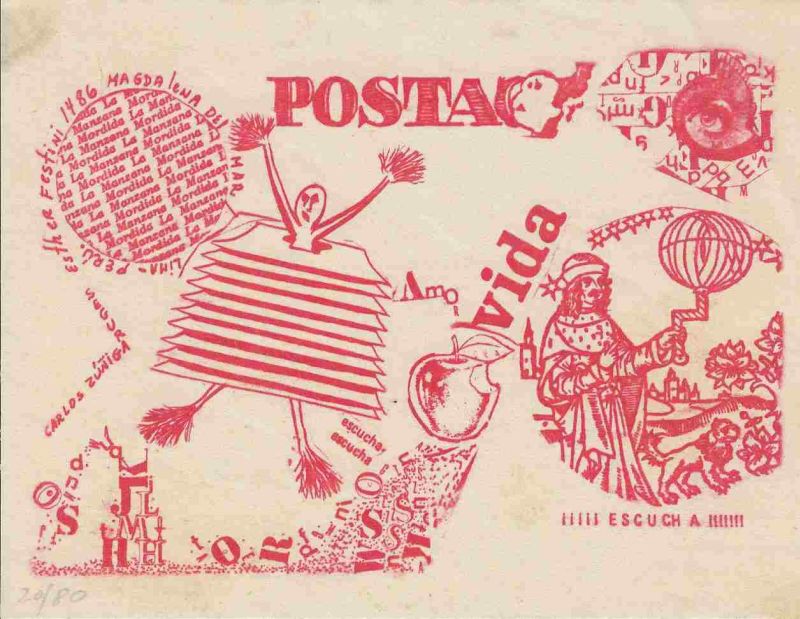
Obra gráfica impressa atribuída ao artista, poeta e editor peruano Carlos Zúñiga Segura, pertencente a uma edição limitada de 80 exemplares. O exemplar apresentado possui a indicação manuscrita 20 de 80 no canto inferior esquerdo, identificando sua posição dentro da tiragem.A composição foi impressa em tinta vermelha sobre papel de tonalidade clara e combina poesia visual, tipografia experimental, desenho, colagem gráfica e imagens apropriadas de diferentes origens. Palavras, letras, figuras humanas, objetos e fragmentos ornamentais ocupam o espaço de maneira não linear, criando uma superfície poética construída pela associação entre texto e imagem.Na parte superior aparece a palavra POSTA em grandes caracteres. A letra final incorpora uma figura semelhante ao mapa da América do Sul, estabelecendo uma possível relação entre comunicação, território e circulação latino americana. Ao lado encontra se uma forma circular composta por letras, sinais e elementos tipográficos organizados ao redor de uma imagem central.A palavra vida ocupa posição de destaque no centro da composição e aparece inclinada verticalmente. Próximo a ela encontram se a palavra Amor, a imagem de uma maçã e uma cena gráfica com personagem histórico segurando uma esfera. A maçã pode ser relacionada ao universo editorial de La Manzana Mordida, revista de poesia fundada e dirigida por Carlos Zúñiga Segura no Peru, embora a imagem isolada não permita confirmar que a obra tenha sido publicada oficialmente como parte da revista.No lado esquerdo, uma grande estrutura circular é formada pela repetição da expressão la Mordida. Ao redor desse núcleo aparecem palavras e fragmentos que parecem incluir festa, música, luna, mar e poema. A repetição produz ritmo visual e transforma a linguagem escrita em matéria gráfica. A expressão Carlos Zúñiga Segura aparece impressa verticalmente na região esquerda, contribuindo para a atribuição autoral da peça.A região central apresenta uma figura humana emergindo de uma estrutura formada por linhas horizontais. A personagem ergue os braços e parece segurar ou produzir formas semelhantes a flores, criando uma imagem associada à celebração, expansão e energia vital. Na parte inferior aparecem letras fragmentadas, sinais, pequenos desenhos e palavras parcialmente legíveis, entre elas escucha, que também reaparece próxima à margem inferior direita.A obra utiliza procedimentos característicos da poesia visual e da publicação experimental. O significado não é construído por uma frase contínua, mas pela circulação do olhar entre palavras, letras, imagens, repetições, mudanças de escala e diferentes direções de leitura. A impressão monocromática reforça a unidade gráfica, enquanto a variedade de fontes e imagens cria um campo visual fragmentado e dinâmico.O trabalho aproxima literatura, design gráfico, ilustração e edição independente. Também se relaciona aos circuitos latino americanos de poesia experimental e intercâmbio postal, nos quais impressos de pequena tiragem circulavam entre poetas, artistas, editores e organizadores culturais. A numeração 20 de 80 demonstra que a peça foi concebida como múltiplo artístico, preservando simultaneamente o caráter reproduzível da impressão e a identificação individual de cada exemplar.EnglishText for the Salsa programPrinted graphic work attributed to the Peruvian artist, poet and editor Carlos Zúñiga Segura, produced as part of a limited edition of 80 copies. The example shown bears the handwritten notation 20 of 80 in the lower left corner, identifying its position within the edition.The composition was printed in red ink on light toned paper and combines visual poetry, experimental typography, drawing, graphic collage and appropriated images from different sources. Words, letters, human figures, objects and ornamental fragments occupy the surface through a nonlinear arrangement, creating a poetic field based on the interaction between text and image.The word POSTA appears in large characters across the upper section. Its final letter incorporates a shape resembling the map of South America, suggesting a possible relationship between communication, territory and Latin American circulation. Beside it is a circular construction composed of letters, signs and typographic elements arranged around a central image.The word vida occupies a prominent position near the center and is placed at an inclined vertical angle. Nearby appear the word Amor, the image of an apple and a graphic scene showing a historical figure holding a sphere. The apple may be associated with the editorial universe of La Manzana Mordida, the poetry journal founded and directed by Carlos Zúñiga Segura in Peru, although the image alone does not confirm that the work was officially published as part of the journal.On the left side, a large circular structure is formed by the repeated expression la Mordida. Words and fragments positioned around this nucleus appear to include festa, música, luna, mar and poema. Repetition generates visual rhythm and transforms written language into graphic material. The name Carlos Zúñiga Segura is printed vertically in the left section, supporting the attribution of the work.The central area presents a human figure emerging from a structure formed by horizontal lines. The figure raises both arms and appears to hold or produce flower like forms, creating an image associated with celebration, expansion and vital energy. The lower section contains fragmented letters, signs, small drawings and partially legible words, including escucha, which also appears near the lower right margin.The work uses procedures associated with visual poetry and experimental publishing. Meaning is not constructed through a continuous sentence, but through the movement of the viewer between words, letters, images, repetition, changes of scale and different reading directions. The monochromatic printing creates graphic unity, while the diversity of typefaces and images produces a fragmented and dynamic visual field.The work brings together literature, graphic design, illustration and independent publishing. It can also be situated within Latin American networks of experimental poetry and postal exchange, in which small edition prints circulated among poets, artists, editors and cultural organizers. The numbering 20 of 80 demonstrates that the piece was conceived as an artistic multiple, combining the reproducible character of printmaking with the individual identification of each copy.
Obra gráfica impressa atribuída a Carlos Zúñiga Segura, Peru, numerada manualmente como exemplar 20 de uma edição de 80. A composição apresenta impressão em vermelho sobre papel claro e reúne poesia visual, tipografia experimental, desenho e apropriação de imagens. Entre os elementos legíveis encontram se POSTA, vida, Amor, escucha, Carlos Zúñiga Segura e a repetição da expressão la Mordida. Também aparecem uma maçã, uma figura humana com os braços erguidos, um personagem histórico segurando uma esfera e formas construídas por letras e sinais. A presença da maçã e da expressão la Mordida pode estabelecer relação com La Manzana Mordida, revista de poesia fundada e dirigida pelo artista, mas essa vinculação editorial não pode ser confirmada somente pela imagem. Não foram localizados na face apresentada título, data de produção, técnica específica, editora, oficina de impressão ou assinatura manuscrita.Observation textPrinted graphic work attributed to Carlos Zúñiga Segura, Peru, manually numbered as copy 20 from an edition of 80. The composition is printed in red on light toned paper and combines visual poetry, experimental typography, drawing and appropriated imagery. Legible elements include POSTA, vida, Amor, escucha, Carlos Zúñiga Segura and the repeated expression la Mordida. The work also contains an apple, a human figure with raised arms, a historical character holding a sphere and forms constructed from letters and signs. The presence of the apple and the expression la Mordida may establish a connection with La Manzana Mordida, the poetry journal founded and directed by the artist, but this editorial relationship cannot be confirmed from the image alone. No title, production date, precise technique, publisher, printing workshop or handwritten signature was identified on the visible face.
Inglês
Printed graphic work attributed to the Peruvian artist, poet and editor Carlos Zúñiga Segura, produced as part of a limited edition of 80 copies. The example shown bears the handwritten notation 20 of 80 in the lower left corner, identifying its position within the edition.
Dimensions: 4,9 x 6,3 in