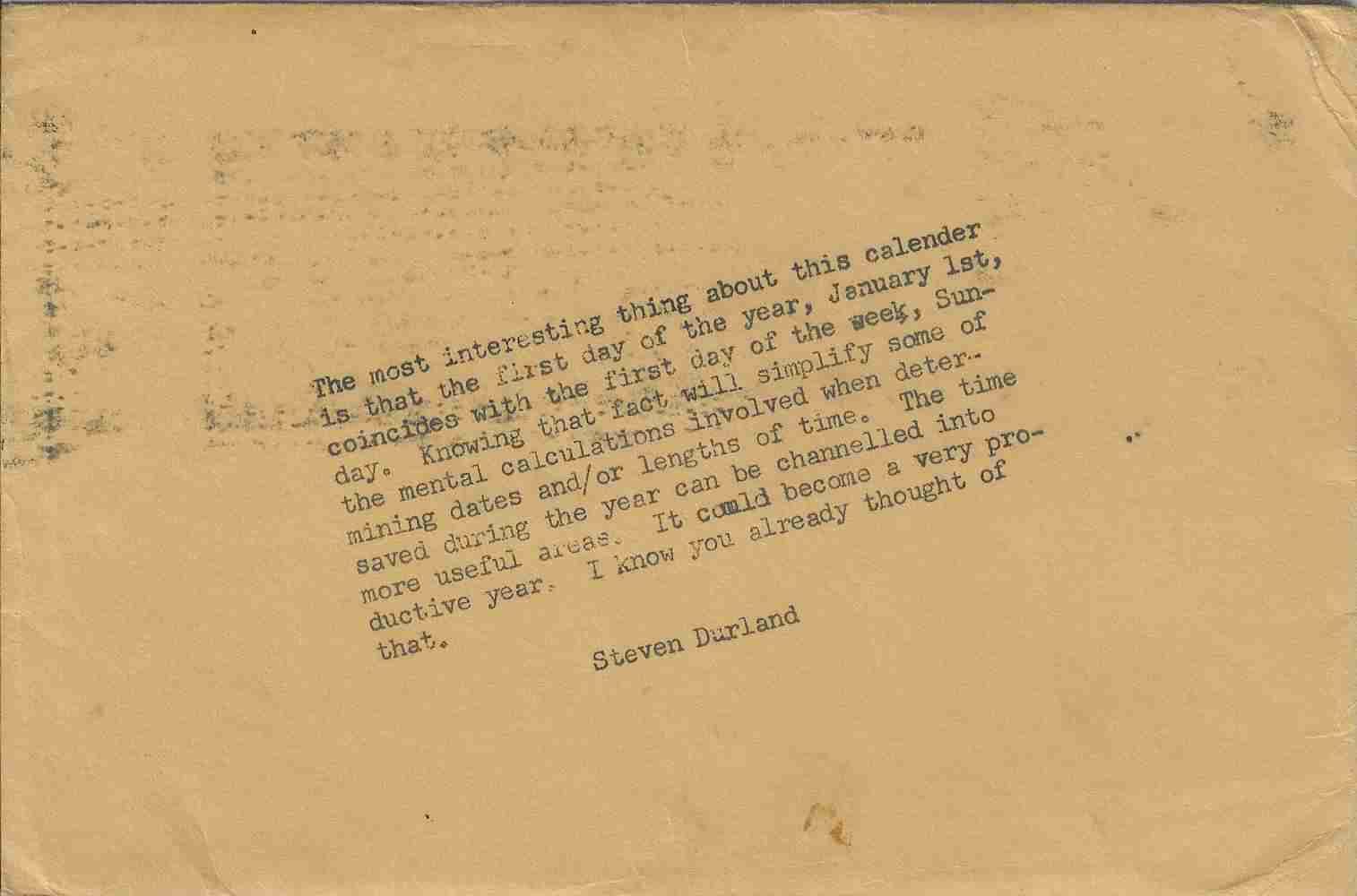
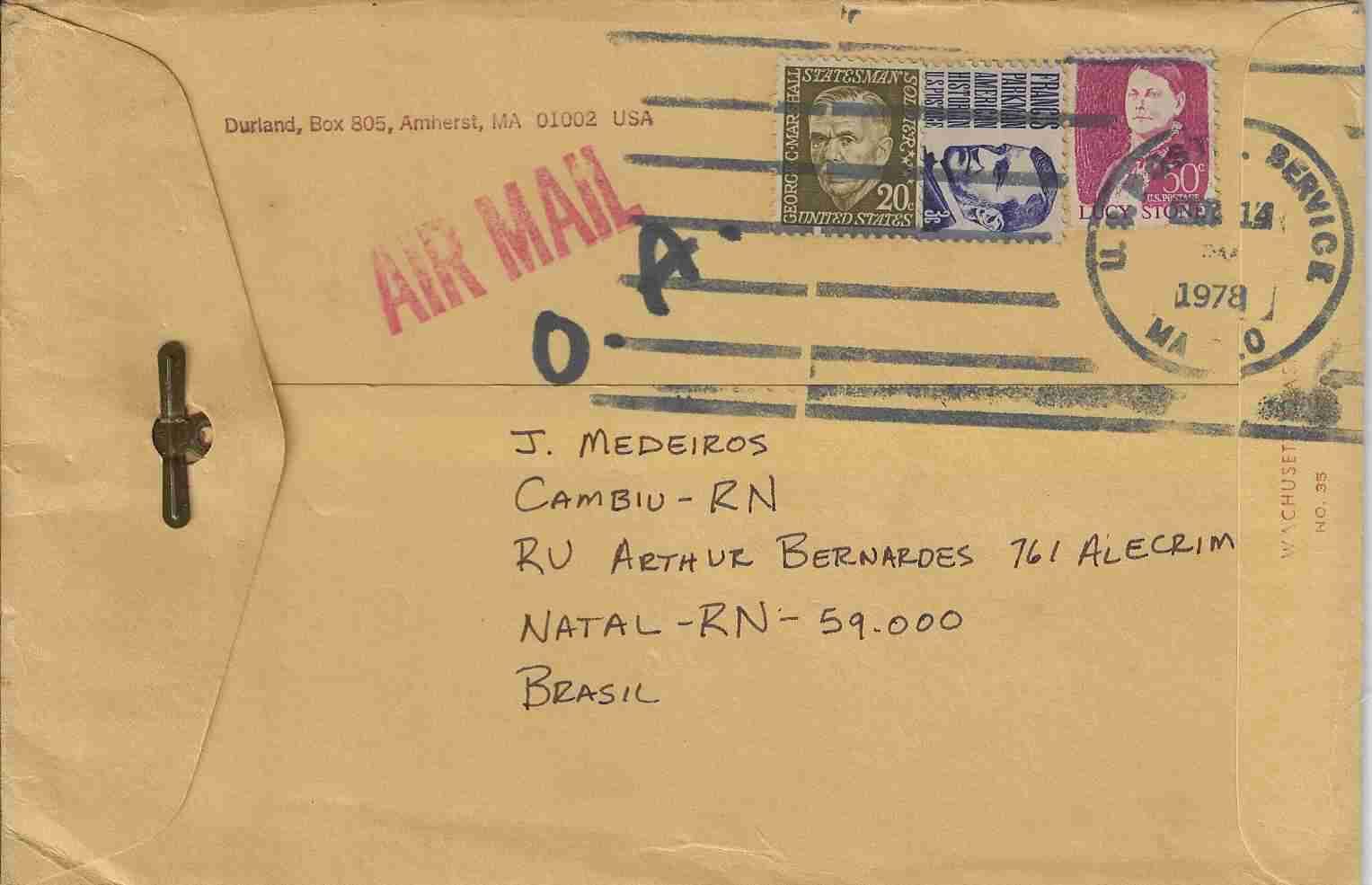
Envelope de arte postal produzido por Steven Durland e enviado de Amherst, Massachusetts, Estados Unidos, para J. Medeiros, em Natal, Rio Grande do Norte, Brasil. O carimbo postal registra a data de 14 de fevereiro de 1978.
Steve Durland - USA
Categoria: Mail Art
Acervo: 03830
Data: 14 de Fevereiro de 1978
Dimensões: 12,7 x 19,2 cm
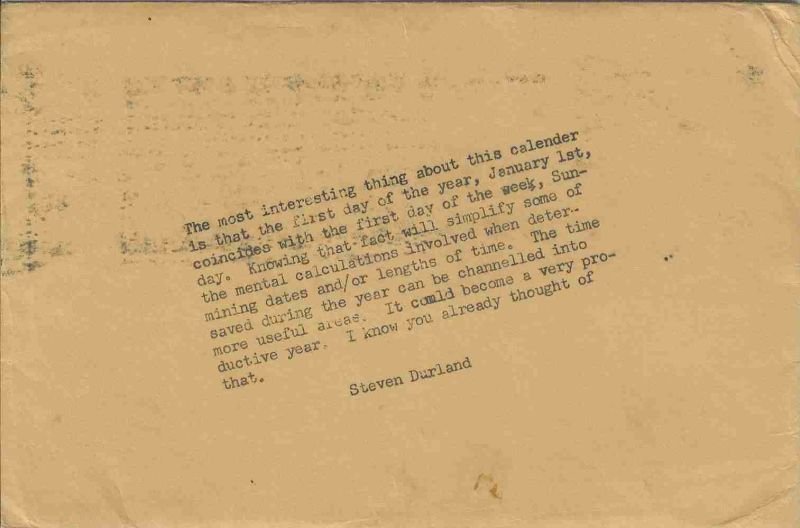
Envelope de arte postal produzido por Steven Durland e enviado de Amherst, Massachusetts, Estados Unidos, para J. Medeiros, em Natal, Rio Grande do Norte, Brasil. O carimbo postal registra a data de 14 de fevereiro de 1978. A peça combina correspondência, texto datilografado, composição gráfica, apropriação filatélica, carimbos, elemento metálico e reflexão conceitual sobre calendário, organização do tempo e produtividade.O remetente aparece identificado como Durland, caixa postal 805, Amherst, Massachusetts, código postal 01002, Estados Unidos. O destinatário foi registrado como J. Medeiros, Rua Arthur Bernardes, número 761, bairro do Alecrim, Natal, Rio Grande do Norte, código postal 59000, Brasil. Entre o nome do destinatário e o endereço aparece uma inscrição que parece corresponder a Cambiu RN. A leitura permanece parcialmente incerta por causa da grafia manuscrita.Na área superior do envelope foram aplicados três selos postais norte americanos com retratos de personalidades históricas. Um dos selos homenageia George C. Marshall e apresenta valor de vinte centavos. Outro selo é dedicado a Lucy Stone e possui valor de cinquenta centavos. O selo central apresenta retrato invertido e texto parcialmente encoberto pelas marcas postais, não permitindo identificação definitiva apenas pela imagem.Os retratos dos selos foram modificados por faixas horizontais escuras colocadas sobre a região dos olhos. A intervenção produz um efeito de censura, anonimato ou cancelamento simbólico da identidade. O procedimento transforma selos oficiais em componentes de uma composição artística e aproxima a peça de práticas de apropriação, colagem, alteração de imagens públicas e crítica aos sistemas de representação institucional.A expressão Air Mail foi aplicada em vermelho próximo aos selos. Abaixo dela aparece uma forma circular preta e uma pequena figura gráfica colocada sobre as linhas do cancelamento postal. Esses elementos interferem na área administrativa do envelope e tornam as marcas dos correios parte da estrutura visual da obra.Na margem esquerda encontra se um fecho metálico atravessando a aba do envelope. O objeto altera a superfície plana do papel e introduz uma dimensão tridimensional. O fecho também sugere abertura, fechamento, proteção e controle do conteúdo, aproximando o envelope da assemblage e do objeto artístico.No interior encontra se um texto datilografado e assinado como Steven Durland. O artista afirma que o aspecto mais interessante do calendário é o fato de o primeiro dia do ano, primeiro de janeiro, coincidir com o primeiro dia da semana, domingo. Segundo o texto, conhecer esse fato simplificaria alguns cálculos mentais relacionados à determinação de datas e durações.Durland afirma ainda que o tempo economizado ao longo do ano poderia ser direcionado para atividades mais úteis e resultar em um ano muito produtivo. A mensagem termina com a observação de que o destinatário provavelmente já havia pensado nisso.O texto parte de uma informação aparentemente prática, mas desenvolve uma lógica irônica e conceitual. A relação entre primeiro de janeiro e domingo só possui validade para determinados anos. O comentário transforma uma coincidência calendárica em promessa de economia mental e aumento de produtividade, criando uma paródia dos discursos de eficiência, planejamento e administração do tempo.O ano de 1978 começou em um domingo, o que confirma a correspondência entre o argumento do texto e o calendário daquele ano. A mensagem foi enviada em fevereiro, quando o destinatário já havia vivido as primeiras semanas dessa configuração temporal. A frase final reconhece de maneira humorística que a descoberta poderia não ser nova nem particularmente necessária.A disposição inclinada do bloco datilografado reforça o caráter visual da mensagem. O texto não funciona apenas como conteúdo verbal. Sua posição diagonal sobre o papel transforma a escrita em elemento gráfico e aproxima a peça da poesia visual, da arte conceitual e das publicações experimentais.O envelope documenta uma relação direta entre Steven Durland e J. Medeiros em 1978. A correspondência insere o destinatário brasileiro na rede internacional de arte postal que utilizava cartas, cartões, envelopes, selos, carimbos, textos, fotografias e objetos como meios de criação e comunicação.Steven Durland não integrou formalmente o movimento Poema Processo. Sua relação com esse contexto ocorre por meio da circulação postal e do intercâmbio com artistas e agentes culturais de Natal, cidade fundamental para o desenvolvimento do movimento. O documento constitui uma evidência da conexão entre o ambiente experimental do Rio Grande do Norte e as redes internacionais de mail art durante a década de 1970.TEXT FOR THE SALSA PROGRAM IN ENGLISHMail art envelope produced by Steven Durland and sent from Amherst, Massachusetts, United States, to J. Medeiros in Natal, Rio Grande do Norte, Brazil. The postal cancellation records the date 14 February 1978. The work combines correspondence, typewritten text, graphic composition, philatelic appropriation, postal marks, a metal component and a conceptual reflection on calendars, the organization of time and productivity.The sender is identified as Durland at Post Office Box 805, Amherst, Massachusetts, postal code 01002, United States. The recipient is recorded as J. Medeiros at Rua Arthur Bernardes, number 761, Alecrim, Natal, Rio Grande do Norte, postal code 59000, Brazil. An inscription between the name and address appears to read Cambiu RN. The reading remains partially uncertain because of the handwriting.Three United States postage stamps bearing portraits of historical figures were applied to the upper area of the envelope. One stamp honors George C. Marshall and has a value of twenty cents. Another is dedicated to Lucy Stone and has a value of fifty cents. The central stamp contains an inverted portrait and text partially concealed by postal markings, preventing definitive identification from the image alone.The portraits on the stamps were altered by dark horizontal bands placed across the eyes. The intervention produces an effect of censorship, anonymity or symbolic cancellation of identity. It transforms official stamps into components of an artwork and connects the piece with appropriation, collage, the alteration of public images and criticism of institutional systems of representation.The words Air Mail were applied in red near the stamps. Below them appears a black circular form and a small graphic figure placed over the postal cancellation lines. These elements interfere with the administrative area of the envelope and make postal processing marks part of the visual structure of the work.A metal fastener passes through the flap on the left side. This object alters the flat paper surface and introduces a three dimensional element. It also suggests opening, closing, protection and control of the contents, connecting the envelope with assemblage and object based art.Inside the envelope is a typewritten text signed Steven Durland. The artist states that the most interesting feature of the calendar is that the first day of the year, January first, coincides with the first day of the week, Sunday. According to the text, awareness of this fact simplifies some of the mental calculations involved in determining dates and lengths of time.Durland further suggests that the time saved during the year could be directed into more useful activities and might produce a very productive year. The message ends with the observation that the recipient had probably already thought about this.The text begins with apparently practical information but develops an ironic and conceptual logic. The correspondence between January first and Sunday is valid only in particular years. The message transforms a calendrical coincidence into a promise of mental economy and increased productivity, creating a parody of discourses concerning efficiency, planning and time management.The year 1978 began on a Sunday, confirming the relationship between the statement and the calendar of that year. The message was sent in February, when the recipient had already experienced the first weeks of this temporal arrangement. The final sentence humorously acknowledges that the discovery may not have been new or particularly necessary.The diagonal placement of the typewritten block reinforces the visual character of the message. The text does not function only as verbal content. Its angled position transforms writing into a graphic element and connects the work with visual poetry, conceptual art and experimental publishing.The envelope documents a direct relationship between Steven Durland and J. Medeiros in 1978. The correspondence places the Brazilian recipient within an international mail art network that used letters, postcards, envelopes, postage stamps, rubber stamps, texts, photographs and objects as forms of creation and communication.Steven Durland was not a formal member of the Process Poem Movement. His relationship with that context developed through postal circulation and exchange with artists and cultural agents in Natal, a city fundamental to the development of the movement. The document is evidence of the connection between the experimental environment of Rio Grande do Norte and international mail art networks during the 1970s.
TEXTO DE OBSERVAÇÃO EM PORTUGUÊSEnvelope original de arte postal produzido por Steven Durland e enviado para J. Medeiros. O carimbo postal indica Amherst, Massachusetts, e a data de 14 de fevereiro de 1978.O remetente aparece como Durland, caixa postal 805, Amherst, Massachusetts, código postal 01002, Estados Unidos. O destinatário foi registrado como J. Medeiros, Rua Arthur Bernardes, número 761, Alecrim, Natal, Rio Grande do Norte, código postal 59000, Brasil.A inscrição localizada abaixo do nome J. Medeiros parece corresponder a Cambiu RN. A leitura não pode ser confirmada integralmente e deve ser preservada com cautela na ficha catalográfica.A frente apresenta a expressão Air Mail, três selos postais, marcas de cancelamento, formas gráficas, endereço manuscrito e um fecho metálico instalado na aba esquerda.Um dos selos homenageia George C. Marshall e possui valor de vinte centavos. Outro apresenta Lucy Stone e valor de cinquenta centavos. A identificação do selo central permanece incerta porque ele foi aplicado de maneira invertida, recebeu intervenção gráfica e está parcialmente coberto por marcas postais.Faixas escuras foram aplicadas sobre os olhos das personalidades representadas nos selos. Essas marcas devem ser registradas como intervenções visuais constitutivas da obra, não como danos acidentais.O fecho metálico atravessa o papel e modifica a estrutura física do envelope. Não deve ser classificado como elemento posterior sem documentação que confirme essa hipótese. Sua integração à composição sugere aplicação intencional.O texto datilografado informa que o aspecto mais interessante do calendário é a coincidência entre o primeiro dia do ano e o primeiro dia da semana. A mensagem afirma que esse conhecimento simplificaria cálculos mentais relacionados a datas e durações e permitiria dedicar o tempo economizado a atividades mais produtivas.O primeiro de janeiro de 1978 ocorreu em um domingo. Essa correspondência confirma que a reflexão foi construída a partir do calendário do ano em que a peça foi enviada.A assinatura Steven Durland aparece datilografada abaixo da mensagem. Não há assinatura manuscrita visível.O bloco textual foi aplicado ou datilografado em posição inclinada. Há resíduos, impressões pouco legíveis e marcas anteriores na parte superior esquerda do papel, mas não é possível transcrevê los com segurança.O envelope apresenta amarelecimento, manchas, dobras, abrasões, desgaste nas bordas, alterações cromáticas e marcas de manipulação. Essas características integram sua história material e testemunham a circulação entre Massachusetts e Natal.A peça deve ser catalogada como envelope de arte postal, correspondência artística, texto conceitual, composição tipográfica, intervenção sobre selos, assemblage, objeto com elemento metálico e obra sobre papel.Para indexação, recomenda se relacionar o documento aos termos Steven Durland, Steve Durland, J. Medeiros, Amherst, Massachusetts, Natal, Rio Grande do Norte, Alecrim, Rua Arthur Bernardes, 14 de fevereiro de 1978, calendário de 1978, primeiro de janeiro, domingo, produtividade, organização do tempo, George C. Marshall, Lucy Stone, Air Mail, arte postal, mail art, correspondence art, poesia visual, texto datilografado, selos postais, intervenção gráfica, assemblage e Poema Processo.OBSERVATION TEXT IN ENGLISHOriginal mail art envelope produced by Steven Durland and sent to J. Medeiros. The postal cancellation identifies Amherst, Massachusetts, and the date 14 February 1978.The sender is recorded as Durland at Post Office Box 805, Amherst, Massachusetts, postal code 01002, United States. The recipient is identified as J. Medeiros at Rua Arthur Bernardes, number 761, Alecrim, Natal, Rio Grande do Norte, postal code 59000, Brazil.The inscription beneath the name J. Medeiros appears to read Cambiu RN. The reading cannot be fully confirmed and should be preserved cautiously in the catalogue record.The front contains the words Air Mail, three postage stamps, cancellation marks, graphic forms, handwritten addressing and a metal fastener installed on the left flap.One stamp honors George C. Marshall and has a value of twenty cents. Another depicts Lucy Stone and has a value of fifty cents. The identity of the central stamp remains uncertain because it was applied upside down, received a graphic intervention and is partially covered by postal markings.Dark bands were applied across the eyes of the historical figures represented on the stamps. These marks should be recorded as intentional visual interventions forming part of the artwork rather than accidental damage.The metal fastener passes through the paper and modifies the physical structure of the envelope. It should not be classified as a later addition without supporting documentation. Its integration into the composition suggests intentional application.The typewritten text states that the most interesting feature of the calendar is the coincidence between the first day of the year and the first day of the week. The message claims that this knowledge would simplify mental calculations involving dates and lengths of time and would allow the saved time to be directed toward more productive activities.The first day of January 1978 was a Sunday. This correspondence confirms that the reflection was constructed from the calendar of the year in which the work was mailed.The name Steven Durland is typewritten below the message. No handwritten signature is visible.The textual block was applied or typed at an angle. Residues, faint impressions and earlier marks appear in the upper left area of the paper, but they cannot be securely transcribed.The envelope shows yellowing, stains, folds, abrasions, worn edges, color changes and evidence of handling. These characteristics form part of its material history and testify to its circulation between Massachusetts and Natal.The work should be catalogued as a mail art envelope, artistic correspondence, conceptual text, typographic composition, intervention on postage stamps, assemblage, object with a metal component and work on paper.For indexing purposes, the document should be associated with Steven Durland, Steve Durland, J. Medeiros, Amherst, Massachusetts, Natal, Rio Grande do Norte, Alecrim, Rua Arthur Bernardes, 14 February 1978, calendar of 1978, January first, Sunday, productivity, organization of time, George C. Marshall, Lucy Stone, Air Mail, mail art, correspondence art, visual poetry, typewritten text, postage stamps, graphic intervention, assemblage and the Process Poem Movement.
Proveniência
Coleção J. MedeirosInglês
Mail art envelope produced by Steven Durland and sent from Amherst, Massachusetts, United States, to J. Medeiros in Natal, Rio Grande do Norte, Brazil. The postal cancellation records the date 14 February 1978.
Dimensions: 5 x 7,6 in