Cartão de arte postal enviado em 1 de julho de 1980 pelo artista neerlandês Kees Francke, conhecido pelas identidades artísticas Spudz, S.P.U.D.Z. e S.P.U.D.Z. Business Calls, para a artista norte americana Pat Fish, cujo nome foi transformado de maneira humorística em Pit Fash.
S.P.U.D.Z. Business Calls é Cees Franke ou Kees Francke é Spudz é Cornelius Kees Francke - Holanda
Categoria: Mail Art
Acervo: 03814
Data: 1 de Julho de 1980
Dimensões: 10,2 x 14,1 cm
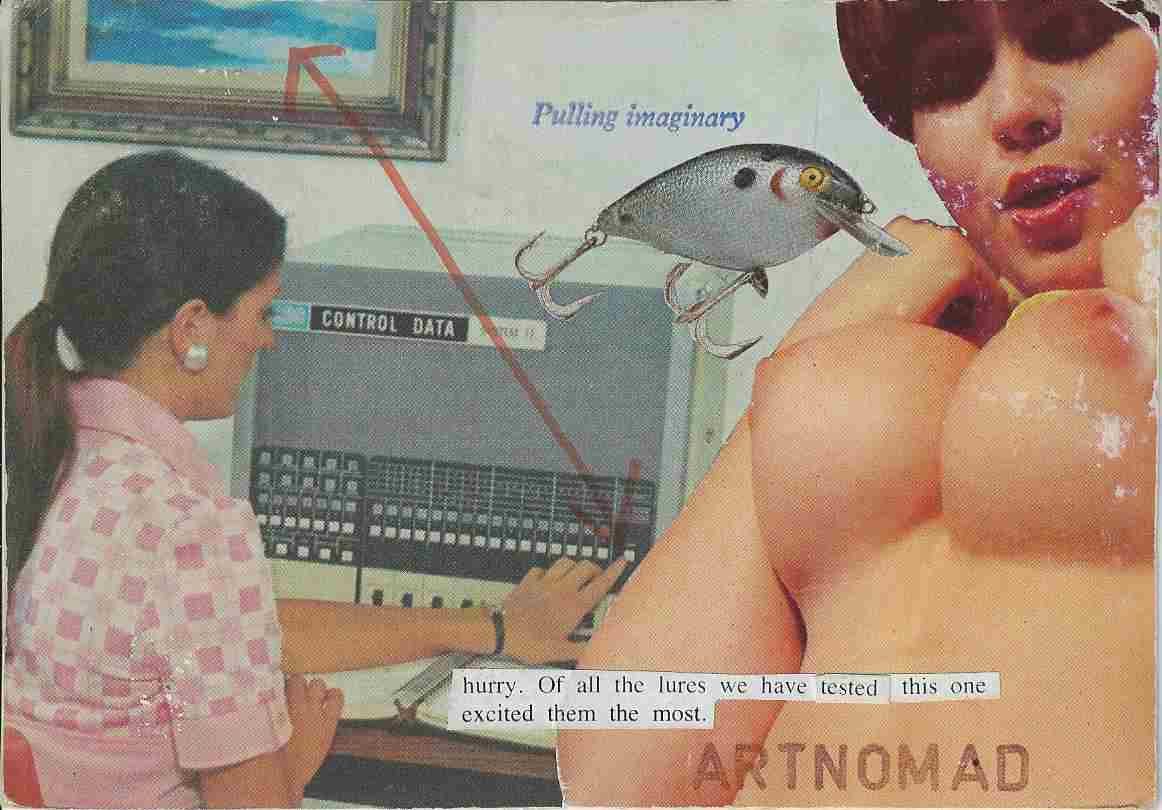
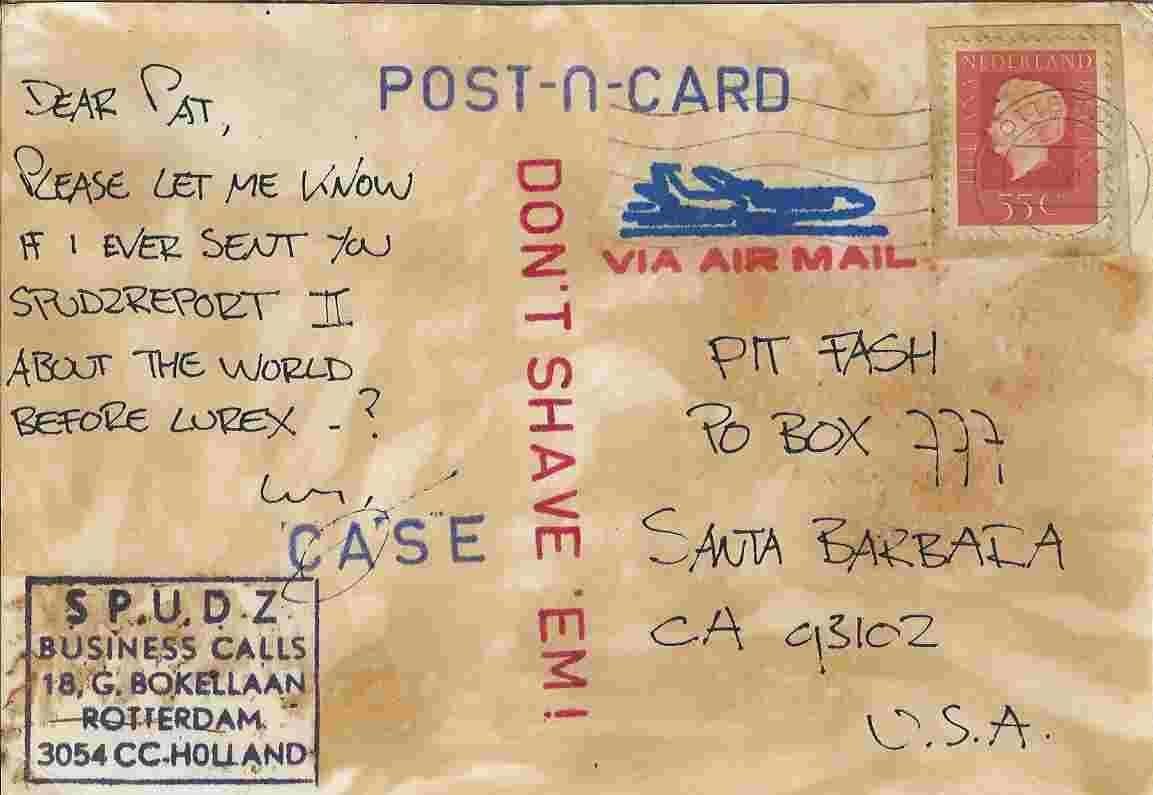
Cartão de arte postal enviado em 1 de julho de 1980 pelo artista neerlandês Kees Francke, conhecido pelas identidades artísticas Spudz, S.P.U.D.Z. e S.P.U.D.Z. Business Calls, para a artista norte americana Pat Fish, cujo nome foi transformado de maneira humorística em Pit Fash. A correspondência foi remetida de Rotterdam, Países Baixos, para Santa Barbara, Califórnia, e integra a rede internacional de arte postal ativa entre as décadas de 1970 e 1980.A frente do cartão apresenta uma colagem realizada com imagens apropriadas de revistas e materiais impressos. A composição reúne uma mulher operando um terminal de computador identificado pela expressão Control Data, uma figura feminina parcialmente nua, uma isca artificial de pesca, uma imagem emoldurada, fragmentos tipográficos e a palavra ArtNomad. O trabalho combina tecnologia, corpo, sexualidade, consumo, desejo, controle da informação e comunicação visual.Na parte superior aparece a expressão Pulling imaginary. Próximo à região inferior foi inserido um fragmento textual que afirma que, entre todas as iscas testadas, aquela foi a que mais os excitou. O texto estabelece uma relação direta entre a isca de pesca, o corpo feminino e as ideias de atração, sedução e estímulo. A justaposição cria uma narrativa deliberadamente ambígua e aproxima o cartão das estratégias de colagem surrealista, apropriação publicitária, humor conceitual e crítica à cultura de consumo.A palavra ArtNomad reforça o caráter móvel da obra e pode ser relacionada à condição do artista postal como nômade da comunicação. Nesse contexto, o correio funciona como meio de transporte, suporte artístico, espaço expositivo e sistema de conexão entre pessoas geograficamente distantes. A obra não permanece ligada a uma galeria ou território fixo, pois adquire significado durante sua circulação entre Rotterdam e a Califórnia.No verso, Spudz dirige a mensagem a Pit Fash, alteração intencional e lúdica do nome Pat Fish. O artista pergunta se alguma vez havia enviado a publicação Spudzreport II, seguida da expressão About the World Before Lurex. O texto documenta a existência de uma publicação ou série editorial associada à identidade Spudz, embora não tenham sido localizadas informações completas sobre sua data de edição, formato, conteúdo ou tiragem.A referência a Lurex estabelece uma relação possível com a imagem da isca. A palavra inglesa lure significa isca, atração ou aquilo que seduz, enquanto Lurex é o nome de um material têxtil metálico relacionado à moda, ao brilho e à cultura visual de consumo. A associação entre lure, Lurex, a isca de pesca e o corpo feminino amplia os jogos verbais e visuais presentes na composição.O verso contém também as expressões Post o card, Don
t shave em letras verticais e as marcações manuscritas Case e Wm, cuja interpretação exata não pode ser confirmada apenas pelo documento. O remetente aparece identificado por carimbo como S.P.U.D.Z. Business Calls, com endereço em Rotterdam. Essa designação funcionava como identidade artística e comunicacional de Kees Francke, utilizada para distribuir colagens, publicações, mensagens e projetos dentro da rede internacional de arte postal.O endereço do destinatário foi escrito como Pit Fash, P.O. Box 777, Santa Barbara, California 93102, USA. O cartão possui selo postal dos Países Baixos e marca de envio por correio aéreo. As intervenções manuscritas, tipográficas, postais e visuais demonstram que tanto a frente quanto o verso foram tratados como campos de criação.A correspondência comprova uma relação direta entre Kees Francke e Pat Fish. Mais do que uma mensagem isolada, o cartão fazia parte de uma troca continuada entre dois artistas ligados à arte postal, à colagem, à comunicação alternativa e às redes independentes de circulação. A pergunta sobre Spudzreport II indica que publicações, relatórios artísticos e materiais editoriais eram enviados entre os participantes como parte das relações de colaboração e amizade.O documento é relevante para a história da arte postal neerlandesa e norte americana, para o estudo de Kees Francke, Pat Fish, Spudzreport II, S.P.U.D.Z. Business Calls, ArtNomad e das redes internacionais de comunicação artística em 1980. Também constitui exemplo significativo do emprego de colagem, apropriação de imagens comerciais, jogos linguísticos, humor, sexualidade, tecnologia e circulação postal como elementos integrados de uma mesma obra.TEXT FOR THE SALSA PROGRAM IN ENGLISHMail art postcard sent on July 1, 1980, by the Dutch artist Kees Francke, known through the artistic identities Spudz, S.P.U.D.Z. and S.P.U.D.Z. Business Calls, to the American artist Pat Fish, whose name was humorously transformed into Pit Fash. The correspondence was mailed from Rotterdam in the Netherlands to Santa Barbara, California, and belongs to the international mail art network active during the 1970s and 1980s.The front of the postcard presents a collage made with images appropriated from magazines and printed materials. The composition brings together a woman operating a computer terminal identified by the words Control Data, a partially nude female figure, an artificial fishing lure, a framed image, typographic fragments and the word ArtNomad. The work combines technology, the body, sexuality, consumption, desire, information control and visual communication.The phrase Pulling imaginary appears near the upper area. A textual fragment placed near the lower part states that, among all the lures tested, this particular one excited them the most. The text establishes a direct relationship between the fishing lure, the female body and the ideas of attraction, seduction and stimulation. The juxtaposition creates a deliberately ambiguous narrative connected with surrealist collage, advertising appropriation, conceptual humor and criticism of consumer culture.The word ArtNomad reinforces the mobile character of the work and may be related to the condition of the mail artist as a nomad of communication. In this context, the postal service functions as a means of transportation, an artistic support, an exhibition space and a system connecting geographically distant individuals. The work is not attached to a gallery or fixed territory, since it acquires meaning through its circulation between Rotterdam and California.On the reverse, Spudz addresses the message to Pit Fash, an intentional and playful alteration of the name Pat Fish. The artist asks whether he had ever sent the publication Spudzreport II, followed by the phrase About the World Before Lurex. The text documents the existence of a publication or editorial series associated with the Spudz identity, although complete information regarding its publication date, format, contents and edition size has not been located.The reference to Lurex establishes a possible relationship with the image of the fishing lure. The English word lure means bait, attraction or something used to entice, while Lurex is the name of a metallic textile associated with fashion, shine and visual consumer culture. The association between lure, Lurex, the fishing bait and the female body expands the verbal and visual games within the composition.The reverse also contains the expressions Post o card and Don
t shave in vertical lettering, as well as the handwritten markings Case and Wm, whose exact interpretation cannot be confirmed from the document alone. The sender is identified by a rubber stamp reading S.P.U.D.Z. Business Calls, with an address in Rotterdam. This designation functioned as the artistic and communication identity used by Kees Francke to distribute collages, publications, messages and projects throughout the international mail art network.The recipient address was written as Pit Fash, P.O. Box 777, Santa Barbara, California 93102, USA. The postcard carries a Netherlands postage stamp and an airmail marking. Its handwritten, typographic, postal and visual interventions demonstrate that both the front and reverse were treated as fields of artistic creation.The correspondence confirms a direct relationship between Kees Francke and Pat Fish. Rather than an isolated message, the postcard formed part of a continuing exchange between two artists connected with mail art, collage, alternative communication and independent circulation networks. The question concerning Spudzreport II indicates that publications, art reports and editorial materials were exchanged among participants as part of collaborative and personal relationships.The document is relevant to the history of Dutch and American mail art and to the study of Kees Francke, Pat Fish, Spudzreport II, S.P.U.D.Z. Business Calls, ArtNomad and international networks of artistic communication in 1980. It is also a significant example of the integrated use of collage, appropriated commercial imagery, linguistic games, humor, sexuality, technology and postal circulation.
TEXTO DE OBSERVAÇÃO EM PORTUGUÊSCartão postal com colagem e intervenções manuscritas enviado por Kees Francke, conhecido como Spudz e S.P.U.D.Z., para Pat Fish em Santa Barbara, Califórnia. O nome da destinatária foi alterado para Pit Fash como parte do humor e dos jogos linguísticos utilizados pelo artista.A frente reúne imagens apropriadas de uma operadora diante de um terminal Control Data, uma figura feminina parcialmente nua, uma isca artificial de pesca, fragmentos de texto e a palavra ArtNomad. A composição estabelece relações entre tecnologia, informação, corpo, desejo, sedução, consumo e controle.No verso, Spudz pergunta se já havia enviado Spudzreport II e acrescenta a expressão About the World Before Lurex. A referência constitui evidência documental da existência de uma publicação ou série associada à identidade Spudz, embora seus dados bibliográficos completos não tenham sido localizados. O carimbo S.P.U.D.Z. Business Calls registra a identidade artística e comunicacional utilizada por Kees Francke em Rotterdam.Documento datado de 1 de julho de 1980, enviado por correio aéreo dos Países Baixos para os Estados Unidos. O cartão documenta a correspondência entre Kees Francke e Pat Fish e integra os campos da arte postal, colagem, poesia visual, publicação de artista, humor conceitual e comunicação alternativa.OBSERVATION TEXT IN ENGLISHPostcard with collage and handwritten interventions sent by Kees Francke, known as Spudz and S.P.U.D.Z., to Pat Fish in Santa Barbara, California. The name of the recipient was altered to Pit Fash as part of the humor and linguistic play employed by the artist.The front combines appropriated images of an operator before a Control Data terminal, a partially nude female figure, an artificial fishing lure, textual fragments and the word ArtNomad. The composition establishes relationships between technology, information, the body, desire, seduction, consumption and control.On the reverse, Spudz asks whether he had already sent Spudzreport II and adds the phrase About the World Before Lurex. This reference provides documentary evidence of a publication or series associated with the Spudz identity, although its complete bibliographic information has not been located. The S.P.U.D.Z. Business Calls rubber stamp records the artistic and communication identity used by Kees Francke in Rotterdam.Document dated July 1, 1980, and sent by airmail from the Netherlands to the United States. The postcard documents the correspondence between Kees Francke and Pat Fish and belongs to the fields of mail art, collage, visual poetry, artists publications, conceptual humor and alternative communication.
Inglês
Mail art postcard sent on July 1, 1980, by the Dutch artist Kees Francke, known through the artistic identities Spudz, S.P.U.D.Z. and S.P.U.D.Z. Business Calls, to the American artist Pat Fish, whose name was humorously transformed into Pit Fash.
Dimensions: 4 x 5,6 in