Envelope e obra original de Vagrich Bakhchanyan, também grafado Bakhchanyan, enviados de Nova York para Marcelo Dolabela e para a Comissão BH 100, Temporada de Poesia, em Belo Horizonte, Minas Gerais, Brasil, em 1994
Vagrich Bakhchanyan - Alexander Bakchanyan - USA
Categoria: Mail Art
Acervo: 03800
Data: 1994
Dimensões: 10,5 x 24 cm
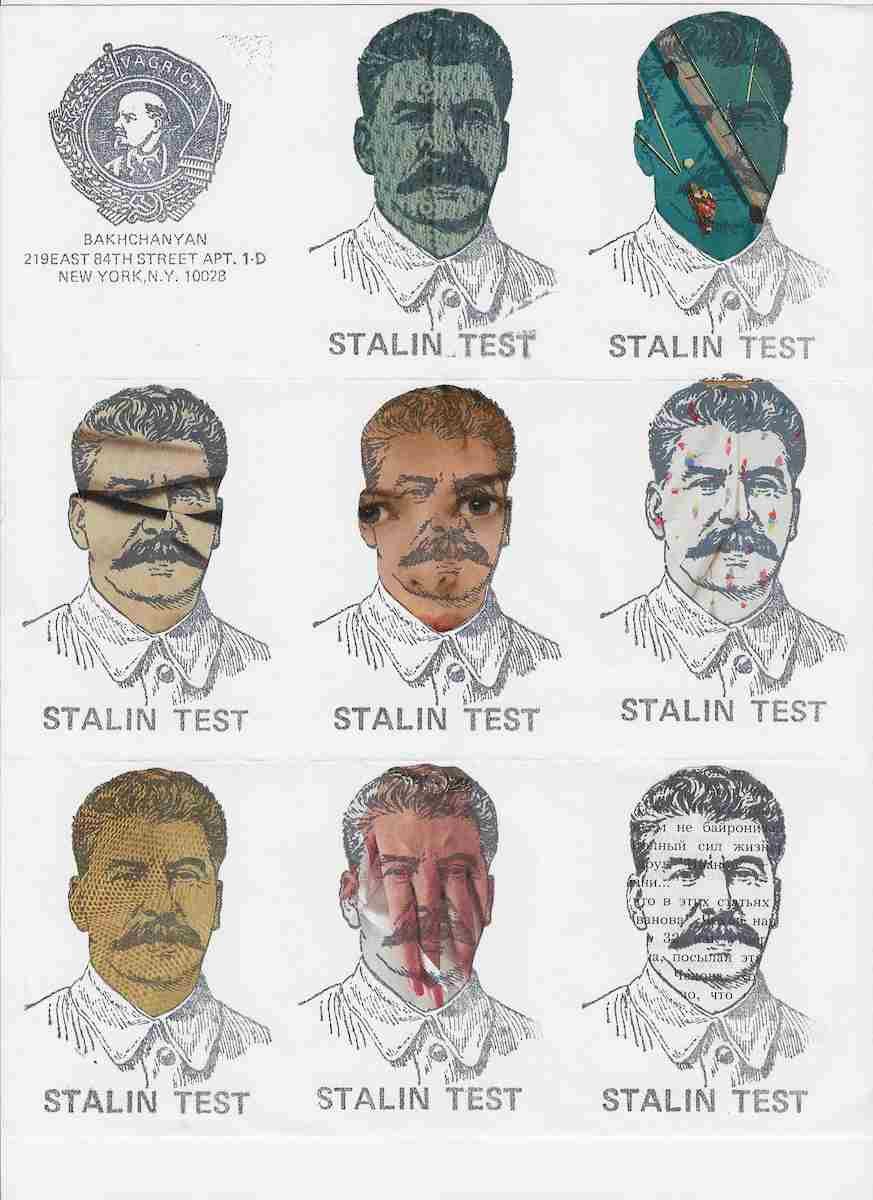
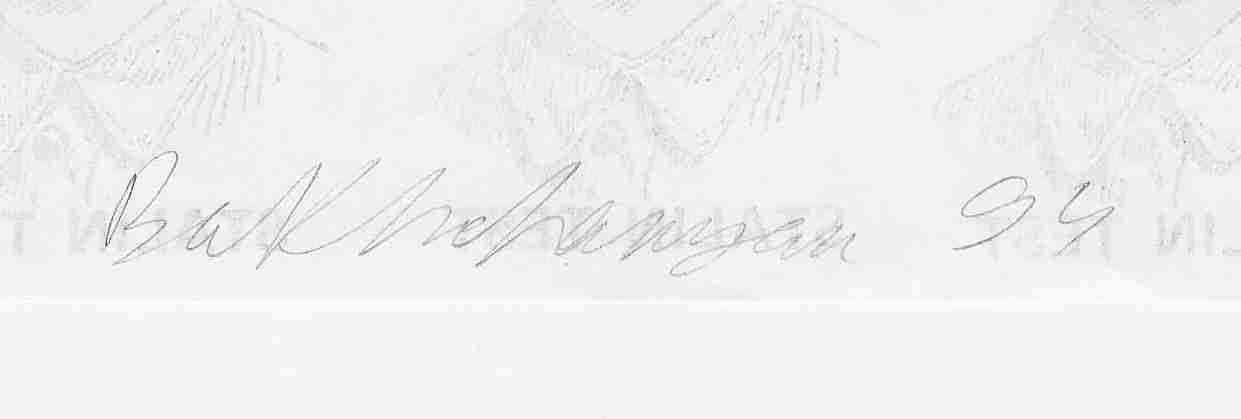
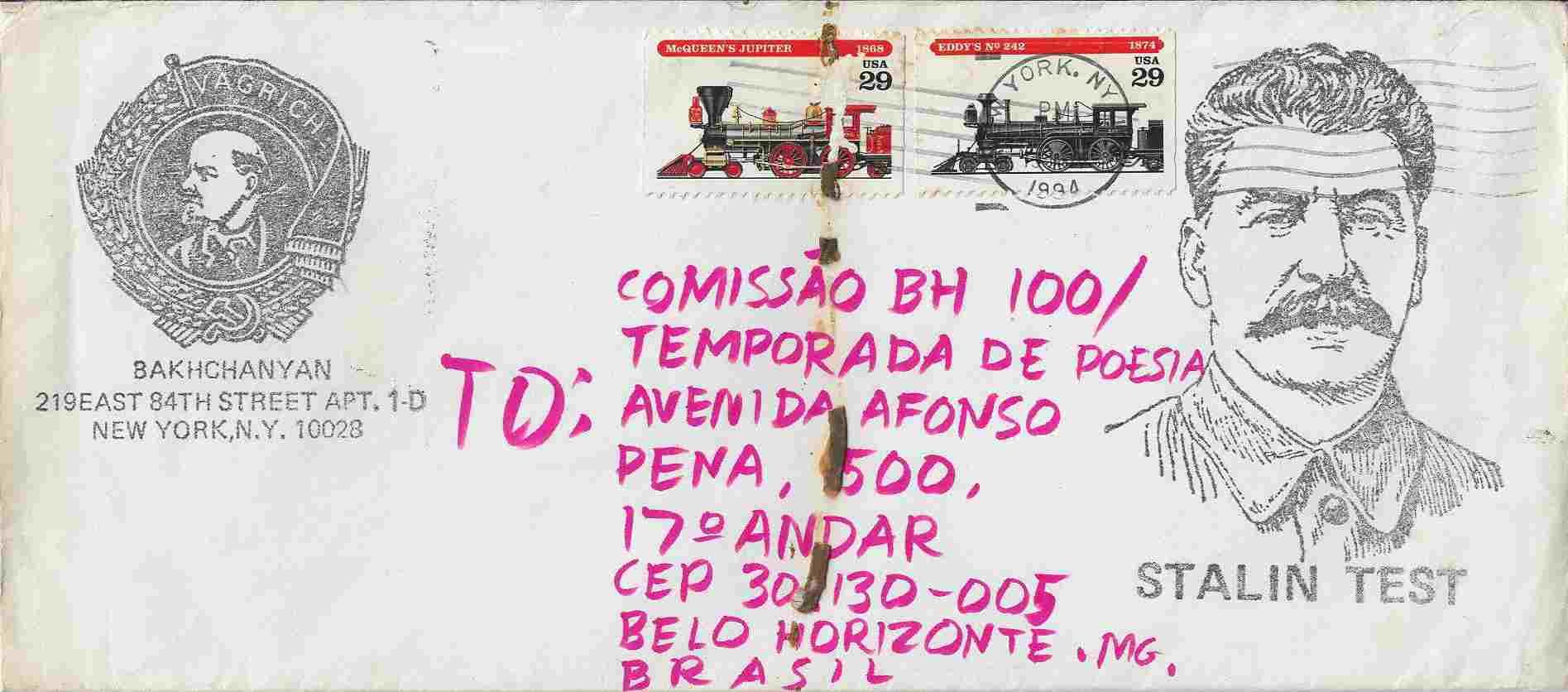
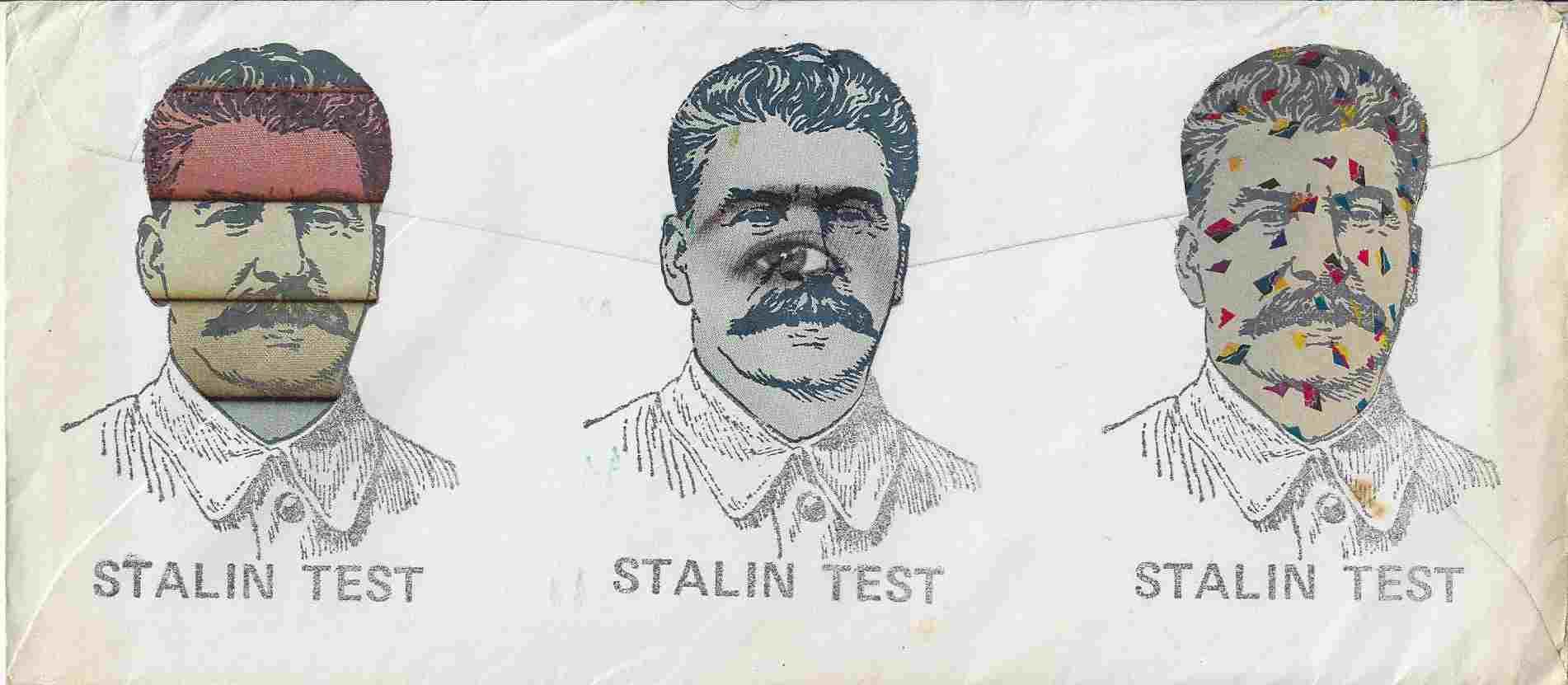
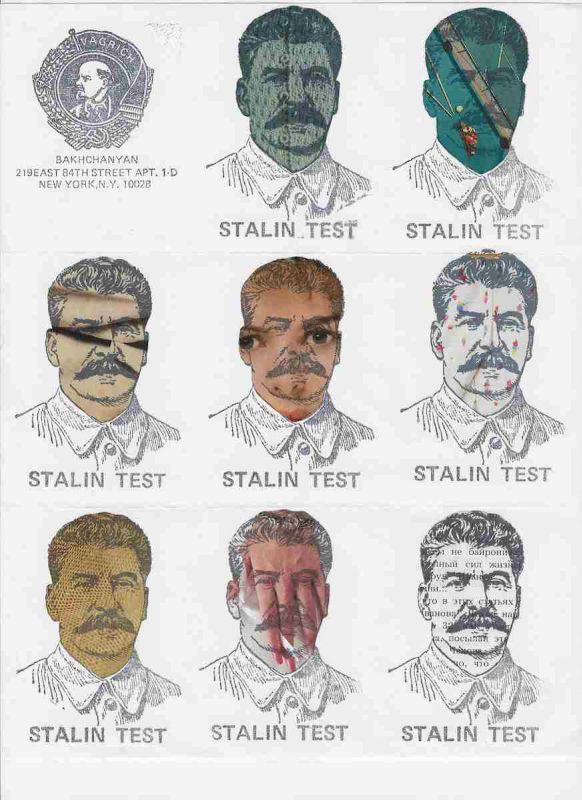
Envelope e obra original de Vagrich Bakhchanyan, também grafado Bakhchanyan, enviados de Nova York para Marcelo Dolabela e para a Comissão BH 100, Temporada de Poesia, em Belo Horizonte, Minas Gerais, Brasil, em 1994. O conjunto constitui documento particularmente importante para a história da circulação internacional de arte conceitual, Mail Art, poesia visual e produção experimental no Brasil durante a década de 1990, pois estabelece uma conexão material direta entre Bakhchanyan, artista ligado ao não conformismo soviético, ao Sots Art, ao conceitualismo de Moscou e posteriormente às redes internacionais de arte postal, e o circuito de poesia experimental organizado em Belo Horizonte em torno de Marcelo Dolabela e da Comissão BH 100.O envelope apresenta no canto esquerdo a identificação impressa BAKHCHANYAN e o endereço 219 East 84th Street, Apt. 1D, New York, N.Y. 10028. No lado direito aparece o retrato de Joseph Stalin acompanhado da inscrição STALIN TEST. A correspondência foi endereçada manualmente à Comissão BH 100, Temporada de Poesia, Avenida Afonso Pena 500, 17º andar, CEP 30130 005, Belo Horizonte, Minas Gerais, Brasil. Os selos postais norte americanos e o carimbo de Nova York confirmam a circulação física da correspondência entre Estados Unidos e Brasil.O conteúdo enviado é uma obra da série Stalin Test, assinada no verso Bakhchanyan 94, confirmando a autoria e a data de 1994. A peça apresenta nove imagens repetidas de Joseph Stalin organizadas em uma grade de três por três. Cada retrato é submetido a uma intervenção distinta por meio de colagem, sobreposição de imagens, fragmentos impressos, cor, texto e alterações gráficas. A repetição do mesmo rosto funciona como estrutura visual e conceitual, enquanto cada modificação interrompe a uniformidade da imagem política oficial.A série Stalin Test é uma das produções mais reconhecidas de Vagrich Bakhchanyan. A University of Notre Dame preserva um núcleo documental específico dedicado ao projeto e informa que Stalin Test foi concebido por Bakhchanyan em 1979, em relação ao centenário do nascimento de Joseph Stalin. Nos anos seguintes o artista reuniu centenas de representações do ditador realizadas por artistas, escritores e outras figuras culturais russas e emigradas. A coleção atualmente preservada pela instituição contém 401 desenhos originais relacionados ao projeto.A obra enviada à Comissão BH 100 não corresponde simplesmente a uma reprodução histórica do projeto inicial. Ela pertence ao desenvolvimento continuado de Stalin Test ao longo de diferentes anos, formatos e procedimentos. Exemplares conhecidos utilizam carimbo, impressão, colagem e mídia mista. A Sothebys registra um conjunto de seis folhas de Stalin Test datado de 1989, executado com carimbo e colagem sobre papel, enquanto outros exemplares conhecidos são datados de 1984 e 1987. A peça enviada a Belo Horizonte e assinada em 1994 demonstra que Bakhchanyan continuava reelaborando esse núcleo visual e conceitual muitos anos após sua concepção inicial.O procedimento utilizado na obra enviada ao Brasil é característico da produção de Bakhchanyan. A figura de Stalin é apresentada repetidamente como um modelo fixo, quase como formulário, teste, documento de identificação ou ficha burocrática. Entretanto, cada rosto é contaminado por novas imagens. Em alguns retratos aparecem fotografias sobrepostas aos olhos e ao rosto. Em outros surgem superfícies coloridas, fragmentos gráficos, textos impressos e pequenos elementos de colagem. O resultado desmonta progressivamente a estabilidade da imagem oficial.A palavra TEST é central para a interpretação da obra. A repetição do retrato sugere um teste visual de reconhecimento, memória e identificação política. Ao modificar continuamente o mesmo rosto, Bakhchanyan converte um dos ícones mais controlados da propaganda soviética em uma imagem instável, aberta a interferências e associações. O trabalho articula memória histórica, culto à personalidade, propaganda, censura, repetição e desconstrução da autoridade visual.O conjunto possui também características claras de Mail Art. O envelope não funciona apenas como embalagem. Ele é parte conceitual do trabalho, trazendo a identidade gráfica de Bakhchanyan, sua localização em Nova York e novamente a imagem de Stalin acompanhada pelo título STALIN TEST. Dessa maneira, obra, envelope, endereço, postagem e destinatário formam uma única cadeia documental de circulação artística.Essa dimensão postal encontra confirmação institucional no arquivo de Bakhchanyan. A University of Notre Dame preserva as Vagrich and Irene Bakhchanyan Collections, organizadas em quatro grandes conjuntos, entre eles The Stalin Test e uma Mail Art Collection. O arquivo contém correspondências, materiais impressos, fotografias, efêmera visual e centenas de documentos ligados à rede internacional de arte postal.Há ainda documentação que relaciona diretamente Stalin Test ao circuito de Mail Art. O acervo da University of Notre Dame conserva material de uma exposição postal intitulada BIG BROTHER IS WATCHING 1984, recebida por Bakhchanyan em Nova York, cuja documentação reproduz uma versão de Stalin Test entre os trabalhos selecionados. Esse registro confirma que a obra circulava não apenas como projeto conceitual independente, mas também dentro das redes internacionais de Mail Art.O documento brasileiro de 1994 acrescenta uma informação de grande relevância historiográfica. Ele comprova que Bakhchanyan enviou diretamente uma obra de Stalin Test de Nova York para a Comissão BH 100, Temporada de Poesia, em Belo Horizonte. Isso estabelece uma ligação concreta entre um artista proveniente do ambiente soviético e posteriormente norte americano e um programa brasileiro dedicado à poesia e à experimentação artística.Marcelo Dolabela foi um dos principais articuladores da poesia experimental em Belo Horizonte e esteve diretamente envolvido em projetos editoriais e curatoriais ligados à Comissão BH 100. Nesse contexto, a presença de uma obra de Bakhchanyan permite aproximar o circuito mineiro de debates internacionais sobre poesia visual, arte conceitual, texto imagem, Mail Art e publicações experimentais.O envio não deve ser interpretado apenas como correspondência administrativa. A escolha de Stalin Test como contribuição para a Temporada de Poesia sugere a compreensão ampliada da poesia adotada naquele circuito, na qual linguagem verbal, imagem, apropriação, montagem e conceito podiam constituir formas de produção poética. A obra de Bakhchanyan utiliza a própria repetição do título STALIN TEST e a serialização do retrato como elementos linguísticos e visuais.A assinatura manuscrita Bakhchanyan 94 no verso fornece um dado de proveniência particularmente relevante. Ela confirma que a obra foi assinada e datada pelo artista em 1994. Associada ao envelope com endereço de Bakhchanyan em Nova York e ao destinatário brasileiro claramente identificado, cria se uma cadeia documental excepcionalmente consistente entre autor, obra, data, origem e destino.Este conjunto permite ainda esclarecer a identificação anteriormente incerta do artista. A associação entre o sobrenome Bakhchanyan, o endereço de Nova York e sobretudo o título Stalin Test corresponde diretamente à produção documentada de Vagrich Bakhchanyan, 1938 a 2009. A University of Notre Dame identifica Vagrich Bakhchanyan como destacado artista, escritor e poeta soviético e posteriormente norte americano e preserva tanto o arquivo Stalin Test quanto sua coleção de Mail Art.Dessa maneira, embora alguma documentação brasileira possa registrar o primeiro nome Alexander, as evidências materiais deste conjunto e as fontes institucionais permitem identificar a autoria da obra como Vagrich Bakhchanyan. Para indexação museológica, bibliográfica e digital, recomenda se utilizar Vagrich Bakhchanyan como nome principal e registrar Alexander Bakhchanyan apenas como variante encontrada na documentação brasileira, evitando criar duas identidades distintas para a mesma obra sem necessidade documental.O conjunto Envelope e Stalin Test, 1994, constitui portanto uma fonte primária de grande importância para estudos sobre Vagrich Bakhchanyan, Marcelo Dolabela, Comissão BH 100, Temporada de Poesia, poesia visual, poesia experimental, arte conceitual, Sots Art, Moscow Conceptualism, arte soviética não oficial, Mail Art e circulação artística entre Nova York, Estados Unidos, e Belo Horizonte, Brasil, durante a década de 1990.ENGLISHText for the Salsa programOriginal envelope and artwork by Vagrich Bakhchanyan, also documented under the spelling Bakhchanyan, sent from New York to Marcelo Dolabela and Comissão BH 100, Temporada de Poesia, in Belo Horizonte, Minas Gerais, Brazil, in 1994. The ensemble is an especially important document for the history of the international circulation of conceptual art, Mail Art, visual poetry and experimental production in Brazil during the 1990s because it establishes a direct material connection between Bakhchanyan, an artist associated with Soviet nonconformism, Sots Art, Moscow Conceptualism and later international postal art networks, and the experimental poetry environment developed in Belo Horizonte around Marcelo Dolabela and Comissão BH 100.The envelope bears the printed identification BAKHCHANYAN and the return address 219 East 84th Street, Apt. 1D, New York, N.Y. 10028. On the right appears a portrait of Joseph Stalin accompanied by the title STALIN TEST. The correspondence is manually addressed to Comissão BH 100, Temporada de Poesia, Avenida Afonso Pena 500, 17th floor, CEP 30130 005, Belo Horizonte, Minas Gerais, Brazil. United States postage and the New York postal cancellation document the physical movement of the correspondence between the United States and Brazil.The enclosed work belongs to the Stalin Test series and is signed on the reverse Bakhchanyan 94, establishing both authorship and the date 1994. The composition presents nine repeated portraits of Joseph Stalin arranged in a three by three grid. Each image is subjected to a different intervention through collage, superimposed photographs, printed fragments, color, text and graphic alteration. The repetition of the same portrait provides the visual and conceptual structure, while each intervention disrupts the uniformity of the official political image.Stalin Test is one of the most significant projects associated with Vagrich Bakhchanyan. The University of Notre Dame preserves a dedicated archival group for the project and records that Stalin Test was conceived by Bakhchanyan in 1979 in connection with the one hundredth anniversary of Joseph Stalin's birth. During subsequent years Bakhchanyan assembled hundreds of representations of Stalin produced by Russian and émigré artists, writers and cultural figures. The institutional collection currently contains 401 original portrait drawings connected with the project.The work sent to Comissão BH 100 should not be understood merely as a reproduction of the original 1979 project. Stalin Test continued to be developed by Bakhchanyan over many years through changing formats and techniques. Known examples incorporate rubber stamp, printing, collage and mixed media. Sothebys records a group of six Stalin Test sheets dated 1989 made with ink stamp and collage on paper, while other documented examples are dated 1984 and 1987. The work sent to Brazil and signed in 1994 demonstrates that Bakhchanyan continued to revisit this visual and conceptual structure long after its initial conception.The procedure visible in the Brazilian work is characteristic of Bakhchanyan's artistic language. Stalin's portrait appears repeatedly as a fixed model resembling a questionnaire, identification form, bureaucratic document or examination sheet. Each face, however, is contaminated by a different visual intervention. Some portraits contain photographic fragments placed across the eyes or face. Others incorporate colored surfaces, printed texts, graphic fragments and small collage elements. Through this serial procedure, the stability of the official portrait is progressively dismantled.The word TEST is fundamental to the work. The repetition of Stalin's portrait suggests an examination involving recognition, memory and political identification. By continually modifying the same image, Bakhchanyan transforms one of the most tightly controlled icons of Soviet propaganda into an unstable surface open to intervention and reinterpretation. The work addresses historical memory, the cult of personality, propaganda, censorship, repetition and the deconstruction of visual authority.The ensemble also clearly belongs to the field of Mail Art. The envelope does not function merely as packaging. It forms part of the conceptual structure of the work, carrying Bakhchanyan's graphic identity, his New York address and once again the Stalin portrait with the title STALIN TEST. Artwork, envelope, address, postal circulation and recipient therefore form a single documentary chain.This postal dimension is institutionally documented within the artist's archive. The University of Notre Dame preserves the Vagrich and Irene Bakhchanyan Collections, which are organized into four principal groups including The Stalin Test and a dedicated Mail Art Collection. The archive contains correspondence, printed materials, photographs, visual ephemera and extensive documentation concerning international postal art networks.There is also direct documentary evidence linking Stalin Test to Mail Art circulation. The University of Notre Dame preserves material from the postal exhibition BIG BROTHER IS WATCHING 1984, received by Bakhchanyan in New York, whose documentation reproduces a Stalin Test work among selected contributions. This confirms that Stalin Test circulated not only as an independent conceptual project but within international Mail Art networks.The Brazilian document from 1994 adds an especially important historical fact. It demonstrates that Bakhchanyan directly sent a Stalin Test work from New York to Comissão BH 100, Temporada de Poesia, in Belo Horizonte. It therefore establishes a concrete connection between an artist emerging from the Soviet and later American context and a Brazilian program devoted to poetry and artistic experimentation.Marcelo Dolabela was an important figure in experimental poetry in Belo Horizonte and participated directly in publishing and cultural projects associated with Comissão BH 100. Within this context, the presence of a Bakhchanyan work establishes a significant point of contact between the Minas Gerais experimental poetry environment and international debates concerning visual poetry, conceptual art, word and image relationships, Mail Art and experimental publishing.The contribution should not be interpreted solely as administrative correspondence. The selection of Stalin Test for a poetry program demonstrates the expanded definition of poetry operating within this experimental environment, where verbal language, imagery, appropriation, montage and conceptual structure could function as forms of poetic practice. Bakhchanyan's repeated use of the title STALIN TEST and the serial portrait structure operates simultaneously as language and image.The handwritten signature Bakhchanyan 94 on the reverse provides an important provenance marker. It confirms that the work was signed and dated by the artist in 1994. Combined with the envelope bearing Bakhchanyan's New York address and the clearly identified Brazilian recipient, the ensemble provides an unusually coherent documentary chain linking author, artwork, date, origin and destination.The material also helps resolve the artist identification that had previously remained uncertain. The surname Bakhchanyan, the New York location and especially the title Stalin Test correspond directly to the documented production of Vagrich Bakhchanyan, 1938 to 2009. The University of Notre Dame describes Vagrich Bakhchanyan as a prominent Soviet and later American artist, writer and poet and preserves both The Stalin Test archive and his Mail Art Collection.Accordingly, although Brazilian documentation may contain the first name Alexander, the material evidence of this ensemble together with institutional archival documentation supports identifying the artist as Vagrich Bakhchanyan. For museum, bibliographic and digital indexing purposes, Vagrich Bakhchanyan should be used as the principal name, while Alexander Bakhchanyan may be retained as a documentary name variant found in the Brazilian material.The ensemble Envelope and Stalin Test, 1994, is therefore an important primary source for research on Vagrich Bakhchanyan, Marcelo Dolabela, Comissão BH 100, Temporada de Poesia, visual poetry, experimental poetry, conceptual art, Sots Art, Moscow Conceptualism, Soviet unofficial art, Mail Art and artistic circulation between New York, United States, and Belo Horizonte, Brazil, during the 1990s.
Envelope e obra original Stalin Test de Vagrich Bakhchanyan enviados de Nova York para Marcelo Dolabela e para a Comissão BH 100, Temporada de Poesia, em Belo Horizonte, Minas Gerais, Brasil, em 1994. O envelope apresenta a identificação BAKHCHANYAN, o endereço 219 East 84th Street, Apt. 1D, New York, N.Y. 10028 e uma imagem de Joseph Stalin acompanhada do título STALIN TEST. A obra interna apresenta nove retratos repetidos de Stalin organizados em grade, cada um alterado por colagem, sobreposição, cor, texto e intervenção gráfica. No verso encontra se a assinatura manuscrita Bakhchanyan 94. O conjunto comprova a circulação direta de uma obra da série Stalin Test entre Vagrich Bakhchanyan e o circuito de Marcelo Dolabela e da Comissão BH 100 em Belo Horizonte. A série Stalin Test foi concebida pelo artista em 1979 e desenvolvida posteriormente em diferentes formatos e técnicas. Documento relevante para a história da Mail Art, arte conceitual, Sots Art, conceitualismo de Moscou, poesia visual e das relações entre redes experimentais dos Estados Unidos, Europa Oriental e Brasil.Observation textOriginal envelope and Stalin Test artwork by Vagrich Bakhchanyan sent from New York to Marcelo Dolabela and Comissão BH 100, Temporada de Poesia, in Belo Horizonte, Minas Gerais, Brazil, in 1994. The envelope bears the identification BAKHCHANYAN, the address 219 East 84th Street, Apt. 1D, New York, N.Y. 10028 and an image of Joseph Stalin accompanied by the title STALIN TEST. The enclosed work presents nine repeated portraits of Stalin arranged in a grid and individually altered through collage, photographic superimposition, color, text and graphic intervention. The reverse bears the handwritten signature Bakhchanyan 94. The ensemble provides direct evidence of the circulation of a work from the Stalin Test series between Vagrich Bakhchanyan and the cultural environment of Marcelo Dolabela and Comissão BH 100 in Belo Horizonte. The Stalin Test project was conceived by Bakhchanyan in 1979 and subsequently developed through different formats and techniques. An important document for the history of Mail Art, conceptual art, Sots Art, Moscow Conceptualism, visual poetry and the connections between experimental networks in the United States, Eastern Europe and Brazil.
Proveniência
Coleção Marcelo DolabelaInglês
Original envelope and artwork by Vagrich Bakhchanyan, also documented under the spelling Bakhchanyan, sent from New York to Marcelo Dolabela and Comissão BH 100, Temporada de Poesia, in Belo Horizonte, Minas Gerais, Brazil, in 1994.
Dimensions: 4,1 x 9,4 in