
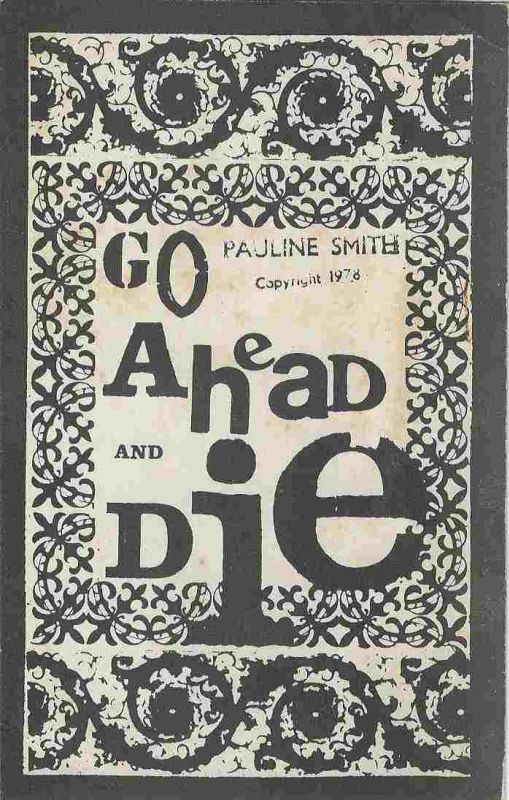
Go Ahead and Die é um cartão de arte postal de Pauline Smith, artista britânica ligada à Mail Art, poesia visual, arte conceitual, colagem e publicações experimentais, realizado em 1978.
Pauline Smith - Pauline Elizabeth Smith . Reino Unido
Categoria: Mail Art
Acervo: 03752
Data: 1978
Dimensões: 14 x 8,8 cm
Go Ahead and Die é um cartão de arte postal de Pauline Smith, artista britânica ligada à Mail Art, poesia visual, arte conceitual, colagem e publicações experimentais, realizado em 1978. A obra é confirmada documentalmente pelo Network Atlas de Géza Perneczky como Go Ahead and Die, postcard action, 1978, situando o trabalho de maneira inequívoca dentro das ações postais desenvolvidas por Smith no final da década de 1970.O cartão apresenta composição gráfica em preto, branco e tons do suporte, estruturada por uma moldura ornamental extremamente carregada. A região superior contém formas circulares semelhantes a olhos inseridas em padrões decorativos repetitivos. No campo central, diferentes caracteres tipográficos foram combinados para formar a frase Go Ahead and Die. Acima da composição textual aparece o nome Pauline Smith e a inscrição Copyright 1978. O desenho das letras varia deliberadamente em escala, espessura, família tipográfica e posição, aproximando a obra da poesia visual, da colagem tipográfica e da tradição gráfica de publicações alternativas.A frase Go Ahead and Die pode ser traduzida aproximadamente como Vá em frente e morra, mas o título original deve ser preservado na catalogação. Seu caráter direto, agressivo e desconfortável está relacionado a uma fase da produção de Pauline Smith em que morte, corpo, luto, absurdo e comportamento social se tornaram temas recorrentes. No mesmo período a artista produziu trabalhos como Corpse Club Members Only, Mourn e Announcing a Day of Mourning, todos documentados em 1978 pela University of Iowa.Go Ahead and Die não deve ser interpretado isoladamente como uma declaração literal dirigida ao destinatário. Dentro da prática de Smith, frases provocativas funcionavam como dispositivos conceituais capazes de interromper a normalidade da comunicação cotidiana. O cartão postal, normalmente associado a saudação, viagem, lembrança ou mensagem amistosa, recebe uma formulação sobre a morte. Essa inversão transforma uma forma banal de comunicação em experiência de estranhamento e confronta o receptor com a própria linguagem utilizada pelo sistema postal.A composição visual reforça essa operação. O excesso ornamental aproxima o cartão de certificados, convites, impressos comemorativos e elementos decorativos de publicações populares. Em contraste, o núcleo verbal é reduzido a uma ordem curta e perturbadora. A oposição entre decoração e conteúdo cria humor negro e ironia, procedimentos recorrentes na produção postal de Pauline Smith.A frase está organizada como imagem. Go ocupa a região superior esquerda. Ahead é fragmentado visualmente por variações tipográficas, enquanto and aparece em escala menor. Die domina a área inferior por meio de grandes caracteres. A palavra final adquire peso visual superior às demais e funciona como conclusão gráfica e semântica. Dessa maneira, a leitura não ocorre apenas linguisticamente. Tamanho, posição e desenho das letras determinam ritmo, intensidade e hierarquia, aproximando a obra de procedimentos da poesia visual.A ornamentação também funciona como dispositivo de enquadramento. Os padrões repetidos delimitam rigidamente a área da mensagem, criando um campo semelhante a uma página impressa ou certificado. O resultado combina aparência decorativa com comunicação hostil, produzindo deliberadamente uma incompatibilidade entre forma e conteúdo.A obra pertence ao período mais intenso da atividade de Pauline Smith na Mail Art. A Tate registra que, depois de entrar nas redes internacionais por intermédio de Opal L Nations, Global Infantilism e contatos associados a Genesis P Orridge, Smith organizou sua própria lista de correspondentes e passou a distribuir regularmente pequenas edições postais. Entre suas séries estão Lost Marbles Dump, A Present from Belfast, Adolf Hitler Fan Club e posteriormente Corpse Club. A Tate informa que sua atividade postal intensa terminou em 1978 por razões de saúde.A trajetória imediatamente anterior ajuda a contextualizar Go Ahead and Die. Em 1974 Pauline Smith havia criado Adolf Hitler Fan Club, ação irônica e dadaísta de Mail Art que utilizava carimbos e materiais encontrados para questionar política, autoridade e liberdade de expressão. Posteriormente desenvolveu Corpse Club e Body Sculpture, documentados como ação postal em janeiro de 1977. O Network Atlas registra Go Ahead and Die logo depois desses projetos em sua cronologia da artista.Essa sequência demonstra uma mudança progressiva do uso de organizações fictícias e símbolos políticos para uma investigação ainda mais direta da morte e do corpo. Corpse Club, Mourn, Announcing a Day of Mourning e Go Ahead and Die compartilham um vocabulário relacionado à mortalidade, mas empregam esse tema como instrumento de crítica da comunicação e das convenções sociais.O contexto de 1978 também é relevante internacionalmente. Nesse ano Smith participou de diferentes redes e projetos de Mail Art. A documentação da University of Iowa conserva cartões postais seus intitulados Cape of No Hope, 2 Varieties, Pyramids Hid from View by This Postcard, To Left of This Postcard e Canadian Pyramid, executados com tipos impressos, carimbos e fotomontagem. O conjunto demonstra que o cartão postal constituía para Smith uma linguagem artística autônoma, e não apenas um meio para transportar outra obra.A produção de Pauline Smith chegou também ao Brasil. O Museu de Arte Contemporânea da Universidade de São Paulo preserva Members only e Corpse club, de 1977, duas obras em offset sobre papel doadas pela própria artista. Essa presença institucional comprova a circulação brasileira de sua produção e reforça sua importância para estudos das relações entre a Mail Art europeia e as redes latino americanas de poesia visual e arte experimental.Go Ahead and Die deve portanto ser catalogado como cartão de Mail Art, ação postal, poesia visual, publicação ou edição de artista e arte conceitual. A técnica exata deste exemplar não pode ser determinada com segurança apenas pela imagem. Visualmente há forte indicação de reprodução gráfica de uma composição tipográfica e ornamental, mas qualquer identificação como offset, xerografia ou outra técnica deve depender do exame físico ou de documentação específica.Não foi localizada evidência de que Go Ahead and Die tenha relação direta com o movimento brasileiro Poema Processo. Sua importância para esse campo é contextual. Pauline Smith circulava nas mesmas redes internacionais de arte postal e poesia visual que incluíam artistas latino americanos e brasileiros, e obras suas chegaram a uma coleção pública brasileira. O cartão constitui assim documento relevante para compreender a internacionalização das práticas que transformaram linguagem, reprodução gráfica, correspondência e circulação em matéria artística durante os anos 1970.TEXT FOR THE SALSA PROGRAM IN ENGLISHGo Ahead and Die is a Mail Art postcard by Pauline Smith, a British artist associated with correspondence art, visual poetry, Conceptual Art, collage and experimental publishing, produced in 1978. The work is independently documented in Géza Perneczky's Network Atlas as Go Ahead and Die, postcard action, 1978, firmly establishing the object within Smith's postal actions of the late 1970s.The postcard presents a graphic composition in black, white and the natural tones of its support, enclosed within an elaborate ornamental border. The upper section contains circular forms resembling eyes embedded in densely repeated decorative patterns. In the central area, characters from different typographic styles are combined to form the words Go Ahead and Die. Above the text appear the artist's name Pauline Smith and the inscription Copyright 1978. The letters vary deliberately in scale, weight, typographic family and position, connecting the work with visual poetry, typographic collage and the graphic language of alternative publications.The phrase Go Ahead and Die is deliberately direct, aggressive and unsettling. The original English title should be preserved in the catalogue. Its language belongs to a period in Smith's work when death, the body, mourning, absurdity and social convention became recurrent subjects. During the same period she produced works including Corpse Club Members Only, Mourn and Announcing a Day of Mourning, all documented by the University of Iowa in 1978.Go Ahead and Die should not be interpreted as a literal instruction addressed to the recipient. Within Smith's artistic practice, provocative phrases operated as conceptual devices capable of interrupting ordinary communication. A postcard, normally associated with greetings, travel, memory or friendly exchange, is instead made to carry a statement concerning death. The reversal transforms an everyday medium into an experience of estrangement and forces the recipient to reconsider the conventions of postal communication.The visual composition reinforces this operation. The dense ornament recalls certificates, invitations, commemorative prints and decorative popular publications. Against this ornamental structure, the verbal message is reduced to a short and disturbing imperative. The contrast between decorative form and threatening language generates black humor and irony, both recurrent strategies in Smith's correspondence art.The phrase itself is organized as an image. Go occupies the upper left. Ahead is visually fragmented through variations in typography. And appears at a smaller scale. Die dominates the lower portion through very large letterforms. The final word therefore receives greater visual weight and functions simultaneously as semantic conclusion and graphic climax. Reading is not exclusively linguistic. Scale, placement and typographic form determine rhythm, emphasis and hierarchy, linking the work directly to visual poetry.The ornamental border creates a rigid field around the message and makes the object resemble a printed page, certificate or decorative announcement. This visual excess deliberately conflicts with the severity of the text and intensifies the work's conceptual tension.The postcard belongs to the most intensive period of Pauline Smith's involvement in Mail Art. Tate records that after entering international correspondence networks through Opal L Nations, Global Infantilism and contacts associated with Genesis P Orridge, Smith created her own mailing list and began circulating small postal editions on a regular basis. These included Lost Marbles Dump, A Present from Belfast, Adolf Hitler Fan Club and later Corpse Club. Tate states that her intensive Mail Art activity ceased in 1978 because of health problems.The preceding projects provide essential context for Go Ahead and Die. In 1974 Smith had created Adolf Hitler Fan Club, an ironic and Dadaistic Mail Art action using rubber stamps and found material to test political authority, institutional response and freedom of expression. She later developed Corpse Club and Body Sculpture, documented as a postal action in January 1977. Network Atlas places Go Ahead and Die immediately within this sequence of works.This chronology indicates a continuing investigation into death and the body. Corpse Club, Mourn, Announcing a Day of Mourning and Go Ahead and Die share a vocabulary of mortality, but Smith used that vocabulary as a way of questioning communication, bureaucracy and social convention rather than simply representing death as a subject.The broader context of 1978 is also significant. Smith participated in international Mail Art networks and produced several postcard works. The University of Iowa documents Cape of No Hope, 2 Varieties, Pyramids Hid from View by This Postcard, To Left of This Postcard and Canadian Pyramid, executed through press type, rubber stamp impressions and photomontage. These works demonstrate that the postcard itself functioned as an autonomous artistic form in Smith's practice rather than merely as a carrier for another artwork.Pauline Smith's work also circulated in Brazil. Museu de Arte Contemporânea da Universidade de São Paulo preserves Members only and Corpse club from 1977, two offset works on paper donated by the artist. Their presence in a major Brazilian public collection provides material evidence of Smith's circulation within Latin American contexts and strengthens her relevance to studies of the international Mail Art and visual poetry networks of the period.Go Ahead and Die should therefore be catalogued as a Mail Art postcard, postal action, visual poetry, artists publication or postal edition and Conceptual Art. The exact printing technique of the present copy cannot be securely established from the image alone. It visually appears to be a reproduced graphic composition using typography and ornament, but attribution to offset, photocopy or another process should await examination of the physical object or specific documentary evidence.No evidence was located establishing a direct relationship between Go Ahead and Die and the Brazilian Process Poem Movement. Its significance for that field is contextual. Pauline Smith circulated within international Mail Art and visual poetry networks shared with Latin American and Brazilian artists, and examples of her work entered a Brazilian public collection. The postcard is therefore relevant to understanding the international expansion of practices in which language, graphic reproduction, correspondence and circulation became artistic material during the 1970s.
Cartão de arte postal de Pauline Smith intitulado Go Ahead and Die, datado de 1978. A identificação da obra é confirmada pelo Network Atlas de Géza Perneczky, que registra Go Ahead and Die como postcard action realizada por Pauline Smith em 1978.O cartão apresenta composição tipográfica e ornamental em preto e branco. Uma moldura extremamente elaborada ocupa as margens e inclui formas circulares semelhantes a olhos nas regiões superior e inferior. No interior dessa estrutura aparece a frase Go Ahead and Die, construída com letras de diferentes famílias, tamanhos, espessuras e posições. Próximo à parte superior estão impressos Pauline Smith e Copyright 1978.O título constitui parte essencial da obra e não deve ser traduzido no campo de título do cadastro. A frase curta funciona simultaneamente como texto, imagem e provocação. A palavra Die recebe destaque visual por ocupar a maior área da composição, enquanto Go, Ahead e and são organizadas em diferentes escalas. Essa hierarquia aproxima o trabalho da poesia visual e da colagem tipográfica.A aparência ornamental contrasta deliberadamente com a frase relacionada à morte. A moldura poderia pertencer a um certificado, anúncio, convite ou impresso decorativo, mas Smith introduz no centro uma mensagem abrupta e perturbadora. Essa oposição produz ironia e humor negro e transforma um formato gráfico familiar em mecanismo de estranhamento.A obra está relacionada a um conjunto maior de trabalhos de Pauline Smith sobre morte, corpo e luto. A University of Iowa documenta Corpse Club Members Only, Mourn e Announcing a Day of Mourning em 1978, além de seis cartões postais da artista produzidos com tipos de impressão, carimbos e fotomontagem.A relação com Corpse Club é particularmente relevante. Géza Perneczky registra Corpse Club e Body Sculpture como ação postal de janeiro de 1977 e Go Ahead and Die como ação em cartão postal de 1978. A proximidade cronológica e temática permite situar a obra com segurança na fase em que Smith utilizava referências à mortalidade como parte de sua investigação da comunicação postal e das convenções sociais.O trabalho pertence ao período final da fase mais intensa da artista na Mail Art. A Tate registra que Smith distribuía regularmente pequenas edições postais e que suas atividades de Mail Art cessaram em 1978 devido a problemas de saúde. Isso torna a data do cartão particularmente significativa dentro de sua trajetória.A técnica exata do exemplar apresentado não deve ser afirmada sem exame físico. A composição aparenta ser reprodução de trabalho tipográfico e gráfico, mas a fotografia não permite distinguir com segurança entre offset, fotocópia, impressão por duplicador ou outro processo. Deve ser registrada provisoriamente como técnica de reprodução gráfica não identificada, cartão sobre papel, até análise material.Para indexação, recomenda se relacionar o objeto a Pauline Smith, Go Ahead and Die, 1978, Mail Art, arte postal, postcard action, cartão postal, poesia visual, arte conceitual, colagem tipográfica, tipografia experimental, morte, Corpse Club, Body Sculpture, humor negro, correspondência artística, Reino Unido, Londres e redes internacionais de arte postal.OBSERVATION TEXT IN ENGLISHMail Art postcard by Pauline Smith titled Go Ahead and Die, dated 1978. The identification of the work is independently confirmed by Géza Perneczky's Network Atlas, which records Go Ahead and Die as a postcard action produced by Pauline Smith in 1978.The card presents a black and white typographic and ornamental composition. A highly elaborate decorative border surrounds the image and incorporates circular forms resembling eyes in its upper and lower sections. Within this framework the phrase Go Ahead and Die is constructed from letters of different typefaces, sizes, weights and positions. Pauline Smith and Copyright 1978 appear near the upper portion of the composition.The title is an essential part of the artwork and should remain in English in the principal title field. The brief phrase functions simultaneously as language, image and provocation. Die receives the strongest visual emphasis by occupying the largest area of the composition, while Go, Ahead and and are arranged at different scales. This typographic hierarchy links the work to visual poetry and typographic collage.The ornamental appearance deliberately conflicts with the language of death. The border could belong to a certificate, advertisement, invitation or decorative publication, yet Smith places an abrupt and disturbing message at its center. This opposition produces irony and black humor and transforms a familiar graphic format into a mechanism of estrangement.The work belongs to a larger group of Pauline Smith projects addressing death, the body and mourning. The University of Iowa documents Corpse Club Members Only, Mourn and Announcing a Day of Mourning from 1978, as well as six postcards by Smith produced using press type, rubber stamp impressions and photomontage.Its relationship to Corpse Club is particularly relevant. Géza Perneczky records Corpse Club and Body Sculpture as a postal action from January 1977 and Go Ahead and Die as a postcard action from 1978. Their chronological and thematic proximity securely places the work within Smith's period of using mortality as part of her investigation of postal communication and social conventions.The postcard belongs to the final phase of Smith's most intensive Mail Art activity. Tate records that she regularly distributed small postal editions and that her Mail Art activity ceased in 1978 because of health problems. The date therefore has particular significance within her career.The exact production technique of the present copy should not be assigned without physical examination. The image appears to reproduce a typographic and graphic composition, but the photograph does not allow a secure distinction among offset printing, photocopying, duplicator printing or another process. It should provisionally be recorded as unidentified graphic reproduction technique on paper until material examination is possible.For digital and museum indexing, the object should be associated with Pauline Smith, Go Ahead and Die, 1978, Mail Art, correspondence art, postcard action, postcard, visual poetry, Conceptual Art, typographic collage, experimental typography, death, Corpse Club, Body Sculpture, black humor, artistic correspondence, United Kingdom, London and international Mail Art networks.
Proveniência
Coleção Poema ProcessoInglês
Go Ahead and Die is a Mail Art postcard by Pauline Smith, a British artist associated with correspondence art, visual poetry, Conceptual Art, collage and experimental publishing, produced in 1978.
Dimensions: 5,5 x 3,5 in