
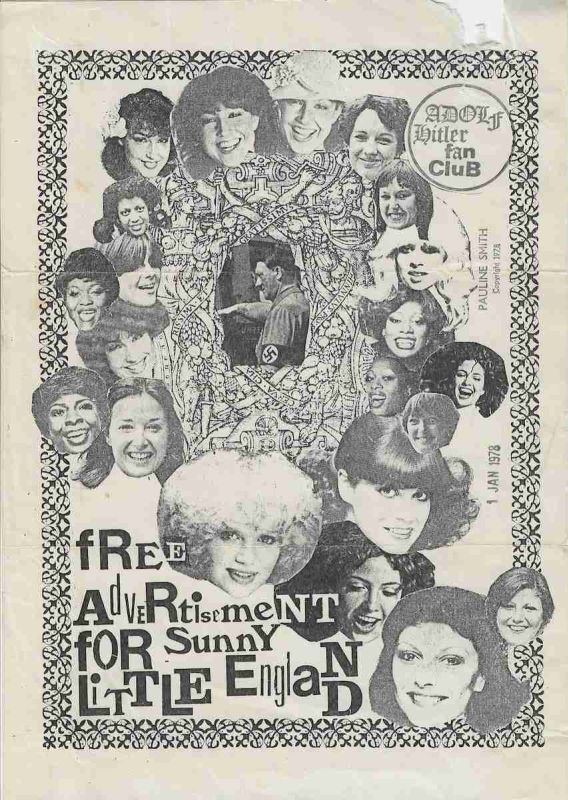
Obra de Mail Art e colagem de Pauline Smith, artista britânica ligada à arte postal, poesia visual, arte conceitual e práticas de correspondência, datada de 1 de janeiro de 1978.
Pauline Smith - Pauline Elizabeth Smith . Reino Unido
Categoria: Mail Art
Acervo: 03751
Data: 1 de Janeiro de 1978
Dimensões: 29,8 x 21 cm
Obra de Mail Art e colagem de Pauline Smith, artista britânica ligada à arte postal, poesia visual, arte conceitual e práticas de correspondência, datada de 1 de janeiro de 1978. A composição apresenta uma montagem fotográfica em preto e branco estruturada por uma moldura ornamental, com numerosas imagens recortadas de mulheres, em grande parte retratos associados à cultura popular e à representação pública da feminilidade. No centro da composição aparece uma figura masculina integrada a um brasão ou estrutura heráldica, acompanhada por uma pequena suástica impressa, enquanto no canto superior direito está aplicado o emblema textual Adolf Hitler Fan Club. A obra também traz verticalmente a identificação Pauline Smith, England, além da data 1 Jan 1978. Na região inferior, letras de diferentes tipos e tamanhos formam a frase Free Advertisement for Sunny Little England.A obra deve ser compreendida dentro da produção crítica e satírica desenvolvida por Pauline Smith nas redes internacionais de Mail Art durante a década de 1970. Smith iniciou em 1974 o projeto Adolf Hitler Fan Club como uma identidade artística provocativa destinada a criticar a política britânica, a autoridade institucional, as transformações urbanas de Chelsea e os limites efetivos da liberdade de expressão. Fontes históricas sobre Mail Art descrevem esse projeto como uma ação irônica e dadaísta, e não como manifestação de apoio político ao nazismo. A própria trajetória do projeto levou a investigações policiais e à interrupção de algumas de suas ações postais.A presença do emblema Adolf Hitler Fan Club nesta composição de 1978 indica a continuidade visual de uma identidade criada por Smith alguns anos antes, mesmo após o período de maior conflito com as autoridades britânicas. O uso de uma estrutura gráfica semelhante a um selo institucional ou marca de associação transforma a própria linguagem burocrática em instrumento de ironia. Na prática de Smith, carimbos, cartões, impressos e nomes de organizações fictícias funcionavam como dispositivos para produzir dúvida, desconforto e crítica política dentro do sistema de comunicação postal. Géza Perneczky registra o Adolf Hitler Fan Club como ação postal irônica e dadaísta iniciada por Smith e documenta também seu endereço londrino no circuito internacional de Mail Art.O título incorporado à obra, Free Advertisement for Sunny Little England, possui importância particular. A University of Iowa documenta uma obra de Pauline Smith com esse título, classificada como colagem e datada de 1976. O exemplar apresentado, entretanto, traz claramente a data 1 Jan 1978 impressa na própria composição. Isso sugere que Smith reutilizou, reeditou ou fez circular novamente uma estrutura criada anteriormente, prática compatível com a lógica de suas pequenas edições postais. Para fins de catalogação do exemplar deve ser preservada a data material visível de 1 de janeiro de 1978, acrescentando se que fontes arquivísticas registram uma versão ou ocorrência de Free Advertisement for Sunny Little England já em 1976.A frase Free Advertisement for Sunny Little England produz um contraste deliberado com a montagem visual. A expressão Sunny Little England evoca uma imagem idealizada, turística, doméstica e aparentemente harmoniosa da Inglaterra, enquanto a obra justapõe símbolos de propaganda, retratos femininos, cultura de massas e uma referência provocativa ao autoritarismo. Essa colisão entre linguagem publicitária e conteúdo politicamente perturbador corresponde ao método satírico de Smith, que frequentemente utilizava formas aparentemente banais ou populares para questionar a realidade política e social britânica.A abundância de rostos femininos acrescenta outra camada à composição. O conjunto lembra visualmente páginas de revistas populares, anúncios de moda, fotografias de celebridades e imagens publicitárias. Essas figuras envolvem uma estrutura central masculina e institucionalizada, criando uma tensão entre cultura de consumo, espetáculo, representação feminina, poder e propaganda. A obra não fornece identificação individual das mulheres representadas, portanto não é seguro atribuir nomes específicos a essas figuras apenas pela imagem.A moldura ornamental reforça a aparência de anúncio, certificado, souvenir ou impresso comemorativo. Essa escolha contradiz deliberadamente o conteúdo político da montagem. Smith trabalhava frequentemente por apropriação de materiais encontrados, e fontes sobre sua obra registram que materiais preexistentes eram elementos importantes em suas pequenas edições postais. Aqui, recortes fotográficos, tipografia irregular, brasão, ornamentação e símbolo político são reorganizados para produzir uma imagem que oscila entre publicidade, documento institucional, sátira e colagem dadaísta.Free Advertisement for Sunny Little England está relacionada ao mesmo ambiente conceitual de obras de Smith como Lost Marbles Dump, A Present from Belfast, Adolf Hitler Fan Club, Corpse Club, Body Sculpture, Mourn e Announcing a Day of Mourning. A Tate registra que Smith distribuiu durante a década de 1970 séries próprias de pequenas edições postais e que sua produção utilizava acontecimentos políticos e sociais como matéria artística.O exemplar apresentado possui valor documental também por sua data. Em 1978 Pauline Smith estava inserida em uma rede internacional de Mail Art que incluía Niels Lomholt, Clemente Padín, Jorge Caraballo, Paulo Bruscky, Klaus Groh, Robert Rehfeldt, Anna Banana, Bill Gaglione e numerosos outros artistas. Nesse mesmo ano Smith participou de projetos colaborativos, ações postais de solidariedade política e exposições internacionais de arte postal. Portanto, esta obra deve ser entendida não apenas como colagem isolada, mas como parte de uma prática de circulação e comunicação internacional.Para indexação museológica e digital, a obra deve ser associada a Pauline Smith, Mail Art, arte postal, poesia visual, arte conceitual, colagem, publicação de artista, edição postal, Neo Dada, crítica política, cultura de massas, propaganda, Reino Unido, Londres, Adolf Hitler Fan Club, Free Advertisement for Sunny Little England, 1978 e redes internacionais de arte experimental. Não há evidência de que a obra pertença ao movimento Poema Processo. Sua relevância para esse contexto decorre das redes internacionais de arte postal e poesia visual que também incluíram artistas brasileiros ligados ao Poema Processo e à experimentação visual.TEXT FOR THE SALSA PROGRAM IN ENGLISHMail Art and collage work by Pauline Smith, a British artist associated with correspondence art, visual poetry, Conceptual Art and experimental postal practices, dated 1 January 1978. The composition is constructed as a black and white photographic montage enclosed within an ornamental border and includes numerous cut out images of women, many of them recalling portraits drawn from popular culture and public representations of femininity. At the center is a male figure incorporated into a heraldic or emblematic structure accompanied by a small printed swastika, while the upper right contains the textual emblem Adolf Hitler Fan Club. The work also bears the vertical identification Pauline Smith, England, together with the date 1 Jan 1978. At the bottom, letters in different typefaces and sizes form the phrase Free Advertisement for Sunny Little England.The work belongs to the critical and satirical practice Pauline Smith developed through international Mail Art networks during the 1970s. In 1974 Smith initiated the Adolf Hitler Fan Club as a deliberately provocative artistic identity intended to criticize British politics, institutional authority, urban transformation in Chelsea and the actual limits of freedom of expression. Historical studies of correspondence art describe this project as ironic and Dadaistic rather than as political support for Nazism. Its circulation eventually led to police investigation and restrictions on some of Smith's postal activities.The presence of the Adolf Hitler Fan Club emblem in this 1978 composition demonstrates the continuing visual use of an identity Smith had created several years earlier, even after the most intense period of conflict with British authorities. Its appearance as an institutional seal or association mark transforms bureaucratic visual language into an instrument of irony. In Smith's practice, rubber stamps, postcards, printed matter and fictitious organizational identities operated as devices for introducing uncertainty, discomfort and political critique into postal communication. Géza Perneczky records Adolf Hitler Fan Club as an ironic and Dadaistic mailing action and also documents Smith's London address within the international Mail Art network.The phrase incorporated into the work, Free Advertisement for Sunny Little England, is particularly significant. The University of Iowa documents a Pauline Smith work under this title, classified as collage and dated 1976. The copy presented here, however, clearly carries the date 1 Jan 1978 within the composition itself. This suggests that Smith reused, reissued or recirculated an earlier structure, a procedure consistent with her production of small postal editions. For cataloguing this particular object, the materially visible date of 1 January 1978 should therefore be retained, while noting that archival sources document a version or occurrence of Free Advertisement for Sunny Little England as early as 1976.The title creates a deliberate contrast with the visual montage. Sunny Little England evokes an idealized, touristic, domestic and apparently harmonious image of Britain, while the composition juxtaposes publicity imagery, female portraits, mass culture and a provocative reference to authoritarian power. This collision between advertising language and politically disturbing imagery corresponds to Smith's satirical method, which frequently used banal or familiar visual formats to question British political and social reality.The abundance of female faces introduces another layer of meaning. The montage visually recalls popular magazines, fashion advertisements, celebrity photography and commercial imagery. The women surround a centralized male and institutional image, generating tension among consumer culture, spectacle, representations of femininity, authority and propaganda. The work itself does not identify the individual women represented, and specific identities should therefore not be assigned solely from the image.The ornamental border contributes to the appearance of an advertisement, certificate, souvenir or commemorative print. This decorative presentation deliberately conflicts with the political content. Smith frequently worked through appropriation of found materials, and historical documentation of her postal editions emphasizes the importance of found imagery within her practice. Here photographic cuttings, irregular typography, heraldic imagery, ornament and political symbolism are reorganized into a composition situated between advertising, institutional document, satire and Dada collage.Free Advertisement for Sunny Little England belongs to the same conceptual environment as Smith's projects Lost Marbles Dump, A Present from Belfast, Adolf Hitler Fan Club, Corpse Club, Body Sculpture, Mourn and Announcing a Day of Mourning. Tate documents that Smith distributed her own series of small postal editions during the 1970s and consistently transformed contemporary political and social issues into artistic material.The date of the present object is also historically significant. In 1978 Pauline Smith was active within an international Mail Art network including Niels Lomholt, Clemente Padín, Jorge Caraballo, Paulo Bruscky, Klaus Groh, Robert Rehfeldt, Anna Banana, Bill Gaglione and many other artists. During the same year she participated in collaborative projects, political solidarity actions and international Mail Art exhibitions. This work should therefore be understood not simply as an isolated collage but as part of a larger practice based on circulation, correspondence and international communication.For museum and digital indexing, the work should be associated with Pauline Smith, Mail Art, correspondence art, visual poetry, Conceptual Art, collage, artists publication, postal edition, Neo Dada, political critique, mass culture, propaganda, United Kingdom, London, Adolf Hitler Fan Club, Free Advertisement for Sunny Little England, 1978 and international experimental art networks. There is no evidence that the work belongs to the Brazilian Process Poem Movement. Its relevance to that field derives from the international Mail Art and visual poetry networks that also included Brazilian artists associated with Process Poem and related experimental practices.
Obra original ou exemplar de edição postal de Pauline Smith com data impressa de 1 de janeiro de 1978. A composição utiliza colagem fotográfica em preto e branco, tipografia de diferentes origens e moldura ornamental. Na região superior direita aparece a identificação Adolf Hitler Fan Club, projeto artístico criado por Pauline Smith em 1974 e documentado historicamente como ação satírica e dadaísta de Mail Art destinada a provocar e testar os limites da autoridade institucional e da liberdade de expressão. A utilização dessa identificação nesta obra deve ser interpretada dentro desse contexto artístico e não como manifestação de apoio político ao nazismo.Na lateral direita aparecem o nome Pauline Smith, a indicação England e a data 1 Jan 1978. Na parte inferior lê se Free Advertisement for Sunny Little England, formada por letras de diferentes estilos e dimensões. A University of Iowa registra uma colagem de Pauline Smith intitulada Free advertisement for sunny little England com data de 1976. A diferença entre a data arquivística de 1976 e a data de 1978 visível neste exemplar deve ser preservada como informação catalográfica. É possível que se trate de reedição, nova circulação ou variante de composição anterior, mas a documentação atualmente consultada não permite determinar com segurança qual dessas hipóteses corresponde ao caso. A data material do exemplar permanece 1 de janeiro de 1978.A montagem contém numerosas fotografias recortadas de mulheres dispostas ao redor de uma figura masculina central inserida em estrutura decorativa semelhante a brasão. Uma pequena suástica aparece no centro inferior dessa estrutura. Como a obra não fornece nomes para os retratos femininos, não devem ser atribuídas identidades individuais sem documentação complementar. A justaposição de imagens femininas provenientes da cultura de massas com a referência ao Adolf Hitler Fan Club, a ornamentação gráfica e a frase sobre a Inglaterra cria uma composição satírica relacionada a publicidade, propaganda, poder, representação social e cultura popular.O trabalho apresenta características típicas da linguagem postal de Pauline Smith, como apropriação de imagens encontradas, colagem, tipografia fragmentada, aparência de publicação efêmera e uso de uma identidade fictícia com aspecto institucional. A Tate registra que Smith produziu pequenas edições postais durante os anos 1970 e que suas séries abordavam desenvolvimento urbano em Chelsea, conflito político na Irlanda do Norte e situação política britânica.A obra deve ser catalogada como Mail Art, colagem, publicação ou edição de artista e arte conceitual. A técnica exata de reprodução do exemplar não pode ser determinada apenas pela fotografia apresentada. A fonte da University of Iowa classifica a ocorrência de 1976 como collage, mas não há informação suficiente para afirmar se o exemplar de 1978 é colagem original, reprodução fotomecânica de uma colagem ou parte de uma pequena edição postal. Esse ponto deve permanecer aberto até exame físico do objeto.A data de 1978 situa o trabalho no período final da fase mais intensa de Pauline Smith na Mail Art. A Tate informa que suas atividades postais diminuíram nesse mesmo ano em razão de problemas de saúde. O documento possui relevância para a história internacional da arte postal por reunir em uma única composição os principais elementos da prática de Smith, apropriação, humor negro, crítica política, mídia impressa, cultura popular, provocação institucional e circulação alternativa.OBSERVATION TEXT IN ENGLISHOriginal work or copy from a postal edition by Pauline Smith bearing the printed date 1 January 1978. The composition uses black and white photographic collage, typography from different sources and an ornamental border. At the upper right appears the identification Adolf Hitler Fan Club, an artistic project created by Pauline Smith in 1974 and historically documented as a satirical and Dadaistic Mail Art action intended to provoke and test the limits of institutional authority and freedom of expression. Its appearance in this work should therefore be interpreted within that artistic context and not as an expression of political support for Nazism.Along the right side appear the name Pauline Smith, the identification England and the date 1 Jan 1978. At the bottom the words Free Advertisement for Sunny Little England are constructed from letters of different styles and sizes. The University of Iowa documents a Pauline Smith collage titled Free advertisement for sunny little England dated 1976. The discrepancy between the archival date of 1976 and the date of 1978 visible on the present object should be preserved in the catalogue record. It may represent a reissue, recirculation or variant of an earlier composition, but the currently available documentation does not establish which interpretation is correct. The physical date of this copy remains 1 January 1978.The montage contains numerous photographic cuttings of women arranged around a central male figure embedded within an ornamental heraldic structure. A small swastika appears within the lower central area of that structure. Because the work does not identify the women represented, individual identities should not be assigned without additional documentary evidence. The juxtaposition of mass media images of women with the Adolf Hitler Fan Club reference, ornamental graphic language and the phrase concerning England produces a satirical composition concerned with advertising, propaganda, authority, social representation and popular culture.The work displays characteristics typical of Pauline Smith's postal practice, including appropriation of found imagery, collage, fragmented typography, the appearance of ephemeral printed matter and the use of a fictitious institutional identity. Tate records that Smith produced small postal editions throughout the 1970s and that her series addressed property development in Chelsea, political conflict in Northern Ireland and contemporary British politics.The object should be catalogued as Mail Art, collage, artists publication or postal edition and Conceptual Art. The exact reproduction technique cannot be established from the photograph alone. The University of Iowa classifies the documented 1976 occurrence as collage, but there is insufficient evidence to determine whether the 1978 object is an original collage, a photomechanical reproduction of a collage or part of a small postal edition. This should remain an open cataloguing question until the physical object can be examined.The date 1978 places the work within the final period of Smith's most intensive involvement in Mail Art. Tate records that her postal activity diminished during that year because of health problems. The work is significant for the history of international correspondence art because it combines many of the defining elements of Smith's practice within a single composition, appropriation, black humor, political criticism, printed media, popular culture, institutional provocation and alternative circulation.
Proveniência
Coleção Poema ProcessoInglês
Mail Art and collage work by Pauline Smith, a British artist associated with correspondence art, visual poetry, Conceptual Art and experimental postal practices, dated 1 January 1978.
Dimensions: 11,7 x 8,3 in