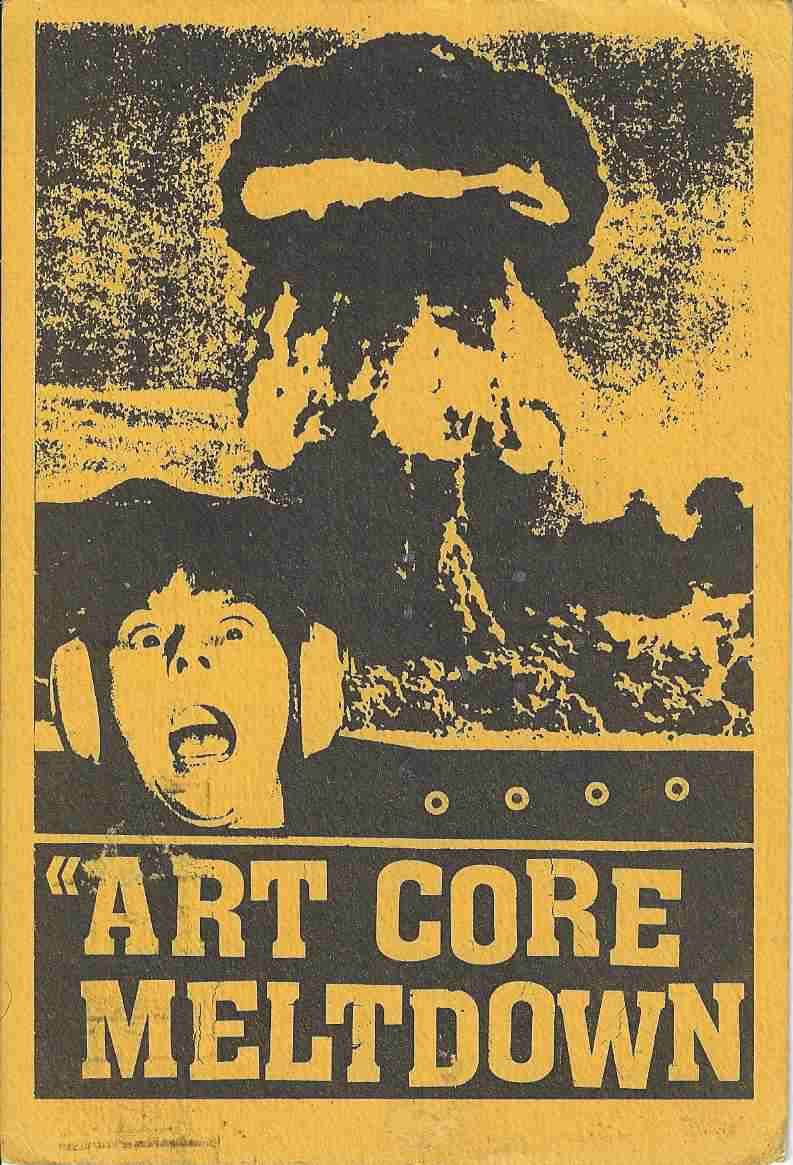
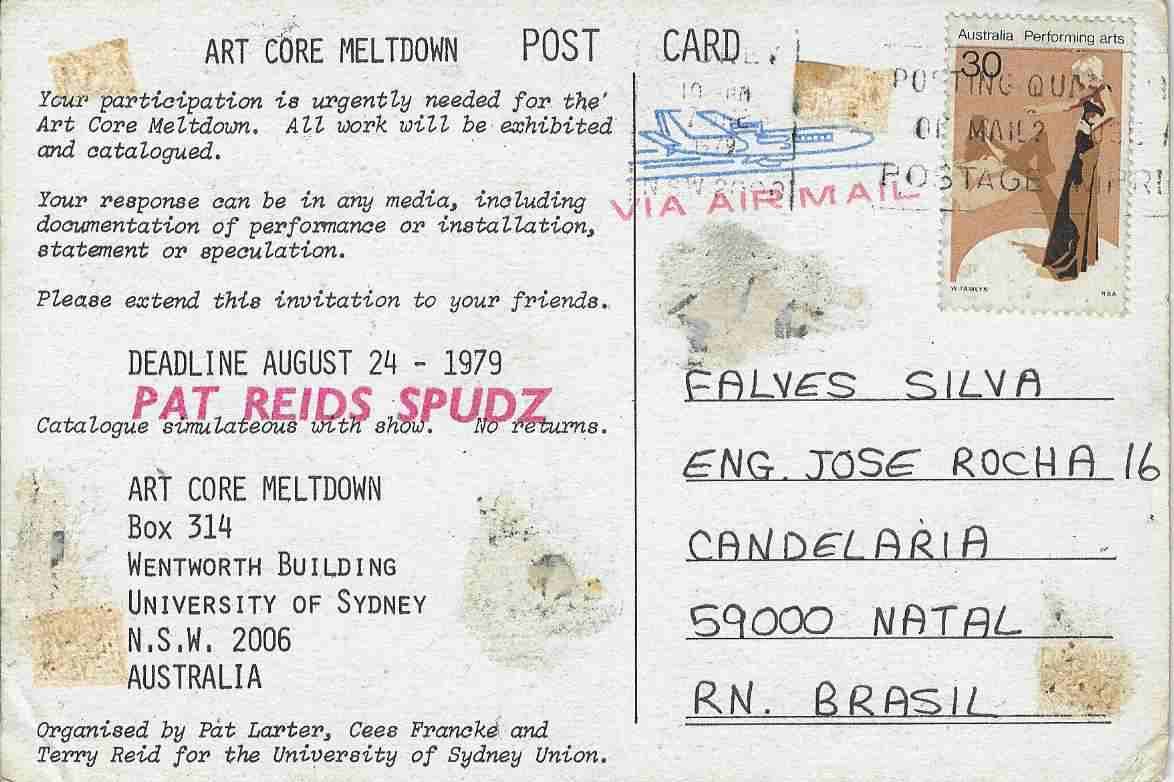
Cartão convite internacional da exposição Art Core Meltdown enviado da Austrália para o artista brasileiro Falves Silva, em Natal, Rio Grande do Norte, em 1979.
Art Core Meltdown Mail Art Exhibition - Terry REid , Pat Larter e Cees Spudz Francke - Sidney
Categoria: Exposição Coletiva Internacional Arte Correio e Mail Art
Acervo: 03744
Data: 1979
Dimensões: 10 x 14,8 cm
Cartão convite internacional da exposição Art Core Meltdown enviado da Austrália para o artista brasileiro Falves Silva, em Natal, Rio Grande do Norte, em 1979. O documento integra a rede internacional de Arte Postal e registra a participação de Falves Silva nos circuitos internacionais de Mail Art conectados à Austrália no final da década de 1970. O cartão convocava artistas a participar do projeto Art Core Meltdown, realizado pela University of Sydney Union, na Universidade de Sydney, Austrália. A organização impressa no documento é atribuída a Pat Larter, Cees Francke e Terry Reid, enquanto pesquisas históricas também registram a colaboração de Madalaine Spiller. A exposição ocorreu no Old Union Cellar da Universidade de Sydney entre 9 e 15 de setembro de 1979 e reuniu aproximadamente 160 participantes internacionais. O convite informava que todas as obras recebidas seriam expostas e catalogadas e aceitava respostas em qualquer meio, incluindo documentação de performances, instalações, declarações e especulações. O prazo indicado para envio era 24 de agosto de 1979. O material deveria ser encaminhado para Art Core Meltdown, Box 314, Wentworth Building, University of Sydney, New South Wales 2006, Austrália. O projeto previa catálogo simultâneo à exposição e não realizava devolução dos trabalhos recebidos. A chamada também solicitava aos participantes que estendessem o convite a outros artistas, característica fundamental das redes abertas e descentralizadas da Arte Postal internacional. A publicação norte americana Umbrella registrou na época a mesma convocatória, confirmando o prazo de 24 de agosto de 1979 e as condições de participação. A proposta de Art Core Meltdown possuía forte conteúdo político e antinuclear. Segundo depoimentos históricos, o título foi sugerido por Richard Larter e o projeto surgiu como resposta ao temor internacional provocado pelo acidente nuclear de Three Mile Island, ocorrido nos Estados Unidos em março de 1979. Terry Reid posteriormente descreveu a exposição como uma manifestação dirigida contra a possibilidade de aniquilação nuclear, combinando Arte Postal, performances e diferentes meios artísticos. A imagem frontal do cartão apresenta uma composição gráfica de forte impacto, associando uma figura humana em expressão de choque ou grito a uma grande explosão nuclear em forma de cogumelo, seguida do título Art Core Meltdown em tipografia monumental. Pesquisas posteriores identificam esta imagem como baseada em um cartaz de Richard Larter com a imagem de Pat Larter, enquanto uma versão gráfica relacionada ao projeto é atribuída a Cees Francke, também conhecido como Spudz. O exemplar destinado a Falves Silva constitui importante evidência documental da inserção do artista potiguar na rede transnacional de Arte Postal durante os anos 1970, conectando Natal e o movimento experimental brasileiro a artistas, organizadores e instituições da Austrália. Falves Silva aparece ainda em documentação internacional da Mail Art de 1979 ao lado de artistas brasileiros e estrangeiros atuantes na mesma rede, reforçando sua presença no circuito internacional de correspondência artística.ENGLISHText for the Salsa programInternational invitation postcard for the Art Core Meltdown exhibition sent from Australia to Brazilian artist Falves Silva in Natal, Rio Grande do Norte, in 1979. The document belongs to the international Mail Art network and records Falves Silva within the transnational circuits of correspondence art connected with Australia during the late 1970s. The postcard invited artists to participate in Art Core Meltdown, a project presented by the University of Sydney Union at the University of Sydney in Australia. The printed document identifies Pat Larter, Cees Francke and Terry Reid as organizers, while historical sources also record the collaboration of Madalaine Spiller. The exhibition was held at the Old Union Cellar at the University of Sydney from 9 to 15 September 1979 and brought together approximately 160 international participants. The invitation stated that every work received would be exhibited and catalogued and that responses could employ any medium, including documentation of performances, installations, statements and speculation. The submission deadline was 24 August 1979. Material was to be sent to Art Core Meltdown, Box 314, Wentworth Building, University of Sydney, New South Wales 2006, Australia. A catalogue was planned to appear simultaneously with the exhibition and submitted material would not be returned. Participants were also encouraged to extend the invitation to their friends, reflecting the open and decentralized structure characteristic of international Mail Art networks. The American publication Umbrella published the same call in 1979, confirming the 24 August deadline and the conditions of participation. Art Core Meltdown had a strong political and antinuclear orientation. Historical accounts indicate that Richard Larter suggested the title and that the project developed in response to international anxiety following the Three Mile Island nuclear accident in the United States in March 1979. Terry Reid later described the exhibition as a response to the possibility of nuclear annihilation, combining Mail Art with performance and other artistic media. The front of the postcard presents a forceful graphic composition combining a human figure with an expression of shock or screaming with a large mushroom shaped nuclear explosion and the monumental title Art Core Meltdown. Later research identifies the underlying poster image as a design by Richard Larter using an image of Pat Larter, while a related graphic version is attributed to Cees Francke, also known as Spudz. The example addressed to Falves Silva is significant documentary evidence of the Brazilian artist's integration into the international Mail Art network during the 1970s, connecting Natal and Brazilian experimental art with artists, organizers and institutions in Australia. Falves Silva also appears in international Mail Art documentation from 1979 alongside Brazilian and foreign artists active in the same network, reinforcing evidence of his participation in international correspondence art circuits.
Documento original de Arte Postal internacional enviado a Falves Silva em seu endereço na Rua Engenheiro José Rocha 16, Candelária, Natal, Rio Grande do Norte, Brasil. O verso apresenta selo australiano de 30 cents da série Performing Arts, marcas postais e indicação de envio por via aérea. Deve ser feita uma distinção importante na catalogação: 24 de agosto de 1979 é o prazo final de participação impresso no convite e não pode ser considerado automaticamente como a data de postagem deste exemplar. A documentação histórica confirma que Art Core Meltdown foi uma importante exposição internacional de Arte Postal realizada na Universidade de Sydney em setembro de 1979, articulada principalmente por Pat Larter, Cees Francke e Terry Reid, com participação também atribuída a Madalaine Spiller. Pat Larter teve atuação destacada na rede internacional de Mail Art australiana e foi a principal responsável por numerosas iniciativas de correspondência artística associadas ao nome Pat e Dick Larter. O projeto Art Core Meltdown ultrapassou o formato de uma exposição convencional, incorporando performances, filmes, leituras, objetos, colagens, cartazes e mensagens relacionadas à arte, à guerra nuclear e aos riscos da energia atômica. O fato de um convite nominal ter sido enviado diretamente da Universidade de Sydney para Falves Silva demonstra que seu endereço em Natal circulava nas redes internacionais de artistas postais em 1979. O documento deve ser relacionado para fins de indexação a Falves Silva, Pat Larter, Richard Larter, Cees Francke, Spudz, Terry Reid, Madalaine Spiller, Art Core Meltdown, University of Sydney Union, University of Sydney, Sydney, Austrália, Arte Postal, Mail Art, International Mail Art, arte experimental, performance, arte conceitual, arte antinuclear, Three Mile Island, redes de artistas, arte brasileira dos anos 1970, Poema Processo e arte experimental latino americana.Observation textOriginal international Mail Art document addressed to Falves Silva at Rua Engenheiro José Rocha 16, Candelária, Natal, Rio Grande do Norte, Brazil. The reverse carries an Australian 30 cent Performing Arts postage stamp, postal markings and an airmail indication. An important cataloguing distinction should be maintained: 24 August 1979 is the submission deadline printed on the invitation and should not automatically be recorded as the mailing date of this particular postcard. Historical documentation confirms Art Core Meltdown as a major international Mail Art exhibition held at the University of Sydney in September 1979 and principally organized by Pat Larter, Cees Francke and Terry Reid, with Madalaine Spiller also documented as a collaborator. Pat Larter was an important figure in the Australian international Mail Art network and was the principal force behind numerous correspondence art activities associated with the name Pat and Dick Larter. Art Core Meltdown extended beyond the conventional exhibition format by incorporating performances, films, readings, objects, collages, posters and messages concerned with art, nuclear war and the risks associated with atomic energy. The direct circulation of this invitation from the University of Sydney to Falves Silva demonstrates that his address in Natal was already circulating within international Mail Art networks in 1979. For digital indexing the document should be associated with Falves Silva, Pat Larter, Richard Larter, Cees Francke, Spudz, Terry Reid, Madalaine Spiller, Art Core Meltdown, University of Sydney Union, University of Sydney, Sydney, Australia, Mail Art, International Mail Art, correspondence art, experimental art, performance art, conceptual art, antinuclear art, Three Mile Island, artist networks, Brazilian art of the 1970s, Poema Processo and Latin American experimental art.
Proveniência
Coleção Falves SilvaInglês
International invitation postcard for the Art Core Meltdown exhibition sent from Australia to Brazilian artist Falves Silva in Natal, Rio Grande do Norte, in 1979.
Dimensions: 3,9 x 5,8 in