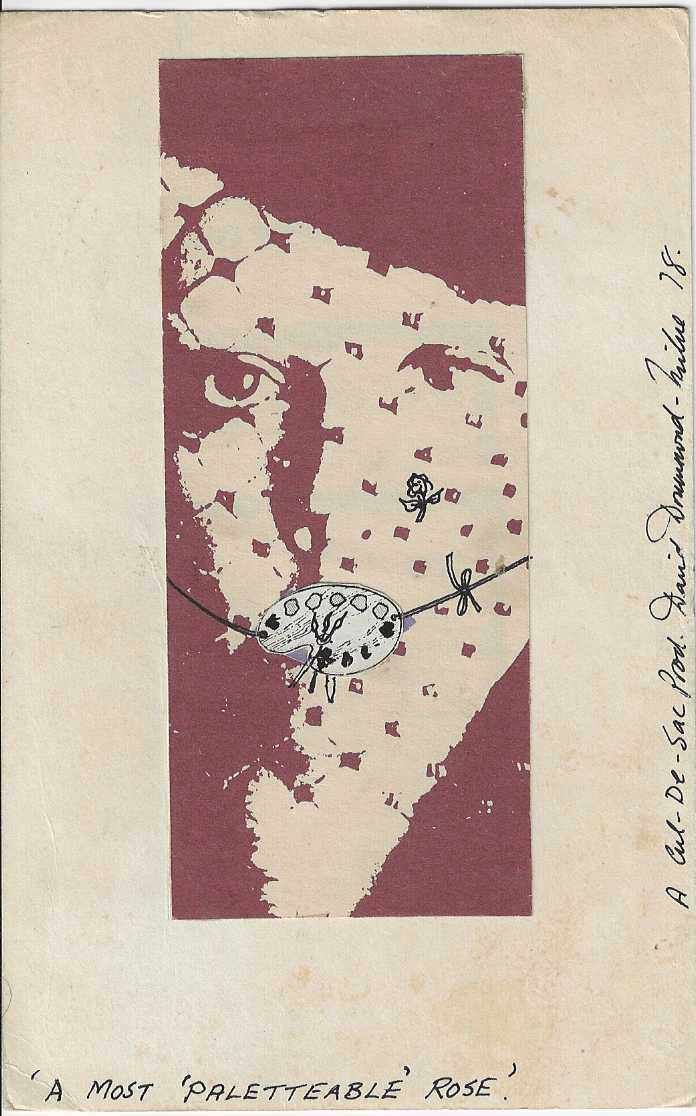
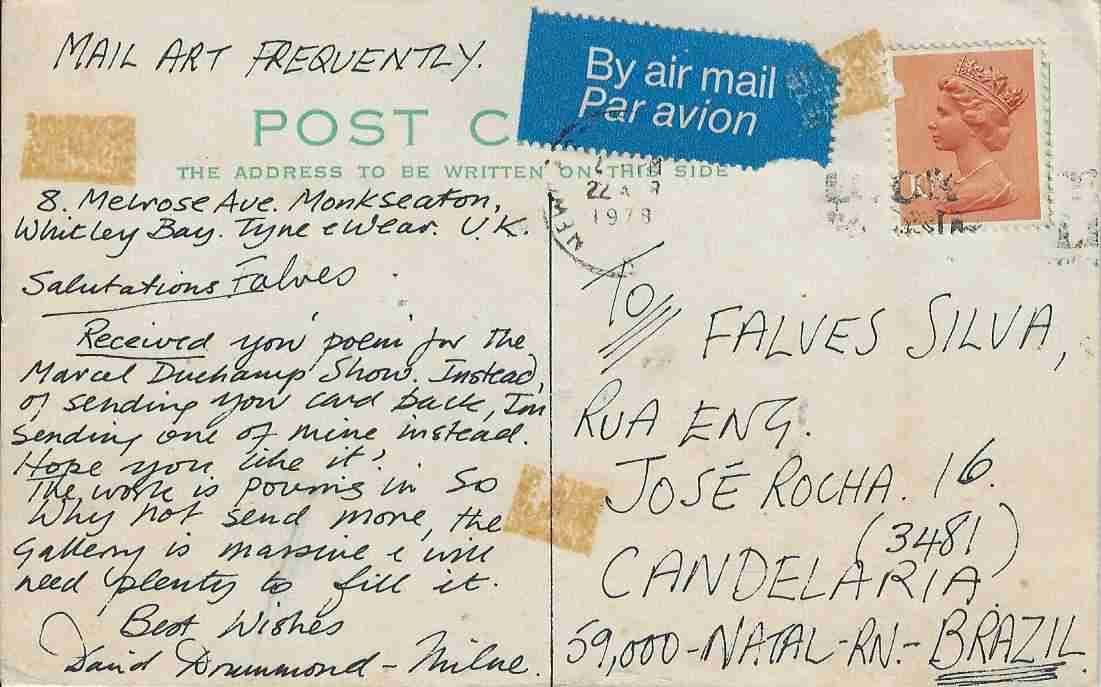
Cartão de arte postal enviado pelo artista britânico David Drummond Milne a Falves Silva em 22 de abril de 1978, a partir de Monkseaton, Whitley Bay, Tyne and Wear, Reino Unido.
David Drummond Milne - UK
Categoria: Mail Art
Acervo: 03741
Data: 22 de Abril de 1978
Dimensões: 13,9 x 8,7 cm
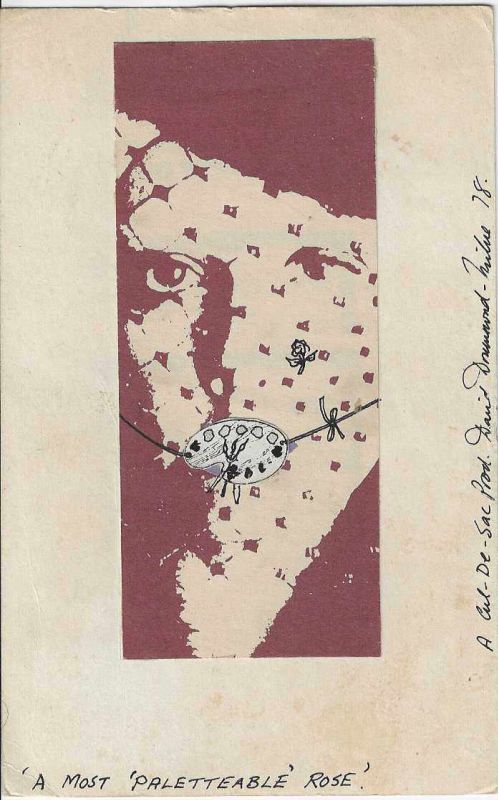
Cartão de arte postal enviado pelo artista britânico David Drummond Milne a Falves Silva em 22 de abril de 1978, a partir de Monkseaton, Whitley Bay, Tyne and Wear, Reino Unido. A correspondência documenta a participação dos dois artistas na rede internacional de mail art e registra o recebimento de uma obra de Falves Silva destinada a uma exposição em homenagem a Marcel Duchamp.Na mensagem manuscrita, David Drummond Milne informa que recebeu o poema enviado por Falves Silva para a Marcel Duchamp Show. Em vez de devolver o cartão brasileiro, o artista britânico decidiu enviar uma obra de sua própria autoria. Ele manifesta a esperança de que Falves Silva apreciasse o trabalho e acrescenta que muitas obras estavam chegando para a exposição. Também convida o artista brasileiro a enviar outras contribuições, explicando que a galeria era muito grande e necessitaria de uma quantidade considerável de trabalhos para ocupar o espaço.A correspondência revela que David Drummond Milne não atuava apenas como participante da exposição, mas também como interlocutor associado à recepção ou articulação das contribuições enviadas pela rede postal. Sua mensagem demonstra o caráter aberto, colaborativo e cumulativo das exposições de arte postal, nas quais artistas de diferentes países eram estimulados a remeter múltiplas obras diretamente pelo correio.A frente do cartão apresenta a obra A Most Paletteable Rose. O título cria um jogo verbal entre as palavras inglesas palatable, relacionada a algo agradável, e palette, referente à paleta do artista. A composição visual combina reprodução gráfica em tons de vinho e creme com intervenções lineares em preto. No centro aparece uma paleta oval atravessada por uma linha horizontal, acompanhada por pequenos laços, uma rosa e outros elementos desenhados. O fundo apresenta áreas orgânicas irregulares, manchas, formas fragmentadas e pequenos módulos quadrangulares.Na margem inferior encontra se a inscrição A Cul De Sac from David Drummond Milne 78, que identifica a obra, o artista e o ano de produção. A expressão Cul De Sac, traduzida como rua sem saída, pode ser compreendida como parte do vocabulário conceitual e poético empregado pelo artista, estabelecendo uma relação entre deslocamento, interrupção, percurso e comunicação.No verso aparece a expressão Mail Art Frequently, seguida pelo endereço de David Drummond Milne em 8 Melrose Avenue, Monkseaton, Whitley Bay, Tyne and Wear, Reino Unido. O cartão foi enviado por via aérea e endereçado a Falves Silva na Rua Engenheiro José Rocha, número 116, Candelária, Natal, Rio Grande do Norte, Brasil.O documento estabelece uma ligação direta entre Monkseaton e Natal e confirma a inserção de Falves Silva em uma rede internacional de arte postal ativa em 1978. Também registra sua participação em uma exposição internacional dedicada a Marcel Duchamp, referência fundamental para a arte conceitual, o objeto artístico, o ready made e as práticas experimentais do século XX. A correspondência integra o contexto histórico da mail art, da poesia visual, da poesia experimental e dos intercâmbios internacionais mantidos por Falves Silva.ext for the Salsa program in EnglishMail art postcard sent by the British artist David Drummond Milne to Falves Silva on 22 April 1978 from Monkseaton, Whitley Bay, Tyne and Wear, United Kingdom. The correspondence documents the participation of both artists in the international mail art network and records the receipt of a work by Falves Silva intended for an exhibition in homage to Marcel Duchamp.In the handwritten message, David Drummond Milne states that he had received the poem sent by Falves Silva for the Marcel Duchamp Show. Instead of returning the Brazilian artists card, the British artist decided to send one of his own works. He expresses the hope that Falves Silva would like it and explains that a large number of works were arriving for the exhibition. He also encourages the Brazilian artist to send additional contributions because the gallery was very large and would require many works to fill the available space.The correspondence indicates that David Drummond Milne acted not only as a participant in the exhibition but also as an interlocutor connected with the reception or coordination of contributions sent through the postal network. His message demonstrates the open, collaborative and cumulative character of mail art exhibitions, in which artists from different countries were encouraged to send several works directly through the postal system.The front of the postcard presents the work A Most Paletteable Rose. The title creates a wordplay between the English word palatable, referring to something pleasing, and palette, referring to an artists palette. The visual composition combines a graphic reproduction in burgundy and cream with black linear interventions. An oval palette crossed by a horizontal line appears at the centre, accompanied by small bows, a rose and other drawn elements. The background contains irregular organic areas, stains, fragmented shapes and small quadrangular modules.The lower margin contains the inscription A Cul De Sac from David Drummond Milne 78, identifying the work, the artist and the year of production. The expression Cul De Sac may be understood as part of the artists conceptual and poetic vocabulary, establishing relationships between movement, interruption, routes and communication.The reverse includes the expression Mail Art Frequently, followed by David Drummond Milnes address at 8 Melrose Avenue, Monkseaton, Whitley Bay, Tyne and Wear, United Kingdom. The postcard was sent by air mail and addressed to Falves Silva at Rua Engenheiro José Rocha, number 116, Candelária, Natal, Rio Grande do Norte, Brazil.The document establishes a direct connection between Monkseaton and Natal and confirms Falves Silvas participation in an active international mail art network in 1978. It also records his contribution to an international exhibition dedicated to Marcel Duchamp, a fundamental reference for conceptual art, the artistic object, the ready made and experimental practices of the twentieth century. The correspondence belongs to the historical context of mail art, visual poetry, experimental poetry and the international exchanges maintained by Falves Silva.
Cartão original de arte postal de David Drummond Milne enviado a Falves Silva em 22 de abril de 1978. A mensagem confirma o recebimento de um poema de Falves Silva destinado à Marcel Duchamp Show e informa que o artista britânico enviou uma obra própria em substituição ao cartão recebido.David Drummond Milne solicita novas contribuições porque muitas obras estavam chegando e a galeria utilizada para a exposição possuía grandes dimensões. A informação demonstra que a mostra permanecia aberta ao recebimento de trabalhos e que Falves Silva poderia participar com mais de uma obra.A obra apresentada na frente possui o título A Most Paletteable Rose e contém a inscrição A Cul De Sac from David Drummond Milne 78. O cartão preserva carimbo postal, selo britânico, etiqueta de envio aéreo e marcas de fita adesiva. O endereço do remetente aparece como 8 Melrose Avenue, Monkseaton, Whitley Bay, Tyne and Wear, Reino Unido.O nome correto do artista é David Drummond Milne. A grafia Drommond presente na descrição inicial corresponde a uma variação incorreta. O documento possui grande relevância para a reconstrução da correspondência internacional de Falves Silva e para a documentação de sua participação em exposições de arte postal ligadas à homenagem a Marcel Duchamp.Observation text in EnglishOriginal mail art postcard by David Drummond Milne sent to Falves Silva on 22 April 1978. The message confirms the receipt of a poem by Falves Silva intended for the Marcel Duchamp Show and states that the British artist sent one of his own works instead of returning the card he had received.David Drummond Milne requests additional contributions because many works were arriving and the gallery used for the exhibition was very large. This information indicates that the exhibition remained open to new submissions and that Falves Silva could participate with more than one work.The work on the front is entitled A Most Paletteable Rose and includes the inscription A Cul De Sac from David Drummond Milne 78. The postcard preserves a postal cancellation, a British postage stamp, an air mail label and fragments of adhesive tape. The senders address is recorded as 8 Melrose Avenue, Monkseaton, Whitley Bay, Tyne and Wear, United Kingdom.The artists correct name is David Drummond Milne. The spelling Drommond in the initial description is incorrect. The document is highly relevant to the reconstruction of Falves Silvas international correspondence and to the documentation of his participation in mail art exhibitions connected with the homage to Marcel Duchamp.
Proveniência
Coleção Falves SilvaInglês
Mail art postcard sent by the British artist David Drummond Milne to Falves Silva on 22 April 1978 from Monkseaton, Whitley Bay, Tyne and Wear, United Kingdom.
Dimensions: 5,5 x 3,4 in