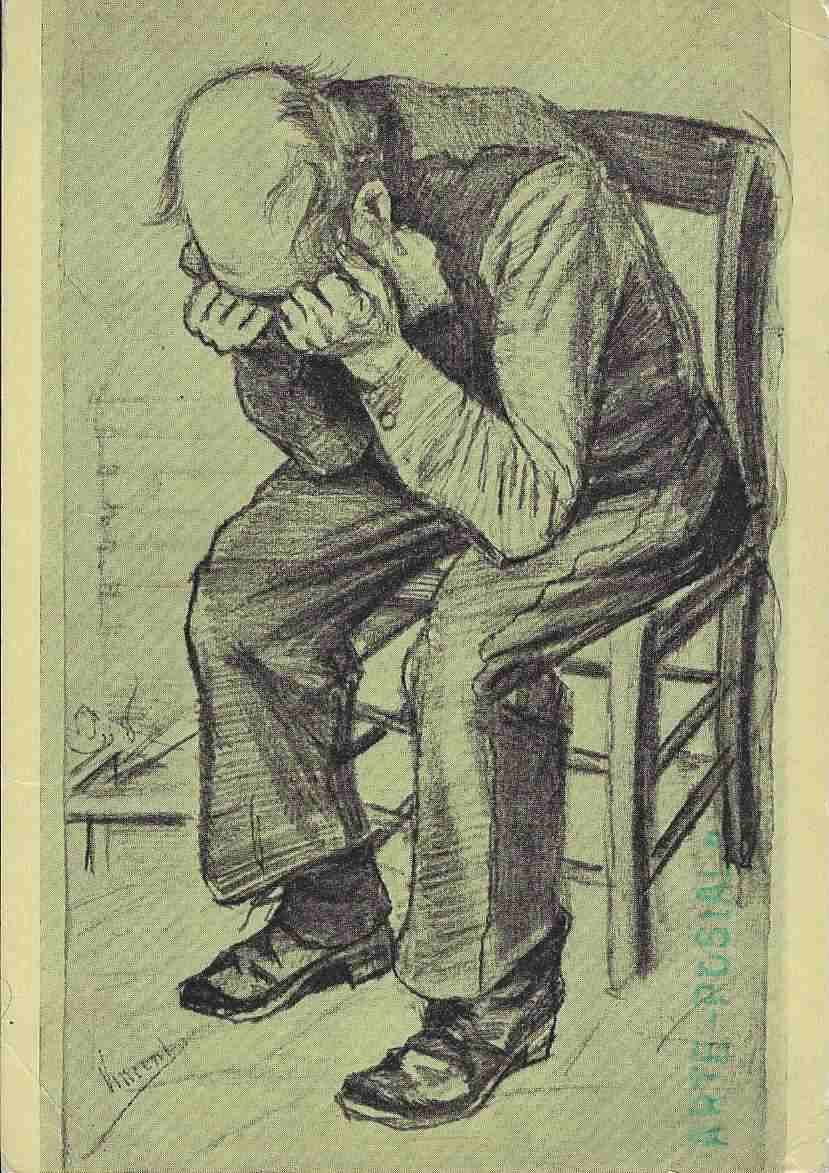
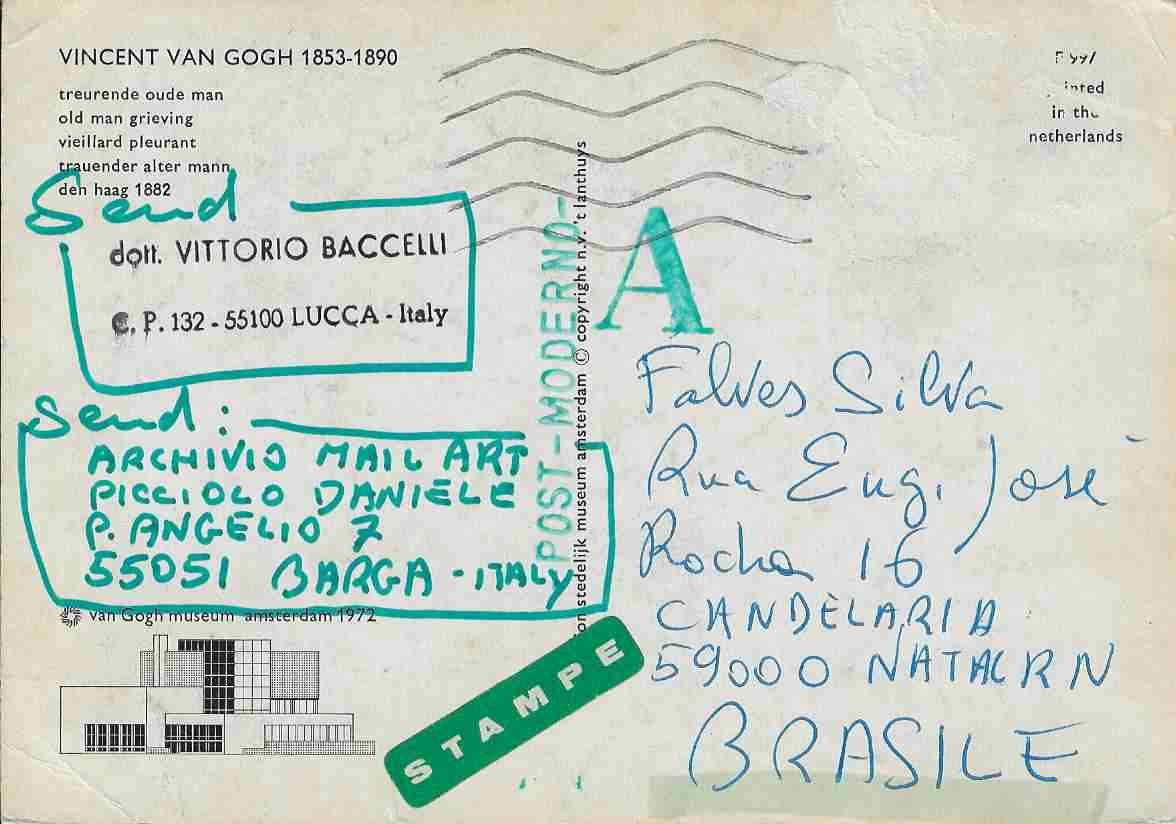
Cartão de arte postal enviado pelo artista, escritor e pesquisador italiano Vittorio Baccelli, de Lucca, Itália, para Falves Silva, em Natal, Rio Grande do Norte.
Vittorio Baccelli - Lucca - Italia
Categoria: Mail Art
Acervo: 03738
Data: 1970
Dimensões: 15 x 10,5 cm
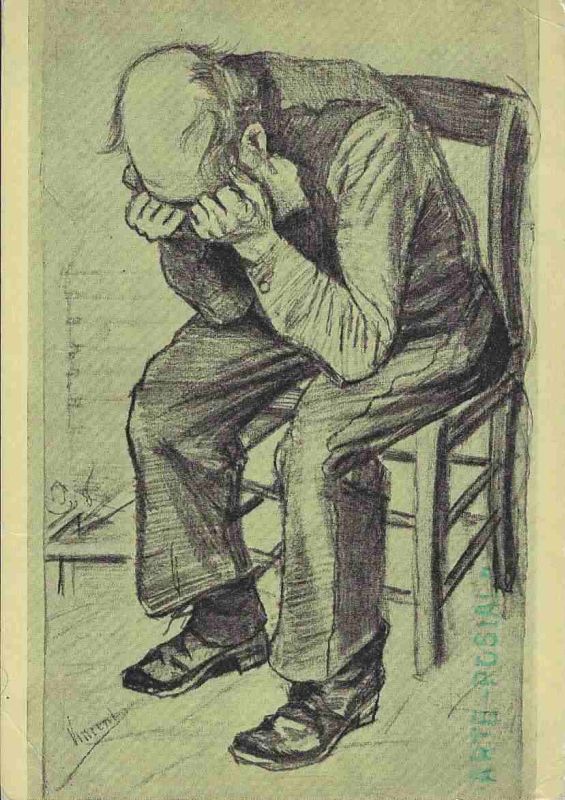
Cartão de arte postal enviado pelo artista, escritor e pesquisador italiano Vittorio Baccelli, de Lucca, Itália, para Falves Silva, em Natal, Rio Grande do Norte. A peça integra o circuito internacional de arte postal e apresenta intervenções manuscritas, carimbos gráficos, endereços de artistas e referências à cultura moderna e pós moderna.A imagem principal reproduz a obra Homem velho em sofrimento, realizada por Vincent van Gogh em Haia, em 1882. A figura masculina aparece sentada em uma cadeira, curvada para a frente e com o rosto apoiado nas mãos. A postura corporal expressa cansaço, tristeza, angústia e recolhimento. A imagem pertence ao conjunto de estudos de Van Gogh sobre trabalhadores, idosos e pessoas em condições sociais vulneráveis.No verso aparecem o nome Vincent van Gogh, as datas 1853 e 1890 e o título da imagem em neerlandês, inglês, francês e alemão. Também são indicados Haia, 1882, o Museu Van Gogh de Amsterdã e a data editorial de 1972. O uso de uma reprodução museológica como suporte para correspondência transforma uma imagem consagrada da história da arte em objeto de circulação, apropriação e intervenção dentro da rede de arte postal.Vittorio Baccelli insere seu nome, o endereço de sua caixa postal em Lucca e inscrições manuscritas em verde. Uma dessas anotações solicita o envio de materiais para o Archivio Mail Art de Picciolo Daniele, localizado em Barga, Itália. A indicação registra a existência de arquivos independentes dedicados à reunião, preservação e circulação de correspondências artísticas.A palavra Post Modern aparece verticalmente na região central do cartão. Essa intervenção situa simbolicamente a peça no debate sobre apropriação, reprodução, arquivo e reutilização de imagens históricas. A obra de Van Gogh deixa de funcionar apenas como reprodução artística e passa a integrar uma nova estrutura comunicacional formada por escrita, carimbo, endereço, selo gráfico e deslocamento postal.O cartão também contém uma etiqueta verde com a palavra Stamp. Esse elemento imita ou comenta a função do selo postal, aproximando comunicação oficial e intervenção artística. Na arte postal, selos fictícios, carimbos autorais e marcas inventadas são empregados para questionar os sistemas de autenticação, circulação e valor da obra de arte.A correspondência foi destinada a Falves Silva na Rua Engenheiro José Rocha, Candelária, Natal, Brasil. O cartão documenta a conexão entre o artista brasileiro e Vittorio Baccelli, assim como a integração de Natal com redes europeias de arte postal. A peça reúne referências a Vittorio Baccelli, Falves Silva, Vincent van Gogh, Picciolo Daniele, Lucca, Barga, Itália, Natal, arte postal, mail art, pós modernismo, apropriação, arquivo artístico, selo de artista, carimbo, correspondência internacional e circulação alternativa.Text for the Salsa program in EnglishMail art card sent by the Italian artist, writer and researcher Vittorio Baccelli from Lucca, Italy, to Falves Silva in Natal, Rio Grande do Norte, Brazil. The piece belongs to the international mail art network and combines handwritten interventions, graphic stamps, artist addresses and references to modern and postmodern culture.The main image reproduces Old Man Grieving, created by Vincent van Gogh in The Hague in 1882. The male figure is seated on a chair, leaning forward with his face covered by his hands. His posture conveys exhaustion, sorrow, anguish and introspection. The image belongs to the group of studies in which Van Gogh represented workers, elderly people and individuals living in socially vulnerable conditions.The reverse presents the name Vincent van Gogh, the dates 1853 and 1890 and the title of the image in Dutch, English, French and German. It also identifies The Hague, 1882, the Van Gogh Museum in Amsterdam and the editorial date 1972. The use of a museum reproduction as a correspondence support transforms a recognized image from art history into an object of circulation, appropriation and intervention within the mail art network.Vittorio Baccelli added his name, his post office box address in Lucca and handwritten inscriptions in green. One of these notes requests that materials be sent to the Archivio Mail Art of Picciolo Daniele in Barga, Italy. This information records the existence of independent archives dedicated to collecting, preserving and circulating artistic correspondence.The expression Post Modern appears vertically in the central area of the card. This intervention symbolically connects the piece with discussions about appropriation, reproduction, archives and the reuse of historical images. The Van Gogh reproduction no longer functions only as an art image. It becomes part of a new communicational structure composed of handwriting, stamps, addresses, graphic labels and postal circulation.The card also contains a green label bearing the word Stamp. This element imitates or comments on the function of a postal stamp, bringing together official communication and artistic intervention. Within mail art, fictional stamps, artist stamps and invented postal marks are used to question systems of authentication, circulation and artistic value.The correspondence was addressed to Falves Silva at Rua Engenheiro José Rocha, Candelária, Natal, Brazil. The card documents the connection between the Brazilian artist and Vittorio Baccelli, as well as the participation of Natal in European mail art networks. The piece brings together references to Vittorio Baccelli, Falves Silva, Vincent van Gogh, Picciolo Daniele, Lucca, Barga, Italy, Natal, mail art, postmodernism, appropriation, artistic archives, artist stamps, graphic marks, international correspondence and alternative circulation.
Cartão de Vittorio Baccelli enviado de Lucca, Itália, para Falves Silva, em Natal, Rio Grande do Norte. Não há data postal claramente identificável na imagem apresentada. O endereço do remetente aparece como Caixa Postal 132, 55100 Lucca, Itália.A imagem utilizada como suporte reproduz Homem velho em sofrimento, trabalho de Vincent van Gogh realizado em Haia em 1882. O verso informa que o cartão foi impresso nos Países Baixos e apresenta referência ao Museu Van Gogh de Amsterdã e ao ano de 1972.Vittorio Baccelli acrescentou inscrições manuscritas em verde, seu nome e uma solicitação de envio de materiais para o Archivio Mail Art de Picciolo Daniele, em Barga, Itália. O endereço manuscrito parece indicar P. Angelio 2, 55051 Barga, mas a leitura do nome da rua não é totalmente segura.O destinatário aparece como Falves Silva, Rua Engenheiro José Rocha, número aparentemente 16, Candelária, 59000 Natal, Rio Grande do Norte, Brasil. O número do imóvel deve ser conferido diretamente no documento original, pois a grafia pode permitir outra leitura.A peça contém a expressão Post Modern em disposição vertical e uma etiqueta verde com a palavra Stamp. Esses elementos reforçam seu caráter de arte postal e sua relação com apropriação de imagens, selos de artista, carimbos alternativos, circulação internacional e arquivos independentes.Observation text in EnglishCard sent by Vittorio Baccelli from Lucca, Italy, to Falves Silva in Natal, Rio Grande do Norte, Brazil. No clearly identifiable postal date is visible in the available image. The sender address appears as Post Office Box 132, 55100 Lucca, Italy.The support reproduces Old Man Grieving, a work created by Vincent van Gogh in The Hague in 1882. The reverse states that the postcard was printed in the Netherlands and includes references to the Van Gogh Museum in Amsterdam and the year 1972.Vittorio Baccelli added handwritten inscriptions in green, his name and a request for materials to be sent to the Archivio Mail Art of Picciolo Daniele in Barga, Italy. The handwritten address appears to indicate P. Angelio 2, 55051 Barga, although the street name cannot be read with complete certainty.The recipient is identified as Falves Silva at Rua Engenheiro José Rocha, apparently number 16, Candelária, 59000 Natal, Rio Grande do Norte, Brazil. The building number should be checked directly against the original object because the handwriting may allow another interpretation.The card contains the expression Post Modern in a vertical arrangement and a green label bearing the word Stamp. These elements reinforce its character as mail art and its relationship with image appropriation, artist stamps, alternative postal marks, international circulation and independent archives.
Proveniência
Coleção Falves SilvaInglês
Mail art card sent by the Italian artist, writer and researcher Vittorio Baccelli from Lucca, Italy, to Falves Silva in Natal, Rio Grande do Norte, Brazil.
Dimensions: 5,9 x 4,1 in