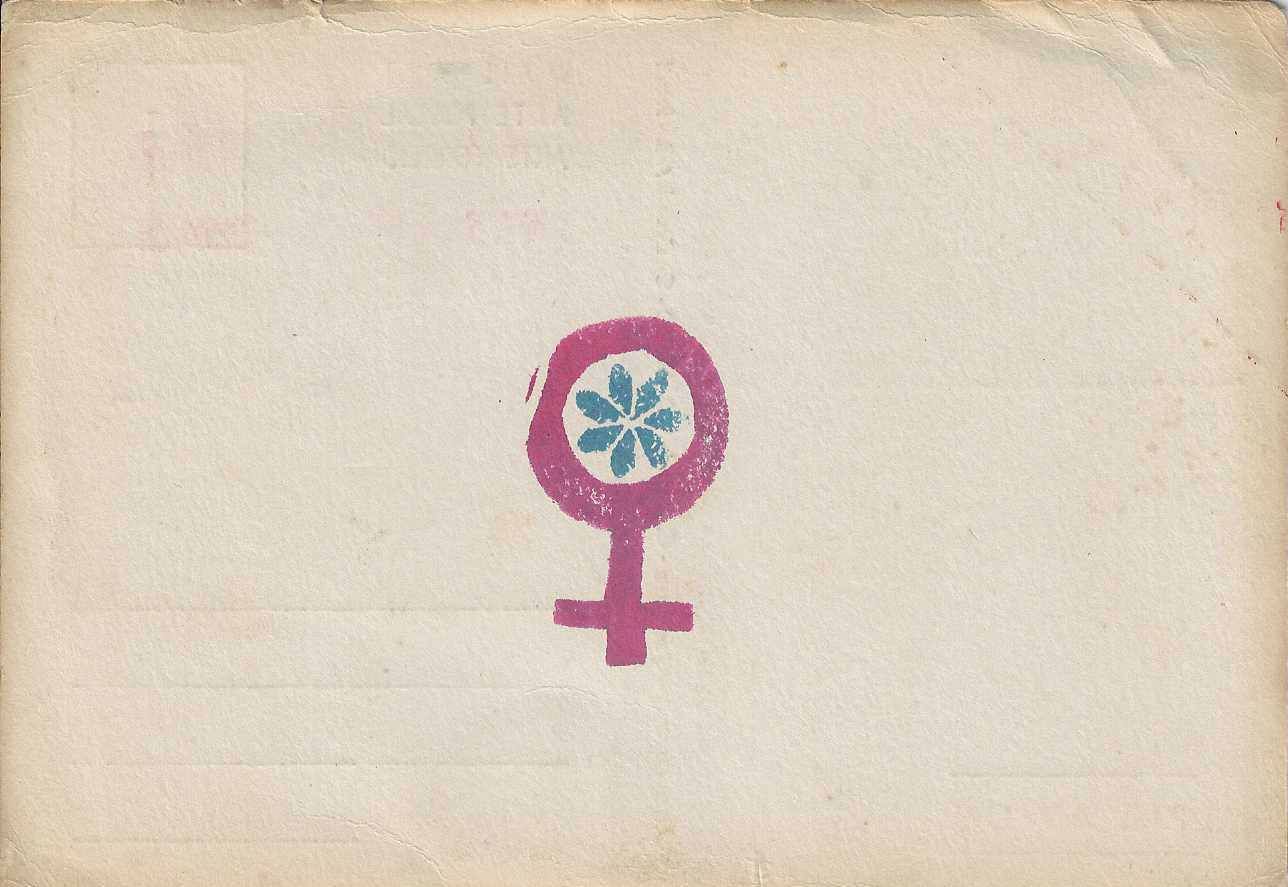
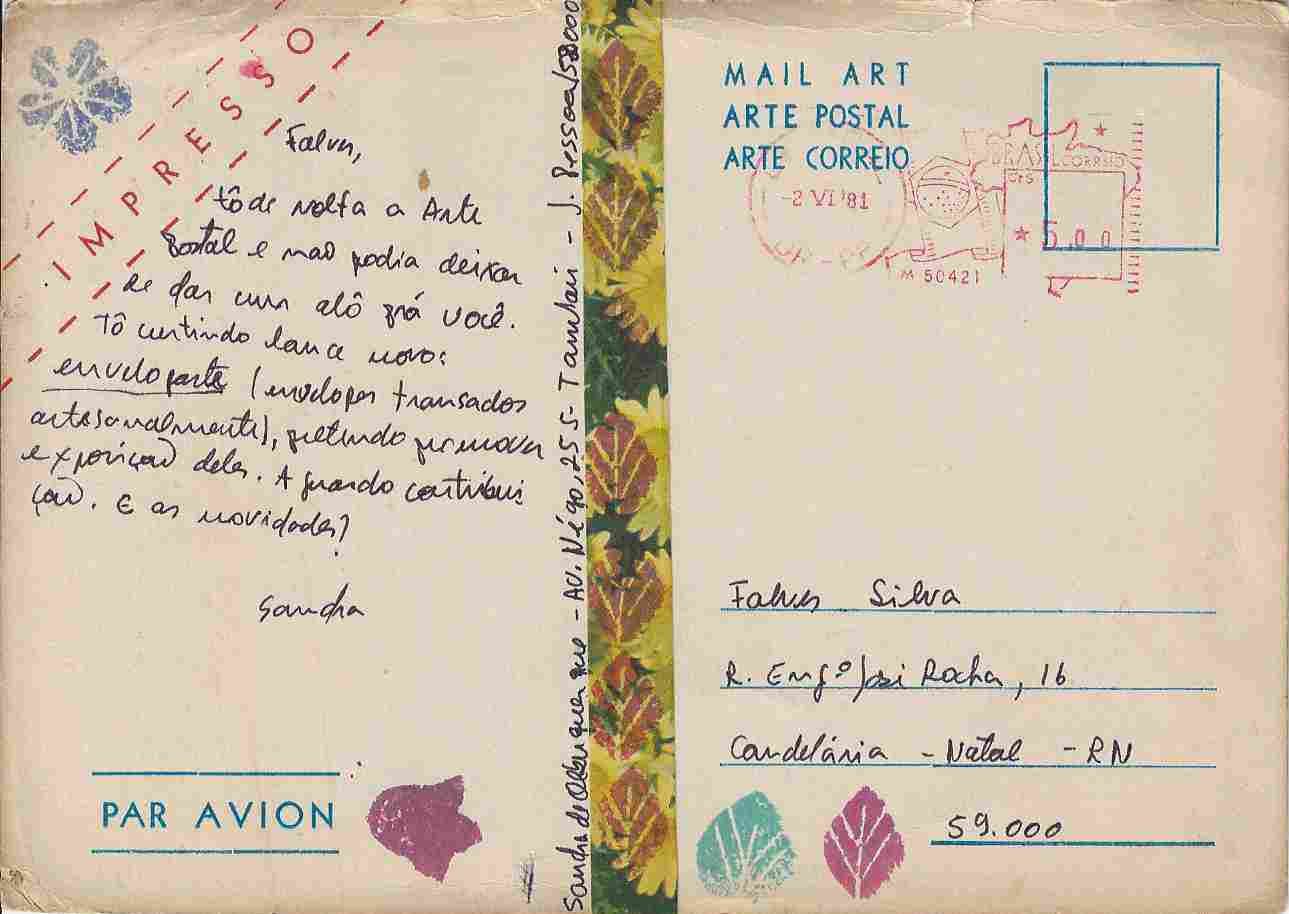
Cartão envelope de arte postal enviado por Sandra de Albuquerque, de João Pessoa, Paraíba, ao artista Falves Silva, em Natal, Rio Grande do Norte, em junho de 1981.
Sandra de Albuquerque - J.P. Paraiba
Categoria: Mail Art
Acervo: 03694
Data: 2 de Junho de 1981
Dimensões: 11,7 x 16,3 cm
Cartão envelope de arte postal enviado por Sandra de Albuquerque, de João Pessoa, Paraíba, ao artista Falves Silva, em Natal, Rio Grande do Norte, em junho de 1981. O conjunto reúne correspondência manuscrita, carimbos postais, inscrições relacionadas à mail art, impressões botânicas, colagem decorativa e um símbolo feminino estampado na face externa. A peça documenta o intercâmbio entre dois participantes da rede brasileira de arte postal no início da década de 1980.Na face destinada ao endereço aparecem as expressões Mail Art, Arte Postal e Arte Correio, impressas em azul. A repetição dos três termos identifica explicitamente a natureza artística da correspondência e apresenta diferentes denominações empregadas no Brasil para as práticas de criação e circulação por meio do sistema postal.O destinatário é Falves Silva, identificado no endereço da Rua Engenheiro José Rocha, número 16, Candelária, Natal, Rio Grande do Norte, código postal 59000. A correspondência apresenta carimbo postal de João Pessoa com leitura aparente de 8 de junho de 1981. Essa data visível no objeto diverge da informação inicial de 2 de junho de 1981 e deve ser confirmada por exame direto do original.A remetente assina apenas Sandra na mensagem, mas o nome completo Sandra de Albuquerque aparece manuscrito verticalmente junto à faixa central decorada. O endereço do remetente parece registrar Avenida Nilo Peçanha, número 255 C, Tambaú, João Pessoa, código postal 58000. Alguns caracteres são de leitura parcialmente incerta e devem ser conferidos no objeto antes do preenchimento definitivo dos campos catalográficos.Na mensagem, Sandra informa a Falves Silva que estava de volta à arte postal e que não poderia deixar de entrar novamente em contato com ele. O texto demonstra que a remetente já havia participado anteriormente dessas redes e que retomava sua atividade em 1981. Ela também menciona a produção de novos envelopes, definidos no próprio documento como envelopes trabalhados artisticamente, e manifesta a intenção de promover uma exposição desse conjunto.A referência a uma futura exposição de envelopes é especialmente importante para compreender sua prática. O envelope não aparece apenas como embalagem para transportar uma obra. Ele próprio é concebido como suporte artístico, superfície de intervenção, objeto expositivo e unidade de comunicação. A correspondência registra, portanto, um projeto de produção continuada de envelopes de arte postal e a intenção de apresentá los publicamente.Sandra também pergunta sobre as atividades e novidades de Falves Silva. Essa passagem revela uma relação de intercâmbio anterior e demonstra que o cartão fazia parte de uma comunicação contínua, e não de um contato isolado. Falves Silva era reconhecido como participante ativo da arte postal, produtor de obras, publicações e informações que circulavam entre diferentes cidades brasileiras e redes internacionais.A face externa apresenta ao centro um símbolo feminino impresso em magenta. Dentro do círculo superior foi inserida uma forma floral azul, com seis partes semelhantes a pétalas ou folhas. A fusão entre o símbolo associado ao feminino e o motivo vegetal cria uma imagem relacionada à identidade, à natureza, à fertilidade, ao corpo e à presença das mulheres na produção artística.A imagem pode ser compreendida como um emblema visual, uma marca de autoria ou uma manifestação ligada à experiência feminina. Entretanto, o cartão não apresenta título ou explicação que permita determinar seu significado definitivo. A associação direta com movimentos feministas ou com um projeto coletivo específico não deve ser feita sem documentação complementar.No interior aparecem pequenas impressões de folhas em azul, verde e magenta. Essas formas botânicas repetem o princípio visual da flor inserida no símbolo feminino. Há também uma faixa vertical composta por imagens vegetais coloridas, utilizada para dividir a área da mensagem e a área postal. Essa faixa funciona simultaneamente como colagem, ornamento, limite espacial e eixo estrutural da composição.Na região da mensagem aparece ainda a palavra Impresso, aplicada diagonalmente em vermelho. O termo pertence à linguagem administrativa do correio, mas sua incorporação visual também reforça a relação entre objeto postal, texto, impressão e criação artística.A indicação Par Avion informa que a peça foi preparada para circulação por via aérea. Embora a correspondência tenha circulado entre João Pessoa e Natal, duas cidades do Nordeste brasileiro, o uso dessa marca aproxima o cartão da linguagem internacional da mail art e das convenções gráficas encontradas em correspondências transnacionais.A obra integra escrita, impressão, carimbo, colagem, elementos botânicos, símbolo gráfico, envelope e circulação postal. Sua estrutura exemplifica a transformação da correspondência cotidiana em obra participativa e documento de relacionamento. O remetente produz a intervenção, o serviço postal acrescenta marcas de circulação, o destinatário recebe e preserva o objeto, e o arquivo permite reconstruir a rede décadas depois.A relação entre Sandra de Albuquerque e Falves Silva está documentalmente confirmada por esta correspondência. O cartão demonstra que, em 1981, Sandra atuava ou retomava sua atuação na arte postal em João Pessoa, produzia envelopes artisticamente trabalhados, planejava uma exposição e mantinha contato com Falves Silva em Natal.O conjunto possui importância para a história da arte postal brasileira por registrar uma participante ainda pouco documentada, por evidenciar a circulação entre Paraíba e Rio Grande do Norte e por apresentar uma reflexão prática sobre o envelope como obra. A peça deve ser relacionada à mail art, arte postal, arte correio, envelope de artista, correspondência artística, colagem, impressão botânica, símbolo feminino, produção de mulheres, João Pessoa, Natal, Sandra de Albuquerque e Falves Silva.SALSA PROGRAM TEXT IN ENGLISHMail art envelope card sent by Sandra de Albuquerque from João Pessoa, Paraíba, to the artist Falves Silva in Natal, Rio Grande do Norte, Brazil, in June 1981. The ensemble combines a handwritten message, postal cancellations, inscriptions referring to mail art, botanical impressions, decorative collage and a female symbol printed on the outer surface. The object documents an exchange between two participants in the Brazilian mail art network during the early 1980s.The address side contains the expressions Mail Art, Arte Postal and Arte Correio printed in blue. The repetition of these three terms explicitly identifies the artistic nature of the correspondence and records different designations used in Brazil for creative practices circulated through the postal system.The recipient is Falves Silva at Rua Engenheiro José Rocha, number 16, Candelária, Natal, Rio Grande do Norte, postal code 59000. The postal cancellation appears to identify João Pessoa and a date of 8 June 1981. This visible date differs from the initially supplied date of 2 June 1981 and should be confirmed through direct examination of the original object.The sender signs the message simply as Sandra, while the full name Sandra de Albuquerque is handwritten vertically beside the decorated central strip. The sender address appears to record Avenida Nilo Peçanha, number 255 C, Tambaú, João Pessoa, postal code 58000. Several characters remain partially uncertain and should be checked on the original before the catalogue fields are finalized.In her message, Sandra informs Falves Silva that she had returned to mail art and could not fail to contact him again. The statement indicates that she had previously participated in postal art networks and was resuming this activity in 1981. She also refers to the production of new envelopes, described in the document as artistically worked envelopes, and expresses her intention to organize an exhibition of them.The reference to a future exhibition of envelopes is particularly important for understanding her practice. The envelope is not treated merely as packaging used to transport an artwork. It becomes the artistic support itself, an intervened surface, an exhibition object and a unit of communication. The correspondence therefore records an ongoing project involving the production of mail art envelopes and the intention to present them publicly.Sandra also asks about Falves Silva
s activities and news. This passage suggests an earlier relationship of exchange and demonstrates that the card formed part of an ongoing communication rather than an isolated contact. Falves Silva was recognized as an active participant in mail art and as a producer of works, publications and information circulated among Brazilian cities and international networks.The outer surface presents a female symbol printed in magenta. A blue floral form composed of six petal or leaf like elements appears within its upper circular section. The fusion of a symbol associated with the feminine and a botanical motif creates an image connected with identity, nature, fertility, the body and the presence of women in artistic production.The image may be understood as a visual emblem, an authorial mark or a statement related to female experience. The card, however, contains no title or explanatory text that establishes its definitive meaning. It should not be automatically connected with a specific feminist movement or collective project without additional documentation.The interior contains small leaf impressions in blue, green and magenta. These botanical forms repeat the visual principle of the flower placed inside the female symbol. A vertical strip composed of coloured plant imagery divides the message area from the postal area. It functions simultaneously as collage, ornament, spatial boundary and structural axis.The word Impresso also appears diagonally in red within the message area. Although the term belongs to the administrative language of the postal service, its visual incorporation reinforces the connections among postal object, text, printing and artistic creation.The expression Par Avion indicates that the work was prepared for airmail circulation. Although the correspondence travelled between João Pessoa and Natal, two cities in northeastern Brazil, this mark connects the object with the international graphic vocabulary of mail art and with conventions commonly found in transnational correspondence.The work combines handwriting, printing, stamping, collage, botanical elements, graphic symbolism, envelope and postal circulation. Its structure exemplifies the transformation of everyday correspondence into a participatory artwork and a record of relationships. The sender produces the intervention, the postal service adds marks of circulation, the recipient receives and preserves the object, and the archive allows the network to be reconstructed decades later.The relationship between Sandra de Albuquerque and Falves Silva is documentarily confirmed by this correspondence. The card demonstrates that in 1981 Sandra was active again in mail art in João Pessoa, was producing artistically worked envelopes, intended to organize an exhibition and maintained contact with Falves Silva in Natal.The ensemble is significant for the history of Brazilian mail art because it records a participant who remains insufficiently documented, demonstrates circulation between Paraíba and Rio Grande do Norte and presents the envelope itself as an artwork. It should be associated with mail art, artists envelopes, artists correspondence, collage, botanical printing, the female symbol, women artists, João Pessoa, Natal, Sandra de Albuquerque and Falves Silva.
TEXTO DE OBSERVAÇÃO EM PORTUGUÊSConjunto constituído por envelope cartão de arte postal com mensagem manuscrita, impressões gráficas, carimbos postais, colagem vegetal e endereço de circulação. A autoria é atribuída a Sandra de Albuquerque com base no nome manuscrito junto à faixa central e na assinatura Sandra ao final da mensagem.A data inicialmente informada como 2 de junho de 1981 não coincide com a leitura aparente do carimbo postal. A marca parece registrar 8 VI 81, correspondente a 8 de junho de 1981. Recomenda se examinar o original com ampliação para estabelecer a data definitiva. Até essa confirmação, o cadastro pode registrar junho de 1981 e indicar 8 de junho como leitura provável do carimbo.A mensagem informa que Sandra estava de volta à arte postal, demonstrando atividade anterior nesse campo. Ela menciona novos envelopes artisticamente trabalhados e declara a intenção de promover uma exposição deles. O nome, a data e o local dessa exposição não aparecem no documento, e sua realização não foi confirmada.A leitura integral de uma parte da mensagem é dificultada pela caligrafia e pelo desgaste do suporte. O sentido geral, entretanto, é claro. Sandra retoma contato com Falves Silva, comenta sua produção de envelopes, menciona o projeto de exposição e pergunta pelas atividades e novidades do destinatário.O endereço da remetente parece estar escrito como Sandra de Albuquerque, Avenida Nilo Peçanha, número 255 C, Tambaú, João Pessoa, código postal 58000. O número e o complemento devem ser conferidos diretamente no original antes da transcrição definitiva.O endereço do destinatário aparece como Falves Silva, Rua Engenheiro José Rocha, número 16, Candelária, Natal, Rio Grande do Norte, código postal 59000.A face externa apresenta um símbolo feminino em magenta com motivo floral azul em seu interior. Não há título, assinatura específica ou texto explicativo associado à imagem. A obra não deve receber interpretação feminista definitiva sem outras fontes, embora o símbolo feminino constitua um elemento visual objetivo e relevante.As pequenas formas coloridas presentes na correspondência parecem resultar de impressões de folhas ou matrizes botânicas. A técnica exata não pode ser determinada somente pelas imagens. Recomenda se registrar provisoriamente impressão colorida de elemento vegetal ou carimbo botânico.A faixa vertical central contém imagens repetidas de folhas em diferentes cores. Não é possível determinar se foi produzida pela artista, recortada de material impresso ou aplicada como fita decorativa. A técnica deve ser descrita como colagem ou aplicação de faixa impressa até exame presencial.A palavra Impresso aparece diagonalmente em vermelho. As expressões Mail Art, Arte Postal, Arte Correio e Par Avion integram materialmente a composição e devem ser registradas como inscrições da obra.Não foram localizadas fontes externas confiáveis que permitissem confirmar a identidade civil completa, a formação, outras obras, exposições ou publicações de Sandra de Albuquerque vinculada a esta correspondência. Não se deve confundir a remetente com outras pessoas homônimas encontradas em registros contemporâneos.O título recomendado para cadastro é Cartão envelope de Sandra de Albuquerque para Falves Silva. Um título descritivo alternativo é Envelope de arte postal com símbolo feminino e motivo floral.A técnica pode ser cadastrada como envelope de papel, escrita manuscrita, impressão colorida, carimbo, colagem, selo ou franquia postal e intervenção gráfica. A presença e o tipo de selo precisam ser confirmados no objeto original, pois a imagem mostra principalmente a marca de franquia e circulação.A peça apresenta vincos, ondulações, amarelecimento, desgaste nas bordas, pequenas manchas, marcas de cola, abrasões e sinais associados à circulação postal e ao envelhecimento do papel.Classificações recomendadas incluem Sandra de Albuquerque, Falves Silva, mail art, arte postal, arte correio, envelope de artista, correspondência artística, símbolo feminino, flor, folhas, impressão botânica, colagem, mulheres na arte postal, João Pessoa, Paraíba, Natal, Rio Grande do Norte, Brasil e 1981.OBSERVATION TEXT IN ENGLISHEnsemble consisting of a mail art envelope card with a handwritten message, graphic impressions, postal cancellations, botanical collage and circulation address. Authorship is attributed to Sandra de Albuquerque on the basis of the full name written beside the central strip and the signature Sandra at the end of the message.The initially supplied date of 2 June 1981 does not correspond with the apparent reading of the postal cancellation. The mark appears to record 8 VI 81, corresponding to 8 June 1981. Enlarged examination of the original is recommended before a definitive date is established. Until then, the catalogue may record June 1981 and identify 8 June as the probable reading of the cancellation.The message states that Sandra had returned to mail art, indicating previous activity in this field. She refers to new artistically worked envelopes and expresses her intention to organize an exhibition of them. The title, date and location of this exhibition are not given, and its realization has not been confirmed.A complete reading of part of the message is made difficult by the handwriting and the condition of the support. Its general meaning is nevertheless clear. Sandra renews contact with Falves Silva, discusses her production of envelopes, mentions an exhibition project and asks about the recipient
s activities and news.The sender address appears to read Sandra de Albuquerque, Avenida Nilo Peçanha, number 255 C, Tambaú, João Pessoa, postal code 58000. The street number and complement should be verified directly on the original before a definitive transcription is entered.The recipient address reads Falves Silva, Rua Engenheiro José Rocha, number 16, Candelária, Natal, Rio Grande do Norte, postal code 59000.The outer surface presents a magenta female symbol containing a blue floral motif. No title, specific signature or explanatory text is associated with the image. The work should not receive a definitive feminist interpretation without further sources, although the female symbol is an objective and significant visual element.The small coloured forms on the correspondence appear to result from impressions of leaves or botanical matrices. The precise technique cannot be determined from the images alone. They should provisionally be recorded as coloured botanical impressions or botanical stamps.The central vertical strip contains repeated leaf imagery in several colours. It cannot be determined whether it was produced by the artist, cut from printed material or applied as decorative tape. The technique should be described as collage or application of a printed strip until physical examination is possible.The word Impresso appears diagonally in red. The expressions Mail Art, Arte Postal, Arte Correio and Par Avion are material inscriptions within the composition and should be recorded as such.No reliable external sources were located that would confirm the complete civil identity, education, other works, exhibitions or publications of the Sandra de Albuquerque associated with this correspondence. The sender should not be confused with contemporary individuals sharing the same name.The recommended catalogue title is Envelope Card from Sandra de Albuquerque to Falves Silva. An alternative descriptive title is Mail Art Envelope with Female Symbol and Floral Motif.The technique may be recorded as paper envelope, handwriting, colour printing, stamping, collage, postal franking and graphic intervention. The presence and exact type of postage should be checked on the original, since the supplied image primarily shows postal processing marks.The object presents folds, surface undulation, yellowing, edge wear, small stains, adhesive traces, abrasions and marks associated with postal circulation and the ageing of paper.Recommended classifications include Sandra de Albuquerque, Falves Silva, mail art, artists envelope, artists correspondence, female symbol, flower, leaves, botanical printing, collage, women in mail art, João Pessoa, Paraíba, Natal, Rio Grande do Norte, Brazil and 1981.
Proveniência
Coleção Poema ProcessoInglês
Mail art envelope card sent by Sandra de Albuquerque from João Pessoa, Paraíba, to the artist Falves Silva in Natal, Rio Grande do Norte, Brazil, in June 1981.
Dimensions: 4,6 x 6,4 in