
Documento biográfico e curricular dedicado ao artista, poeta visual, teórico da mídia e cineasta experimental alemão Klaus Peter Dencker, produzido provavelmente em meados da década de 1980 para divulgação internacional de sua trajetória artística e acadêmica.
Klaus Peter Dencker - Alemanha
Categoria: Curriculo
Acervo: 03152
Data: 1980
Dimensões: 29,5 x 21,2 cm
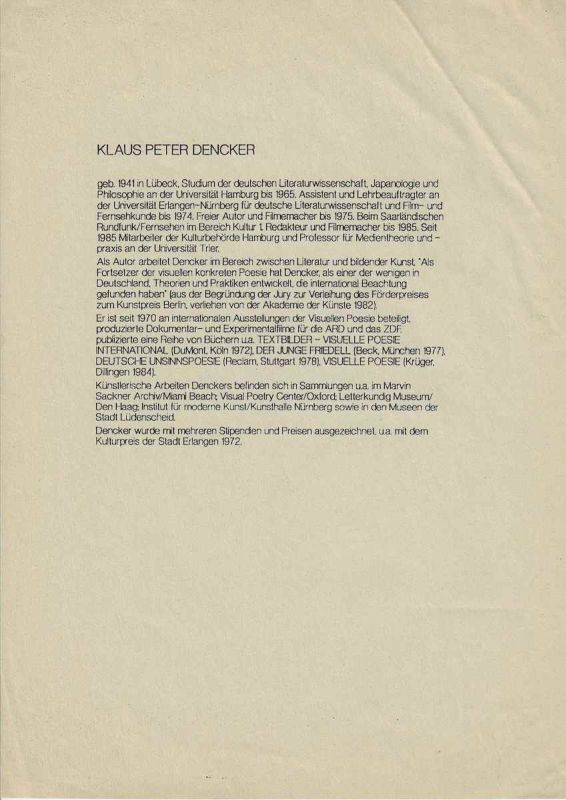
Documento biográfico e curricular dedicado ao artista, poeta visual, teórico da mídia e cineasta experimental alemão Klaus Peter Dencker, produzido provavelmente em meados da década de 1980 para divulgação internacional de sua trajetória artística e acadêmica. O texto apresenta uma síntese detalhada da formação, atuação profissional, produção intelectual e inserção internacional de Dencker no campo da poesia visual, poesia concreta, arte intermídia e literatura experimental.O documento informa que Klaus Peter Dencker nasceu em Lübeck em 1941 e estudou Literatura Alemã, Japonologia e Filosofia na Universidade de Hamburgo até 1965. Atuou como assistente e professor na Universidade de Erlangen Nürnberg, trabalhando nas áreas de Literatura Alemã e Cinema e Televisão até 1974. Entre 1975 e 1985 desenvolveu atividades como autor, cineasta e editor na televisão pública alemã Saarländischer Rundfunk. A partir de 1985 passou a integrar a Secretaria de Cultura de Hamburgo e tornou se Professor de Teoria e Prática da Mídia na Universidade de Trier.O currículo destaca sua atuação como continuador da poesia concreta visual, ressaltando seu reconhecimento internacional por desenvolver teorias e práticas inovadoras no campo da poesia visual. O texto registra sua participação contínua em exposições internacionais desde 1970, a realização de documentários e filmes experimentais para as emissoras ARD e ZDF e a publicação de obras fundamentais como Textbilder Visuelle Poesie International de 1972, Der Junge Friede de 1977, Deutsche Unsinnspoesie de 1978 e Visuelle Poesie de 1984. O documento também informa a presença de obras do artista em coleções internacionais, incluindo o Sackner Archive, Visual Poetry Center de Oxford, Letterkundig Museum de Haia, Institut für moderne Kunst de Nuremberg e Museus Municipais de Lüdenscheid.Biographical and curriculum document dedicated to German artist, visual poet, media theorist and experimental filmmaker Klaus Peter Dencker, probably produced during the mid 1980s for the international dissemination of his artistic and academic career. The text presents a detailed summary of Dencker educational background, professional activities, intellectual production and international involvement in visual poetry, concrete poetry, intermedia art and experimental literature.The document states that Klaus Peter Dencker was born in Lübeck in 1941 and studied German Literature, Japanese Studies and Philosophy at the University of Hamburg until 1965. He worked as assistant and lecturer at the University of Erlangen Nürnberg in the fields of German Literature and Film and Television until 1974. Between 1975 and 1985 he was active as author, filmmaker and editor at the German public broadcasting network Saarländischer Rundfunk. From 1985 onward he joined the Hamburg Ministry of Culture and became Professor of Media Theory and Media Practice at the University of Trier.The curriculum emphasizes his role as a successor to visual concrete poetry and highlights his international recognition for developing innovative theories and artistic practices in visual poetry. The document records his continuous participation in international exhibitions since 1970, the production of documentary and experimental films for ARD and ZDF and the publication of fundamental works such as Textbilder Visuelle Poesie International published in 1972, Der Junge Friede published in 1977, Deutsche Unsinnspoesie published in 1978 and Visuelle Poesie published in 1984. The document also notes that his works are held in important international collections including the Sackner Archive, the Visual Poetry Center in Oxford, the Letterkundig Museum in The Hague, the Institut für moderne Kunst in Nuremberg and the Municipal Museums of Lüdenscheid.Observation English
Observação PortuguêsDocumento biográfico original de Klaus Peter Dencker contendo currículo artístico e acadêmico utilizado para divulgação internacional do artista. O texto apresenta informações sobre sua formação, atividade docente, produção cinematográfica, publicações fundamentais e participação em exposições internacionais de poesia visual, poesia concreta, arte experimental e intermídia. Importante fonte primária para pesquisas sobre poesia visual internacional e arte experimental alemã.Original biographical document of Klaus Peter Dencker containing his artistic and academic curriculum for international circulation. The text presents information concerning his education, teaching activities, film production, major publications and participation in international exhibitions devoted to visual poetry, concrete poetry, experimental art and intermedia practices. Important primary source for research on international visual poetry and German experimental art.
Inglês
Documento biográfico original de Klaus Peter Dencker contendo currículo artístico e acadêmico utilizado para divulgação internacional do artista.
Dimensions: 11,6 x 8,3 in