Home
Artistas
1er FESTIVAL DE LA NEIGE - Championnats du Monde de Ski, 1970
1er FESTIVAL DE LA NEIGE - Championnats du Monde de Ski, 1970
Local de nascimento: Hautes Tatras, Tchécoslovaquia
Data de nascimento: 14 de fevereiro de 1970
Local de falecimento: Hautes Tatras, Tchécoslovaquia
Data de falecimento: 22 fevereiro de 1970
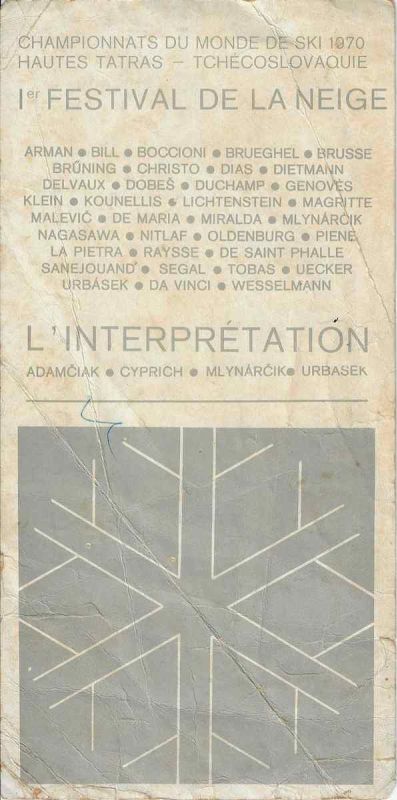
BIOGRAFIA EM PORTUGUÊSO 1er Festival de la Neige, também documentado como 1st Festival of Snow, foi uma manifestação coletiva internacional de arte realizada em 1970 nas Hautes Tatras, Altos Tatras, então Tchecoslováquia e atualmente Eslováquia, em associação direta com os Campeonatos Mundiais de Esqui Nórdico da FIS de 1970. O evento pertence à história da arte conceitual, arte de ação, arte efêmera, apropriação, interpretação artística, práticas ambientais e experimentação internacional do final dos anos 1960 e início dos anos 1970. A documentação preservada no acervo poemaprocesso.com.br consiste em um convite postal de 12 por 25 centímetros, em francês, enviado à residência de Álvaro de Sá no Rio de Janeiro, criando uma conexão documental direta entre essa experiência da vanguarda da Europa Central e uma das figuras centrais do Poema Processo brasileiro.A frente do convite identifica Championnats du Monde de Ski 1970, Hautes Tatras, Tchécoslovaquie e 1er Festival de la Neige. A associação com o campeonato esportivo não era circunstancial. O manifesto do evento afirma que o festival ocorria por ocasião e sob a égide dos Campeonatos Mundiais de Esqui da FIS de 1970 nas Hautes Tatras. Os campeonatos foram realizados em ?trbské Pleso, nos Altos Tatras, entre 14 e 22 de fevereiro de 1970.O festival foi organizado por Alex Mlynár?ik, Robert Cyprich, Milo? Urbásek e Milan Adam?iak. Fontes do Museum of Modern Art dedicadas à arte conceitual da Europa Oriental identificam o 1st Festival of Snow como um projeto organizado por esses quatro artistas em 1970 nas montanhas dos Altos Tatras. A manifestação foi concebida como desdobramento das formulações sobre Interpretação nas artes plásticas desenvolvidas por Alex Mlynár?ik e Milo? Urbásek a partir de 1969.A palavra L Interprétation aparece destacada na frente do documento fornecido e constitui a chave conceitual da manifestação. O verso apresenta o festival como La première manifestation d une interprétation plastique, estabelecendo explicitamente o evento como primeira manifestação dessa proposta no campo das artes plásticas.O conceito de Interpretação havia sido formulado por Alex Mlynár?ik e Milo? Urbásek em 1969. Em vez de compreender a criação exclusivamente como produção de um objeto totalmente autônomo e inédito, a proposta permitia que um artista utilizasse uma obra ou ideia artística preexistente como ponto de partida para uma nova realização. A interpretação poderia reconstruir, transformar, recontextualizar ou materializar de outra forma uma obra anterior. O processo diferenciava se da simples imitação porque pressupunha seleção, compreensão, transformação e contribuição criativa do intérprete.O 1er Festival de la Neige transformou essa teoria em experiência coletiva. A neve foi definida como ponto de partida, matéria e forma para a realização das obras. O documento afirma que o festival especificava LA NEIGE como elemento de origem e de forma para a realização artística. A paisagem de inverno deixava de ser simples cenário e convertia se no próprio suporte da experiência.A utilização da neve possuía consequências conceituais importantes. As obras não eram produzidas prioritariamente para conservação em museus ou comercialização no mercado de arte. Existiam temporariamente, submetidas à temperatura, transformação e desaparecimento do material. A manifestação colocava em questão permanência, autoria, originalidade, mercadoria artística, museu e galeria tradicional. A historiografia do Museum of Modern Art registra aproximadamente trezentas instalações realizadas na neve ou com neve durante o projeto.O texto do festival declara ainda que a manifestação se tornava símbolo de uma criação plástica independente e expressão de uma nova posição social da prática artística, desligada das relações comerciais. A denominada Galeria de Inverno dos Tatras surgiria com o inverno e desapareceria com a atmosfera que lhe dava existência. Esse princípio é central para compreender o caráter efêmero e anticomercial do evento.A ligação com o esporte foi igualmente conceitual. O texto relaciona o festival às ações capazes de renovar os ideais dos antigos Jogos Olímpicos e de procurar uma harmonia entre corpo e espírito. O modelo esportivo era apropriado para formular um encontro artístico temporário, coletivo e aberto, realizando uma aproximação pouco convencional entre competição esportiva internacional, paisagem natural, ação artística e pensamento conceitual.A historiografia do MoMA observa que Mlynár?ik comparava, em parte ironicamente, a manifestação artística a um acontecimento esportivo. Essa operação afastava a arte de seu espaço institucional habitual e colocava a experiência artística dentro de um ambiente social já ocupado por multidões, atletas, visitantes e meios de comunicação internacionais.A frente do convite apresenta uma extensa relação de nomes sob o título do festival. O documento registra Arman, Bill, Boccioni, Brueghel, Brusse, Brüning, Christo, Dias, Dietmann, Delvaux, Dobe?, Duchamp, Genovés, Klein, Kounellis, Lichtenstein, Magritte, Malevic, De Maria, Miralda, Mlynár?ik, Nagasawa, Nitlaf, Oldenburg, Piene, La Pietra, Raysse, de Saint Phalle, Sanejouand, Segal, Tobas, Uecker, Urbásek, Da Vinci e Wesselmann.É essencial interpretar corretamente essa lista. A documentação publicada pelo Museum of Modern Art a apresenta como relação de obras originais que serviram de referência para as interpretações do festival. Portanto, os nomes impressos não devem ser automaticamente catalogados como artistas fisicamente presentes nos Altos Tatras ou como participantes diretos da execução das ações. O princípio da exposição era justamente interpretar obras de artistas do cânone moderno e contemporâneo mediante novas realizações em neve.Essa distinção é particularmente importante para nomes como Leonardo da Vinci, Umberto Boccioni, Pieter Brueghel, Kazimir Malevich, Marcel Duchamp, René Magritte e outros artistas de períodos diferentes. O festival colocava em relação referências históricas e contemporâneas através da interpretação, produzindo um campo experimental no qual a história da arte podia ser retomada como matéria para nova produção.A seção L Interprétation do convite identifica Adam?iak, Cyprich, Mlynár?ik e Urbásek. Essa relação coincide com a historiografia especializada que atribui a organização e realização do projeto a Milan Adam?iak, Robert Cyprich, Alex Mlynár?ik e Milo? Urbásek.Milan Adam?iak foi uma figura importante das experiências intermídia e conceituais da Eslováquia. Robert Cyprich participou de projetos experimentais com Mlynár?ik desde 1969. Milo? Urbásek esteve diretamente ligado à formulação do conceito de Interpretação. Alex Mlynár?ik constituiu o núcleo articulador dessa sequência de eventos, ações e festividades que aproximavam arte, vida, ambiente e participação.A historiografia da arte eslovaca situa o Festival de la Neige dentro das ações de Mlynár?ik que utilizaram apropriação e interpretação como procedimentos artísticos. O evento é descrito como uma ação coletiva de artistas eslovacos que interpretavam ou apropriavam obras de importantes artistas internacionais.A documentação fornecida possui ainda extraordinária relevância para a história do Poema Processo no Brasil. O verso do convite apresenta endereço manuscrito destinado à residência de Álvaro de Sá, no bairro de Santa Teresa, Guanabara, Brasil. O cadastro do poemaprocesso.com.br confirma que o convite foi endereçado à residência de Álvaro de Sá.Essa proveniência documental estabelece uma conexão concreta entre redes internacionais de experimentalismo europeu e o núcleo brasileiro do Poema Processo. Álvaro de Sá foi uma das figuras fundamentais do movimento e trabalhou com poesia visual, sequência, comunicação, participação, livro de artista, histórias em quadrinhos e estruturas processuais. O recebimento do convite demonstra sua inserção em circuitos internacionais de circulação de informações sobre novas práticas artísticas em 1970.É necessário, entretanto, separar a conexão documental de uma afirmação de participação. O material prova que Álvaro de Sá recebeu ou foi destinatário do convite relacionado ao Festival de la Neige. Nas fontes consultadas não foi localizada comprovação de que Álvaro de Sá tenha viajado à Tchecoslováquia, realizado uma interpretação em neve ou participado presencialmente do festival. Portanto, sua relação deve ser catalogada como destinatário do documento e integrante de uma rede de circulação artística internacional, não como participante confirmado.A inscrição Dias existente entre os nomes da frente merece igualmente tratamento cauteloso. O documento e as fontes internacionais consultadas reproduzem apenas Dias. Não foi localizada, até o momento, fonte primária que permita identificar inequivocamente esse nome abreviado como Wlademir Dias Pino, Antonio Dias ou outro artista chamado Dias. Por isso, o cadastro raisonné deve conservar a forma Dias e evitar expansão automática do nome.O verso do documento contém também inscrições manuscritas e assinaturas, além de marcas postais. O registro do poemaprocesso.com.br informa que o convite apresenta autógrafos não identificados. Sem uma fonte documental comparativa de assinaturas, essas inscrições não devem ser atribuídas nominalmente a Mlynár?ik, Adam?iak, Cyprich, Urbásek ou outros participantes.Do ponto de vista museológico, o documento deve ser considerado simultaneamente convite de exposição, documento postal, testemunho de rede internacional, publicação efêmera e componente de arquivo. Seu estado físico visível registra manchas, vincos, amassamentos, rasgos e marcas de circulação, características também mencionadas pelo cadastro do acervo. Essas marcas não são secundárias, pois documentam a vida postal efetiva do objeto entre a Europa Central e o Brasil.O 1er Festival de la Neige ocupa posição relevante na história da arte conceitual da Europa Oriental porque articulou apropriação, ação coletiva, temporalidade, ambiente natural, participação, efemeridade e crítica à mercantilização da arte. Em vez de produzir uma coleção convencional de objetos destinados à galeria, criou uma situação artística temporária submetida às condições do inverno.Para o poemaprocesso.com.br, o documento deve integrar clusters relacionados a arte conceitual internacional, arte efêmera, action art, interpretação artística, apropriação, arte ambiental, redes internacionais de arte experimental, correspondência artística, Álvaro de Sá, Poema Processo e circulação internacional das vanguardas entre Europa e América Latina.A relação conceitual com o Poema Processo também merece atenção, sem que se afirme influência direta não comprovada. Ambos os contextos valorizaram processo, transformação, participação, sistemas de linguagem e questionamento da obra tradicional. O Festival de la Neige produzia interpretações temporárias em neve. O Poema Processo investigava estruturas capazes de gerar versões e transformações. A existência do convite no arquivo de Álvaro de Sá documenta que esses universos, ainda que originados em contextos distintos, chegaram efetivamente a se conectar por meio da circulação internacional de documentos.O 1er Festival de la Neige deve, assim, ser indexado semanticamente com 1st Festival of Snow, Festival de la Neige, Hautes Tatras, High Tatras, Vysoké Tatry, ?trbské Pleso, Tchécoslovaquie, Czechoslovakia, Slovakia, 1970, Championnats du Monde de Ski, FIS Nordic World Ski Championships, Alex Mlynár?ik, Milan Adam?iak, Robert Cyprich, Milo? Urbásek, L Interprétation, conceptual art, action art, ephemeral art, snow art, environmental art, appropriation, independent art production, Álvaro de Sá, Poema Processo, international experimental art networks e correspondence art.
English
BIOGRAPHY IN ENGLISHThe 1er Festival de la Neige, also documented as the 1st Festival of Snow, was an international collective art manifestation held in 1970 in the High Tatras, then Czechoslovakia and now Slovakia, in direct association with the 1970 FIS Nordic World Ski Championships. The event belongs to the histories of conceptual art, action art, ephemeral art, appropriation, artistic interpretation, environmental practices and international experimental art of the late 1960s and early 1970s. The document preserved by poemaprocesso.com.br is a French language postal invitation measuring 12 by 25 centimetres and addressed to the residence of Álvaro de Sá in Rio de Janeiro, establishing a concrete documentary connection between Central European experimental art and a central figure of the Brazilian Process Poem Movement.The front of the invitation identifies Championnats du Monde de Ski 1970, Hautes Tatras, Tchécoslovaquie and 1er Festival de la Neige. Its association with the sporting championships was integral to the project. The festival statement explains that the event took place on the occasion and under the auspices of the 1970 FIS Nordic World Ski Championships in the High Tatras. The championships were held at ?trbské Pleso in the High Tatras from 14 to 22 February 1970.The festival was organized by Alex Mlynár?ik, Robert Cyprich, Milo? Urbásek and Milan Adam?iak. Research published by the Museum of Modern Art on conceptual practices in Eastern Europe identifies the 1st Festival of Snow as a project organized by these four artists in the High Tatra Mountains in 1970. The event developed from ideas concerning Interpretation in fine art formulated by Alex Mlynár?ik and Milo? Urbásek in 1969.The term L Interprétation occupies a prominent place on the front of the surviving invitation and is central to the conceptual structure of the event. The reverse describes the Festival de la Neige as the first manifestation of artistic interpretation in the visual arts, establishing the event as a practical realization of a new theoretical position.The concept of Interpretation had been articulated by Mlynár?ik and Urbásek in 1969. Rather than understanding creation exclusively as the production of an entirely autonomous and unprecedented object, the proposal allowed an artist to use a preexisting artwork or artistic idea as the point of departure for another realization. Interpretation might reconstruct, transform, relocate or materially reformulate an earlier work. It differed from imitation because it required selection, understanding and a creative contribution from the interpreter.The 1er Festival de la Neige transformed this theoretical proposition into a collective experience. Snow was established as the point of departure, material and form of realization. The winter landscape was therefore not merely a setting for artworks. It became an active medium of artistic production.The use of snow had significant conceptual consequences. Works were not principally produced for permanent preservation in museums or circulation through the commercial art market. They existed temporarily and were subject to temperature, environmental transformation and eventual disappearance. The festival therefore addressed permanence, authorship, originality, commodity status, museum structures and conventional exhibition spaces. The Museum of Modern Art records approximately three hundred installations produced in or with snow within the project.The festival statement also describes the event as a symbol of independent artistic creation and as the expression of a new social position for art outside commercial relationships. The Tatra winter gallery existed through winter and disappeared with the atmospheric conditions that made it possible. This principle is fundamental to understanding the ephemeral and anticommercial character of the event.The relationship with sport was equally conceptual. The festival text connects the project with events that renewed the ideals of the ancient Olympic Games and searched for a harmony of body and mind. The structure of a sporting event became a model for a temporary and collective artistic encounter involving natural landscape, international spectatorship and conceptual practice.The Museum of Modern Art notes that Mlynár?ik compared the exhibition, in part ironically, with a sporting event. This operation moved art beyond its conventional institutional spaces and inserted it into a social environment already occupied by athletes, visitors, international audiences and media.The front of the invitation carries an extensive list of names. It records Arman, Bill, Boccioni, Brueghel, Brusse, Brüning, Christo, Dias, Dietmann, Delvaux, Dobe?, Duchamp, Genovés, Klein, Kounellis, Lichtenstein, Magritte, Malevic, De Maria, Miralda, Mlynár?ik, Nagasawa, Nitlaf, Oldenburg, Piene, La Pietra, Raysse, de Saint Phalle, Sanejouand, Segal, Tobas, Uecker, Urbásek, Da Vinci and Wesselmann.This list must be interpreted with documentary precision. Material published by the Museum of Modern Art describes these names as creators of original works that served as sources for artistic interpretations during the festival. They should therefore not automatically be catalogued as artists physically present in the High Tatras or as direct performers of the snow interventions. The conceptual structure of the festival involved responding to works from the international canon of modern and contemporary art.This distinction is especially clear with historical figures such as Leonardo da Vinci, Pieter Brueghel, Umberto Boccioni, Kazimir Malevich and Marcel Duchamp. The project placed historical and contemporary references within the same field of artistic interpretation, transforming art history itself into material for new production.Under L Interprétation, the invitation identifies Adam?iak, Cyprich, Mlynár?ik and Urbásek. This corresponds with specialist historical research identifying Milan Adam?iak, Robert Cyprich, Alex Mlynár?ik and Milo? Urbásek as the principal organizers and interpreters associated with the project.Milan Adam?iak became an important figure in Slovak intermedia and conceptual practice. Robert Cyprich collaborated with Mlynár?ik on experimental projects beginning in 1969. Milo? Urbásek participated directly in formulating the concept of Interpretation. Alex Mlynár?ik served as a central catalyst for a sequence of events, actions and festivities that brought art, everyday life, environment and participation into direct contact.Slovak art historical research places the Festival de la Neige within Mlynár?ik's development of appropriation and interpretation as artistic strategies. The project is described as a collective action by Slovak artists who interpreted or appropriated works by major international artists.The surviving document has exceptional relevance for the history of the Process Poem Movement in Brazil. The reverse contains a handwritten postal address for Álvaro de Sá in Santa Teresa, Guanabara, Brazil. The poemaprocesso.com.br catalogue confirms that the invitation was addressed to Álvaro de Sá's residence.This provenance establishes a concrete connection between international experimental networks in Central Europe and the Brazilian Poema Processo milieu. Álvaro de Sá was one of the principal figures of Process Poem and worked across visual poetry, sequence, communication, participation, artists books, comics and process based structures. His receipt of the invitation documents his position within an international circuit through which information concerning experimental art travelled in 1970.This documentary connection must nevertheless be distinguished from confirmed participation. The surviving object demonstrates that Álvaro de Sá was the recipient of the festival invitation. The sources consulted do not establish that he travelled to Czechoslovakia, made a snow interpretation or participated physically in the festival. His relationship should therefore be catalogued as recipient of the document and as a figure within an international information network rather than as a confirmed exhibiting artist.The name Dias printed among the referenced artists also requires caution. Both the surviving document and the international sources consulted reproduce only Dias. No primary evidence located in the present research establishes conclusively whether this refers to Wlademir Dias Pino, Antonio Dias or another artist named Dias. A catalogue raisonné should therefore retain the documented form Dias without automatically expanding it.The reverse of the invitation also contains handwritten inscriptions, signatures and postal markings. The poemaprocesso.com.br record describes these as unidentified autographs. Without comparative documentary evidence, they should not be attributed to Mlynár?ik, Adam?iak, Cyprich, Urbásek or another participant.Museologically, the object should be classified simultaneously as an exhibition invitation, postal document, record of an international network, ephemeral publication and archive component. Its visible stains, creases, folds and signs of circulation are part of its documentary history and confirm the material trajectory of the object between Central Europe and Brazil.The 1er Festival de la Neige occupies an important place in the history of Eastern European conceptual art because it combined appropriation, collective action, temporality, natural environment, participation, ephemerality and criticism of the commodification of art. Instead of producing a conventional collection of stable gallery objects, it created a temporary artistic situation dependent on winter conditions.For poemaprocesso.com.br, the document belongs within clusters concerning international conceptual art, ephemeral art, action art, artistic interpretation, appropriation, environmental art, international experimental art networks, artistic correspondence, Álvaro de Sá, Process Poem and the circulation of avant garde practices between Europe and Latin America.Its conceptual relationship with Process Poem is also significant, although direct influence should not be claimed without documentary evidence. Both contexts gave importance to process, transformation, participation and the questioning of the traditional artwork. The Festival de la Neige generated temporary interpretations in snow, while Poema Processo investigated structures capable of generating versions and transformations. The presence of this invitation in Álvaro de Sá's archive documents an actual point of contact between these otherwise distinct experimental fields.For semantic indexing, the event should be associated with 1st Festival of Snow, 1er Festival de la Neige, Hautes Tatras, High Tatras, Vysoké Tatry, ?trbské Pleso, Tchécoslovaquie, Czechoslovakia, Slovakia, 1970, FIS Nordic World Ski Championships, Alex Mlynár?ik, Milan Adam?iak, Robert Cyprich, Milo? Urbásek, L Interprétation, conceptual art, action art, ephemeral art, snow art, environmental art, appropriation, independent art production, Álvaro de Sá, Process Poem, international experimental art networks and correspondence art.
Currículo
CURRÍCULO EM PORTUGUÊSIDENTIFICAÇÃONome principal: 1er Festival de la NeigeNome internacional documentado: 1st Festival of SnowDesignação complementar: L InterprétationAno: 1970Tipo: festival de arte, manifestação coletiva, ação artística, exposição efêmera e experiência conceitual internacionalLocalidade: Hautes Tatras, Altos TatrasLocal esportivo associado: ?trbské PlesoPaís histórico: TchecoslováquiaPaís atual: EslováquiaContexto esportivo: Championnats du Monde de Ski 1970, Campeonatos Mundiais de Esqui Nórdico da FISPeríodo dos campeonatos associados: 14 a 22 de fevereiro de 1970Campos artísticos: arte conceitual, arte de ação, arte efêmera, interpretação artística, apropriação, arte ambiental, práticas intermídia, produção artística independente.ORGANIZAÇÃO E INTERPRETAÇÃOAlex Mlynár?ikMilan Adam?iakRobert CyprichMilo? UrbásekOs quatro nomes são identificados pela historiografia do Museum of Modern Art como responsáveis pelo projeto. Na frente do convite aparecem sob L Interprétation as Adam?iak, Cyprich, Mlynár?ik e Urbásek.ORIGEM CONCEITUAL1969: Alex Mlynár?ik e Milo? Urbásek formulam o Manifesto concerning Interpretation in Fine Art.Princípio: utilização de uma obra ou ideia artística anterior como origem para nova realização.A interpretação pode reconstruir, transformar ou atualizar uma obra.O procedimento é diferenciado da imitação pela contribuição criativa do intérprete.1969: desenvolvimento do conceito que serviria de base para o Festival de la Neige de 1970.ESTRUTURA DO FESTIVAL1970: realização por ocasião dos Campeonatos Mundiais de Esqui Nórdico da FIS.1970: neve definida como ponto de partida, matéria e forma da realização.1970: utilização da paisagem de inverno como espaço expositivo temporário.1970: desenvolvimento de aproximadamente trezentas instalações em neve ou com neve segundo pesquisa publicada pelo Museum of Modern Art.1970: formulação da Galeria de Inverno dos Tatras como espaço que nasce com o inverno e desaparece com o fim das condições que a tornam possível.OBJETIVOS DOCUMENTADOSRealizar a primeira manifestação de Interpretação no campo das artes plásticas.Estabelecer uma nova dimensão de pensamento e prática artística.Utilizar a neve como elemento originário e material artístico.Criar uma produção plástica independente.Afastar a criação artística de relações predominantemente comerciais.Relacionar arte, ambiente, corpo, espírito e evento esportivo.Criar uma base para manifestações semelhantes em anos posteriores.ARTISTAS E OBRAS DE REFERÊNCIA IMPRESSOS NO CONVITEArmanBillBoccioniBrueghelBrusseBrüningChristoDiasDietmannDelvauxDobe?DuchampGenovésKleinKounellisLichtensteinMagritteMalevicDe MariaMiraldaMlynár?ikNagasawaNitlafOldenburgPieneLa PietraRayssede Saint PhalleSanejouandSegalTobasUeckerUrbásekDa VinciWesselmann.CLASSIFICAÇÃO DA LISTA DE NOMESA documentação histórica do Museum of Modern Art apresenta a relação como Original artworks by.Esses artistas e referências serviram como fontes para interpretações realizadas no festival.A listagem não comprova presença física individual dos artistas nos Altos Tatras.Não classificar automaticamente todos os nomes como artistas expositores presenciais.IDENTIFICAÇÕES QUE EXIGEM CAUTELADias: identidade completa não localizada nas fontes consultadas.Não expandir automaticamente para Wlademir Dias Pino ou Antonio Dias.Nitlaf: nome preservado conforme aparece na documentação consultada. Identificação completa não confirmada.Tobas: forma preservada conforme a documentação. Identificação completa não confirmada.Bill e outros sobrenomes isolados devem conservar a forma documental quando a fonte não fornece nome completo.RELAÇÃO COM ÁLVARO DE SÁ1970: convite enviado à residência de Álvaro de Sá no Rio de Janeiro.Local manuscrito: Santa Teresa, Guanabara, Brasil.Tipo de relação comprovada: destinatário do convite e integrante de circuito internacional de circulação documental.Participação presencial no Festival de la Neige: não localizada nas fontes consultadas.Produção de obra para o festival por Álvaro de Sá: não localizada nas fontes consultadas.RELAÇÃO COM POEMA PROCESSOÁlvaro de Sá foi figura histórica central do Poema Processo.A presença do convite em sua documentação estabelece relação arquivística direta entre o Festival de la Neige e o arquivo histórico do Poema Processo.A relação documenta circulação de informação entre vanguardas experimentais europeias e brasileiras.Não há, nas fontes consultadas, comprovação suficiente para classificar o 1er Festival de la Neige como exposição de Poema Processo.Não há comprovação localizada de participação oficial do movimento Poema Processo no festival.DOCUMENTO PRESERVADOAno: 1970Tipo: convite postalTítulo catalográfico: Convite do 1er Festival de la Neige, Championnats du Monde de Ski, 1970, Hautes Tatras, TchécoslovaquieDimensões: 12 por 25 centímetrosIdioma: francêsFrente: título, contexto dos campeonatos mundiais, lista de nomes, L Interprétation e composição visual geométrica relacionada à neve.Verso: texto programático em francês, inscrições manuscritas, autógrafos não identificados, endereçamento postal para Álvaro de Sá e marcas de circulação.Estado físico: manchas, vincos e marcas de amassamento visíveis e registradas no cadastro do acervo.Acervo: poemaprocesso.com.br.AUTÓGRAFOS E INSCRIÇÕESO verso apresenta diversas inscrições manuscritas.O cadastro do acervo classifica os autógrafos como não identificados.Não atribuir as assinaturas individualmente sem comparação documental confirmada.CONTEXTO ESPORTIVO1970: Campeonatos Mundiais de Esqui Nórdico da FIS.Local: Vysoké Tatry, ?trbské Pleso, Tchecoslováquia.Período: 14 a 22 de fevereiro de 1970.A realização do festival sob o contexto do campeonato está explicitamente indicada no documento e no manifesto histórico.MOVIMENTOS E CAMPOS RELACIONADOSArte conceitualAction artArte efêmeraArte ambientalApropriaçãoInterpretação artísticaArte de processoPráticas intermídiaLand art em sentido contextual, sem classificar automaticamente o projeto como pertencente formalmente ao movimentoProdução artística independenteArte anticomercialArte e naturezaArte e esporteVanguardas da Europa OrientalArte conceitual eslovacaRedes internacionais de arte experimentalCorrespondência artísticaPoema Processo como conexão arquivística através de Álvaro de SáCRONOLOGIA1969: Alex Mlynár?ik e Milo? Urbásek formulam o Manifesto concerning Interpretation in Fine Art.1969: Robert Cyprich aproxima se de Mlynár?ik e participa de projetos experimentais relacionados.1970: Alex Mlynár?ik, Robert Cyprich, Milo? Urbásek e Milan Adam?iak organizam o 1st Festival of Snow nos Altos Tatras.14 a 22 de fevereiro de 1970: realização dos Campeonatos Mundiais de Esqui Nórdico da FIS em ?trbské Pleso.1970: realização do Festival de la Neige no contexto dos campeonatos.1970: produção de aproximadamente trezentas instalações temporárias em neve ou com neve segundo a historiografia do Museum of Modern Art.1970: circulação internacional do convite.1970: exemplar destinado a Álvaro de Sá, Santa Teresa, Guanabara, Brasil.IMPORTÂNCIA HISTÓRICAPrimeira manifestação prática da teoria de Interpretação nas artes plásticas segundo sua própria documentação.Um dos episódios relevantes da arte conceitual e action art eslovacas de 1970.Transformação da neve em suporte, matéria e condição temporal da obra.Questionamento da permanência e comercialização do objeto artístico.Integração de arte, paisagem, temporalidade, participação e esporte.Apropriação e interpretação de referências internacionais da história da arte.Criação de aproximadamente trezentas instalações efêmeras.Integração do evento à história da arte conceitual da Europa Oriental.Circulação documental internacional até o Brasil.Presença do convite no arquivo de Álvaro de Sá, estabelecendo conexão concreta com as redes documentais do Poema Processo.RELAÇÕES SEMÂNTICAS RECOMENDADAS1er Festival de la Neige1st Festival of SnowL InterprétationAlex Mlynár?ikMilan Adam?iakRobert CyprichMilo? UrbásekHigh TatrasHautes TatrasVysoké Tatry?trbské PlesoTchecoslováquiaEslováquia1970FIS Nordic World Ski ChampionshipsConceptual artSlovak conceptual artAction artEphemeral artSnow artEnvironmental artAppropriationInterpretationIndependent art productionÁlvaro de SáPoema ProcessoCorrespondência artística internacionalRedes internacionais de arte experimental
English
CURRICULUM IN ENGLISHIDENTIFICATIONMain name: 1er Festival de la NeigeDocumented international name: 1st Festival of SnowAssociated conceptual designation: L InterprétationYear: 1970Type: art festival, collective manifestation, artistic action, ephemeral exhibition and international conceptual art projectLocation: Hautes Tatras, High TatrasAssociated sporting venue: ?trbské PlesoHistorical country: CzechoslovakiaPresent country: SlovakiaSporting context: 1970 FIS Nordic World Ski ChampionshipsAssociated championship dates: 14 to 22 February 1970Artistic fields: conceptual art, action art, ephemeral art, artistic interpretation, appropriation, environmental practice, intermedia practice and independent art production.ORGANIZATION AND INTERPRETATIONAlex Mlynár?ikMilan Adam?iakRobert CyprichMilo? UrbásekThe Museum of Modern Art identifies these four figures with the organization of the project. The invitation places Adam?iak, Cyprich, Mlynár?ik and Urbásek beneath the heading L Interprétation.CONCEPTUAL ORIGIN1969: Alex Mlynár?ik and Milo? Urbásek formulate the Manifesto concerning Interpretation in Fine Art.Principle: an earlier artwork or artistic idea may serve as the source for a new realization.Interpretation may reconstruct, transform or reactivate an existing artwork.The process differs from imitation through the creative contribution of the interpreter.1969: development of the theoretical foundation later applied in the Festival de la Neige.FESTIVAL STRUCTURE1970: presentation on the occasion of the FIS Nordic World Ski Championships.1970: snow established as point of departure, medium and formal material.1970: winter landscape used as a temporary exhibition environment.1970: approximately three hundred installations produced in or with snow according to research published by the Museum of Modern Art.1970: development of the idea of a Tatra winter gallery that comes into existence with winter and disappears as the environmental conditions change.DOCUMENTED OBJECTIVESTo realize the first manifestation of Interpretation in the visual arts.To establish a new dimension of artistic thought and practice.To use snow as an originating element and artistic medium.To create independent artistic production.To distance artistic creation from conventional commercial relationships.To connect art, environment, body, mind and a sporting event.To establish a model for similar future manifestations.ARTISTS AND ORIGINAL SOURCES LISTED ON THE INVITATIONArmanBillBoccioniBrueghelBrusseBrüningChristoDiasDietmannDelvauxDobe?DuchampGenovésKleinKounellisLichtensteinMagritteMalevicDe MariaMiraldaMlynár?ikNagasawaNitlafOldenburgPieneLa PietraRayssede Saint PhalleSanejouandSegalTobasUeckerUrbásekDa VinciWesselmann.CLASSIFICATION OF THE PRINTED NAMESHistorical documentation published by the Museum of Modern Art describes these names as Original artworks by.Their works served as sources for interpretations developed during the festival.The list does not demonstrate that each artist was physically present in the High Tatras.The names should not automatically be catalogued as a list of attending exhibitors.IDENTIFICATIONS REQUIRING CAUTIONDias: complete identity not established in the sources consulted.Do not automatically expand Dias to Wlademir Dias Pino or Antonio Dias.Nitlaf: name preserved as documented. Complete identification not confirmed.Tobas: documentary form preserved. Complete identification not confirmed.Bill and other isolated surnames should remain in their documentary form when the surviving source does not provide a complete name.RELATIONSHIP WITH ÁLVARO DE SÁ1970: invitation addressed to Álvaro de Sá's residence in Rio de Janeiro.Handwritten location: Santa Teresa, Guanabara, Brazil.Confirmed relationship: recipient of the invitation and participant in an international documentary circulation network.Physical participation by Álvaro de Sá in the Festival de la Neige: not located in the sources consulted.Artwork produced by Álvaro de Sá for the festival: not located in the sources consulted.RELATIONSHIP WITH THE PROCESS POEM MOVEMENTÁlvaro de Sá was a central historical figure of Poema Processo.The invitation preserved in his documentary context establishes a direct archival relationship between the Festival de la Neige and the historical archive of Process Poem.The object documents the circulation of information between European and Brazilian experimental avant garde networks.The sources consulted do not support classification of the 1er Festival de la Neige as a Process Poem exhibition.No confirmed formal participation by the Process Poem Movement in the festival was located.PRESERVED DOCUMENTYear: 1970Type: postal invitationCatalogued title: Convite do 1er Festival de la Neige, Championnats du Monde de Ski, 1970, Hautes Tatras, TchécoslovaquieDimensions: 12 by 25 centimetresLanguage: FrenchFront: festival title, World Ski Championships context, list of artistic references, L Interprétation and geometric snow related graphic composition.Reverse: programmatic French text, handwritten inscriptions, unidentified autographs, postal address for Álvaro de Sá and circulation marks.Physical condition: stains, folds and creases visible on the document and recorded in the archive catalogue.Current archive: poemaprocesso.com.br.AUTOGRAPHS AND HANDWRITTEN INSCRIPTIONSSeveral handwritten inscriptions are visible on the reverse.The archive record identifies the autographs as unidentified.No individual attribution should be made without confirmed comparative signature documentation.SPORTING CONTEXT1970: FIS Nordic World Ski Championships.Location: Vysoké Tatry and ?trbské Pleso, Czechoslovakia.Dates: 14 to 22 February 1970.The relationship between the artistic festival and the championships is explicitly documented both on the invitation and in the historical manifesto.RELATED MOVEMENTS AND FIELDSConceptual artAction artEphemeral artEnvironmental artAppropriationArtistic interpretationProcess based artIntermedia practicesLand art as a contextual comparison without automatically assigning the project formally to that movementIndependent art productionAnticommercial artArt and natureArt and sportEastern European avant gardesSlovak conceptual artInternational experimental art networksArtistic correspondenceProcess Poem as an archival connection through Álvaro de SáCHRONOLOGY1969: Alex Mlynár?ik and Milo? Urbásek formulate the Manifesto concerning Interpretation in Fine Art.1969: Robert Cyprich develops collaborations with Mlynár?ik within experimental projects.1970: Alex Mlynár?ik, Robert Cyprich, Milo? Urbásek and Milan Adam?iak organize the 1st Festival of Snow in the High Tatras.14 to 22 February 1970: FIS Nordic World Ski Championships held at ?trbské Pleso in the High Tatras.1970: Festival de la Neige realized within the context of the championships.1970: approximately three hundred temporary installations produced in or with snow according to the Museum of Modern Art historical account.1970: international circulation of the festival invitation.1970: surviving copy addressed to Álvaro de Sá in Santa Teresa, Guanabara, Brazil.HISTORICAL IMPORTANCEFirst practical manifestation of the theory of Interpretation in fine art according to the event's own historical documentation.Important episode within Slovak conceptual and action art of 1970.Transformation of snow into medium, material and temporal condition of the artwork.Questioning of artistic permanence and commercialization.Integration of art, landscape, temporality, participation and sport.Interpretation and appropriation of international art historical references.Creation of approximately three hundred ephemeral installations.Integration of the project within the broader history of Eastern European conceptual art.International documentary circulation reaching Brazil.Preservation of the invitation in the documentary context of Álvaro de Sá, creating a concrete connection with Process Poem networks.RECOMMENDED SEMANTIC RELATIONSHIPS1er Festival de la Neige1st Festival of SnowL InterprétationAlex Mlynár?ikMilan Adam?iakRobert CyprichMilo? UrbásekHigh TatrasHautes TatrasVysoké Tatry?trbské PlesoCzechoslovakiaSlovakia1970FIS Nordic World Ski ChampionshipsConceptual artSlovak conceptual artAction artEphemeral artSnow artEnvironmental artAppropriationInterpretationIndependent art productionÁlvaro de SáProcess Poem MovementInternational artistic correspondenceInternational experimental art networks

